
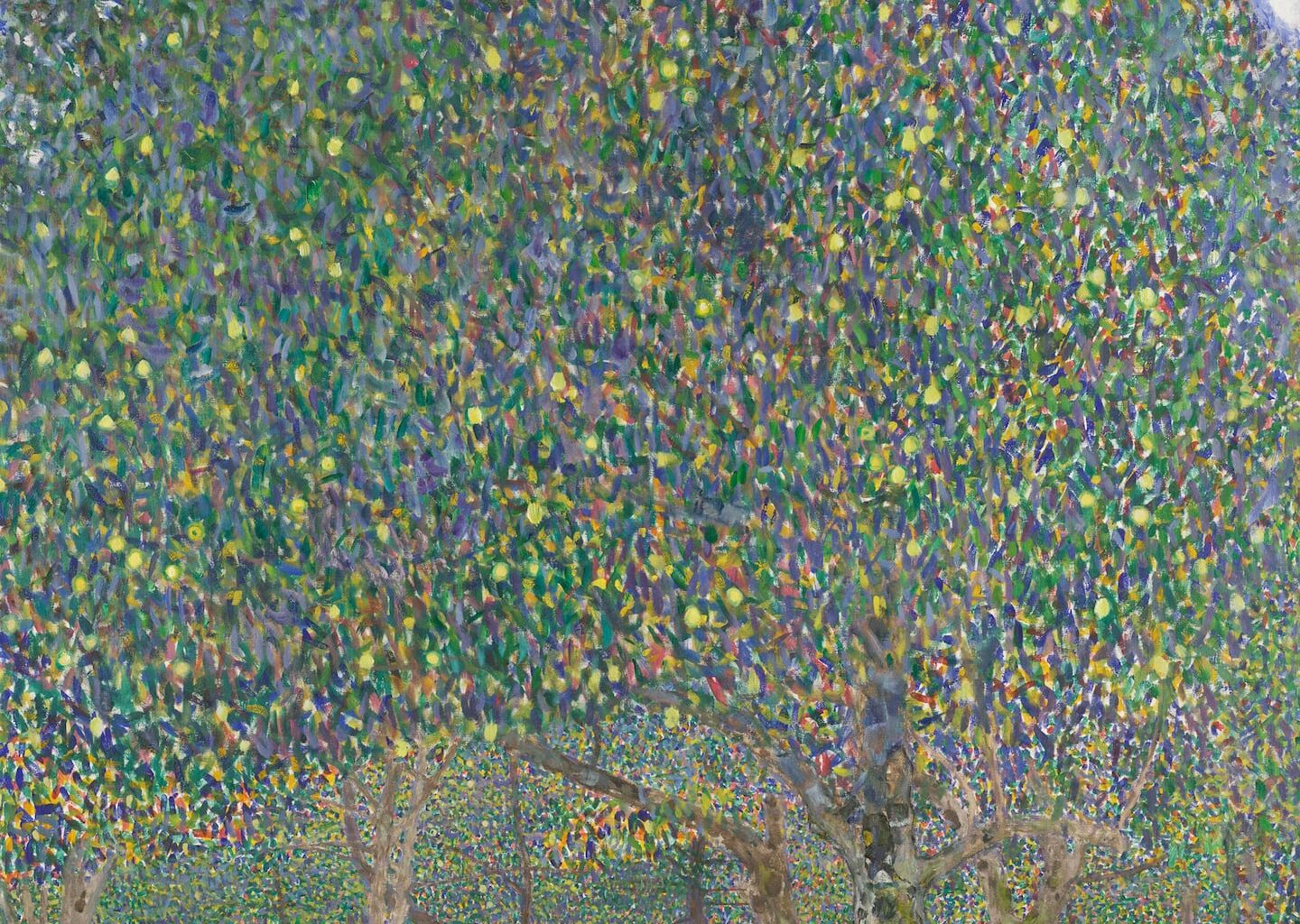
A painting caught my eye at the Harvard Art Museums not long ago — a beautiful pear tree with colors that made me hopeful for spring.
I was surprised to read that it was Gustav Klimt. To be more specific, it was his “Pear Tree, 1903 (reworked by the artist 1903/1918).”
You may already know this work is Klimt, dear reader. Forgive me, I’m not much of an art historian.
My thought was: “Klimt … did trees?”
Going to college in the 1990s ruined Klimt for me. Dorm art is different now — students have a wide range of options and can download/create whatever they want — but back in my day, there were only about 20 options for posters at the shop down the hill from campus.
They included: John Belushi wearing a top that says “COLLEGE,“ various Georgia O’Keeffe vaginal allusions, Al Pacino in “Scarface,” band posters (Nirvana, etc.), Salvador Dali melting clocks, and, on the walls of some of my peers, Klimt’s “The Kiss.”
I found the work romantic and aspirational at first. Maybe someone would kiss me like that, now that I was in college. Anything seemed possible.
But after a few months, those “Kiss” posters had peeled. I’d seen classmates puke in front of the image. Students were hooking up and then avoiding each other. “The Kiss” seemed to mock us all as a depiction of heavenly love and contentment amid a real-life scene of hungover teens eating aged pizza near snow boots soiled by Syracuse weather.
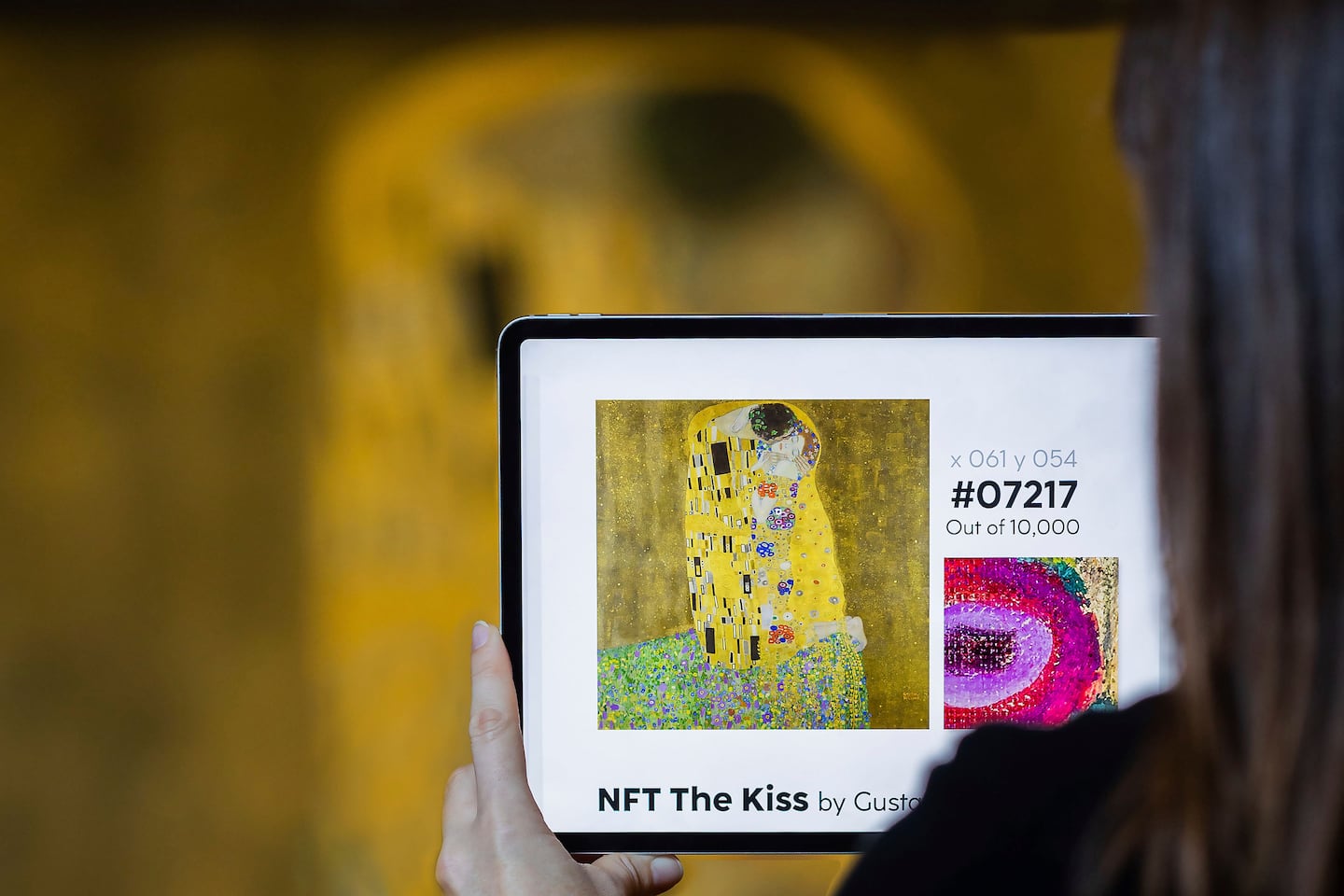 In this image released on Tuesday, Feb. 8, 2022, NFT presentation “The Kiss” by Gustav Klimt at the Upper Belvedere Gallery, Austria. Ouriel Morgensztern/Associated Press
“The Kiss” lost its meaning — and even years later, other Klimt works with similar golden palettes were spoiled by association.
But finding “Pear Tree” — its lushness, its bright colors — was a new way into Klimt.
Lynette Roth, curator at the Harvard Art Museums, explained in an interview that even though Klimt’s “Pear Tree” was revelatory to me, a quarter of his works are actually landscapes.
“For a long time, there was a misconception that Klimt was always painting people,” she said. “They did a show at the Neue Galerie in New York [in 2024] and borrowed our ‘Pear Tree’ and showed it with other landscapes to drive home how committed he was to landscape, and especially landscape in Upper Austria.”
Roth said that apart from the rare loan to Neue, the work is “always on permanent view” at the Harvard Art Museums. In fact, a postcard featuring Klimt’s “Pear Tree” is a staple in the gift shop.
Another notable fact about the painting that calls to me as someone who primarily writes about human relationships, “Pear Tree” was Klimt’s gift to Emilie Flöge, whom the museum placard calls “his muse and mistress in 1903.”
“Mistress” feels like a very 1903 word to describe Flöge. She was Klimt’s longtime partner.
Flöge was an artist herself — in the world of textiles and fashion — and is credited with designing loose-fitting dresses for women so they could actually move around.
That means this beautiful painting — housed right in Harvard Square — was given as a token of love to a woman who is perhaps indirectly responsible for me having a wardrobe that allows me to remain comfortable after eating a massive wrap from Falafel King near work.
Give the woman all the pear trees for that.
As a relationship writer, I also love that Klimt kept working on this painting long after he’d given it to Flöge. He tinkered for years, adding to the scene. You’ll notice the description says, “reworked by the artist 1903/1918.″
Roth told me, “It becomes, through that reworking, even more filled in. The trees, at the lower right, were more bare. It was more open. And he went back in and kept adding to that — which is the advantage of giving it to your romantic partner, your lifetime companion. He still had access.”
Seems like a metaphor, right? Love is not still life. You have to keep adjusting and contributing so it can flourish.
The pear tree kept growing.
I find that more romantic than “The Kiss” — more authentic, more aspirational, more beautiful.
Meredith Goldstein can be reached at Meredith.Goldstein@Globe.com.