
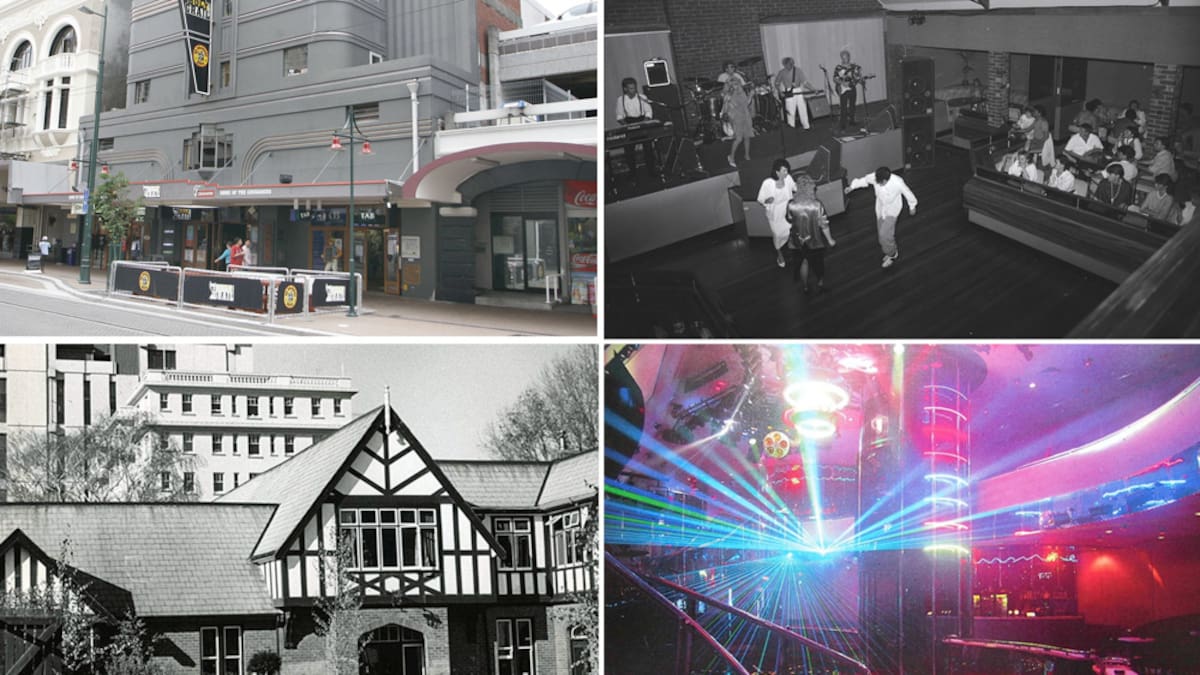
“I had previously been a student there from 71 to 73. So, I knew the building very well.”
The early days of the legendary Dux de Lux. Photo / Supplied
When the building came up for lease in 1978, he and a mate had the thought to transform it into a vegetarian restaurant with entertainment.
“Someone else got it and subsequently had a very similar idea to us which was a vegetarian restaurant and they opened Dux de Lux.”
The side entrance to the Dux de Lux as it is in 2026. Photo / Mike Thorpe
A year or so later, he bought it off them and expanded the venue – leaning into live music five or six nights a week at a time when suburban bars dominated that space.
“This is 1983/84 now, and New Zealand music was just starting to really grab people,” says Sinke.
The Dux de Lux, featuring in the Dance Exponents music video for Victoria in 1982.
The Dux features in the music video for The Dance Exponents’ smash hit Victoria. The small bar that the band plays in helped launch the careers of some other big-name Kiwi groups like the Feelers, Salmonella Dub and Shapeshifter.
Salmonella Dub performing at the Dux de Lux in Christchurch. The band were regulars at the bar. Photo / Supplied
Sinke recalls the Feelers’ “farewell gig” in particular.
“They came down on a Thursday night to do a gig, and that bar held about 140 people at the absolute max squeeze, you know? No room to turn around sort of thing and it was hilarious, 2000 people turned up!”
The Dux also started their own craft beer in the late 1980s, well before it was a thing in New Zealand.
The Dux courtyard hosting the buskers festival. Photo / Supplied
The courtyard was a summer staple and each corner of the establishment offered something for everyone. It has been sadly missed over the past 15 years and while the venue is looking likely to return, it’s unlikely that Sinke will be involved – not through lack of trying, he says.
“After the earthquake, I always had a dream of standing there in that doorway, the entrance to the restaurant from the courtyard and seeing people in that spot, you know? I really tried to make that happen.”
Richard Sinke giving the thumbs up from a packed Dux de Lux courtyard. Photo / Supplied
The Hillsborough Tavern
As a live music venue, the Hillsborough Tavern was unrivalled. It was one of several big suburban pubs around Christchurch.
During its heyday of the late 1970s to early 1980s, it hosted big-name acts from both sides of the Tasman – including Midnight Oil, who played five nights in a row there in 1979.
It also helped launch the career of iconic Kiwi rock band Dance Exponents. Lead singer Jordan Luck says the venue was perfect for live music.
“As a punter, the fact that you could be watching a band, dancing to a band, and then just to your right, pretty much you’d be able to get a pint or whatever you were after. The bar was the length of the room, so yeah, this, it was longer, way longer than it was wide,” said Luck.
It was hugely popular among bands, too.
“It was good sound all the way through. Massive PA in there. It was loud, and clear if you had a good sound man,” recalls Luck.
Fire at the Hillsborough Tavern in 2009.
The Dance Exponents’ first manager and legendary Christchurch booking agent, the late Jim Wilson, reckoned the most memorable gig he saw at the Hillsborough (and he saw hundreds – if not thousands) was John Cale, a founding member of the Velvet Underground. It was 1983 and Cale played with Chris Knox’s group The Tall Dwarfs.
Luck says that touring bands would often play the Hillsborough instead of the Town Hall because it was easier.
“We could get x amount at the town hall or 800 at the Hillsborough and do two nights sort of thing and not have the hire charge or security or the cost. You just walk in, take the door, or percentage of the door, yeah.”
The Hillsborough burnt down in September 2009 but it hadn’t been a hot spot for many years before.
The Palladium
The Palladium Night Club (previously Mojo’s) was considered to have “the largest and most spectacular” laser light show in Australasia when it began illuminating patrons and their perms in the mid 1980s.
“A million-dollar lighting display that takes you to infinity and back again”, reads an advertisement from the time – open seven nights from 7.30pm to 3.30am.
Opening within Chancery Lane on October 15, 1986, it boasted a staircase that lit up with footsteps and neon as far as the eye could see – the ‘Get-laid-ium’ (as it was colloquially known) was Christchurch’s place to be. A mix of live music and DJs entertained a crowd with a capacity of around 800 people – who happily parted with a $10 cover charge.
The Palladium Night Cub in Christchurch opened in 1986 with “the largest and most spectacular” laser light show in Australasia.
A former resident DJ says that in the early days, the bands ruled.
“When rap and dance music exploded – Tone Loc, MC Hammer, Young MC, Rebel MC, KLF, Betty Boo, Yazz, Vanilla Ice … the DJ was king. Big time,” says Ian Avery aka DJ Birdman.
At that point, the plug was pulled on live music, and DJs were exclusively responsible for keeping the dance floor full at all times.
The Palladium was eventually rebranded as Illusions before becoming a strip bar – The Dolls House. It was demolished after the earthquakes and the land is now part of Te Pae and the vacant block that flanks what will soon be the new Sheraton Hotel.
The Holy Grail
Originally the Avon Theatre, the Art Deco-era building was transformed into the Holy Grail Sports Bar in late 2000. The multi-levelled 1500m2 venue had the biggest screen in town – a cinema-sized picture (6.5m x 7.6m) that could be seen clearly from every tier.
The Holy Grail Sports bar in Christchurch, during a Crusaders match. Photo / John McCombe, Getty Images
Huge crowds would flock to watch Crusaders games, All Blacks tests and the Melbourne Cup. Each of the four levels offered something different, from pool tables to dining and a private function room. One side of the Grail featured a 60-seat grandstand and below the big screen was a dance floor.
The building had survived fire in its previous 75 years but didn’t survive the 2011 earthquake and is now a temporary car park.
The Holy Grail Sports Bar on Worcester Street.
Shooters / Grumpy Mole / Loaded Hog
The intersection of Manchester and Cashel Streets. Four corners, three bars and basically one clientele. Queues formed outside them all.
Shooters had previously been known as Trader McKendry’s. As ‘Trader’s’ it hosted the local radio promotion “How far will you go?” where the first prize was four pies and a jug of beer each week for a year. The winner went as far as setting fire to a cross … and then nailing it to his scrotum. That corner is now a little less nuts, it houses an apartment block.
Shooters (left), Loaded Hog (centre) and the Grumpy Mole (right). Photo / Google
Before The Grumpy Mole took up residence on the southern corner, it was Sneakers Sports Bar, owned by former Kiwis and Canberra Raiders rugby league prop Brent Todd. It’s now a block of retail stores; in fact, The Grumpy Mole is now Sweaty Betty.
The Loaded Hog, which had originally been situated in Dundas Street, took up residence in the PGG Building on the eastern corner and briefly employed Olympic champion Danyon Loader behind the bar. The bar became Malba’s before it became rubble in the post-quake demolition. It may well be part of Lyttelton Harbour now. The site will soon be part of the new Downtown development by Richard Peebles.
The one corner that didn’t have a bar (the Western corner) had a busy hotdog vendor.
The Clock
Situated on Main South Road in Hornby, The Clock was arguably never more popular than when booze-fueled bus trips became a weekend ritual. Touring from town to country and back again, the privately owned buses allowed passengers to pack whatever alcohol they liked on board before briefly stopping off at half a dozen suburban and semi-rural pubs. Unassuming patrons who would have a front row seat for whatever game was on the big screen were suddenly confronted with a hen’s night or fancy dress birthday party for a 30-minute hurricane of RTDs, dancing, drama and then an airhorn to alert passengers the buses were departing again.
Other bus trip destinations included The Yaldhurst, The Golden Mile and The Islington Tavern. Those pubs are still in business – as are the bus trips, though these days they’re alcohol free, by law.
The Clock Bar in the Clock Tower building in Hornby. Photo / Google
The Clock and the Clock Tower Building, in which it was housed, are no more. It was closed before the quakes and refurbished as an office block, it then made way for a Carl’s Jnr.
Firehouse Nightclub
Opening in 1985, Firehouse Nightclub was an icon of class, sophistication and a doorman with a bow-tie. Inside, it was plush. Fashionably upholstered horseshoe booths and intimate tables for two surrounded the stage and timber dance floor.
The Firehouse Night Club
Originally, the building was home to the Sydenham Fire Station – in fact, it’d been there since the 1870s.
The Firehouse survived an attempt to blow it up in 1989 when explosive experts defused two bombs and detonated a third. In a separate incident, it was visited by a gunman. Ironically, the former fire station burnt down in the early to mid 1990s.
Peak 80s, Firehouse Night Club in Christchurch.
It’s now the site of Firehouse Centre at 289 Colombo Street, a seven-store retail hub.
Warner’s Hotel
Situated in the northern corner of Cathedral Square, Warner’s Hotel stood where its timber predecessor was built in 1863. The replacement opened at the turn of the 20th century and it served customers until the 2011 earthquakes.
A noted live music venue that hosted numerous bands – perhaps none bigger than the 1993 performance by Radiohead to a crowd of just 200. Warner’s also boasted a brilliant beer garden that held the wake of one of its regular patrons in 2005, much-loved Green Party co-leader Rod Donald.
It’s now a parking lot next to the Novotel.
Looking across Avon River to Oxford Terrace (aka The Strip), Christchurch.
Coyote
Coyote was the easiest to spot along Christchurch’s much-vaunted “Strip” of Oxford Terrace. The Mexican adobe facade stood out like a cactus among the traditional buildings that surrounded it. Inside, a central bar greeted patrons as soon as they got through the door – which was welcomed as it was likely that they’d just stood in line for a significant length of time. Coyote and its neighbour, Azure, were soon surrounded as the Strip filled up with bars and even crossed Hereford St. All Bar One, The Tap Room, The Boulevard, Viaduct and Dilusso.
The Strip on Oxford Terrace, Christchurch. Coyote’s adobe facade can be seen to the right of the red brick.
Names would change before it all came down after 2011.
The Strip 2.0 is a different place for a different city but both serve their times equally well.
Nancy’s / Fat Ladies Arms
Nancy’s or Nancy Hancock’s, as it was known, took pride of place on one of the busiest intersections in Christchurch. It was opposite Hagley Park at number 1 Riccarton Rd, with Deans Ave running from north to south alongside it.
Annie Hancock had purchased the hotel in 1930 with her husband, Bert.
An unfortunate accident just weeks after taking possession saw Bert fall down an open trapdoor. He died a year after sustaining a serious injury. Annie – known as ‘Nancy’ took over the licence and remained there until 1968. It’s said that the “worst thing” to happen at the hotel during her tenure was a bus crashing through the Riccarton Rd roundabout and into the public bar. Nobody was harmed.
The bar became popular with students from the University of Canterbury. That continued when Nancy’s became the Fat Ladies Arms in the late 1990s. Radio ads for the Fat Ladies Arms were voiced by the franchise creator, Leo Molloy, spruiking nightly specials that always finished with the same slogan “the best bar in the world, and that’s a fact”.
The old pub was bulldozed. It’s now a Monster Chicken.
Noteworthy mentions.
Live music venues The Gladstone Hotel, The Star and Garter Tavern and The Aranui Motor Hotel.
Christchurch’s Gladstone Hotel was one of the city’s best live music venues throughout the 1970’s and 80’s. Photo / Facebook
“We could often be playing three or four gigs a night. We might do an opening say at the Hillsborough, then do a slot at the Gladstone, then it could be a gig at the university and then PJ’s [Night Club] which often really only kicked off after 12pm, so we might come on at 1am or 2am.”
Suburban bars were big then. The Caledonian in St Albans, the Shirley Lodge. Closer to the city centre were the Eastern Tavern, the Provincial Hotel and the Fitzgerald Arms.
As the suburban bars died off, the city took over.
The disco-themed Boogie Nights on Manchester St was one of a kind. Lochinvar’s – the longest bar in the land was its claim. It stretched 42m according to some – but was seemingly only 7m-8m wide.
Boogie Nights, Manchester St.
Cashel Mall bars included Rattlesnake (which became The Bog) which is now roughly the alleyway to Riverside, Vault and Cafe Bleu (previously Zetland Hotel).
Victoria St’s original Jolly Poacher hosted kick-ons before kick-ons were called kick-ons.
Dance bars Ministry and then Base enjoyed a strong following with electronic music lovers. Base moved from Colombo St to Sol Square where it neighboured the original Fat Eddy’s, Fish & Chips, Yellow Cross, Toast and His Lordship’s.
Fat Eddie’s and Toast in Sol Square. Base can be seen on the right.
Poplar Lane was the other community of bars that popped up in what was previously a service lane. The Twisted Hop, Vespa Room, Bismarck and Poplar Lane Brew Bar added a new dimension to Christchurch’s hospitality offerings before the earthquake.
A special mention goes to the Carlton which is not lost but is nothing at all like it was back in its “big bar” days. It was rebuilt after the earthquakes in the same spot, but the history left with the bricks.
The Carlton Hotel, after the 6.3 earthquake. Photo / NZPA
To truly understand how prolific hospitality was in Christchurch, you only need to examine the legendary Square Mile inside the four avenues of the central city.
The Square Mile wasn’t a bar – it was a challenge. A 52-venue pub crawl where participants would start with a jug, finish with a jug and drink a 7oz glass of beer at every bar in between. Or they mostly wouldn’t.
A 2026 version would be virtually impossible given the boom in bars … and the scarcity of jugs and 7s.
Mike Thorpe is a senior multimedia journalist for the Herald, based in Christchurch. He has been a broadcast journalist across television and radio for 20 years and joined the Herald in August 2024.