
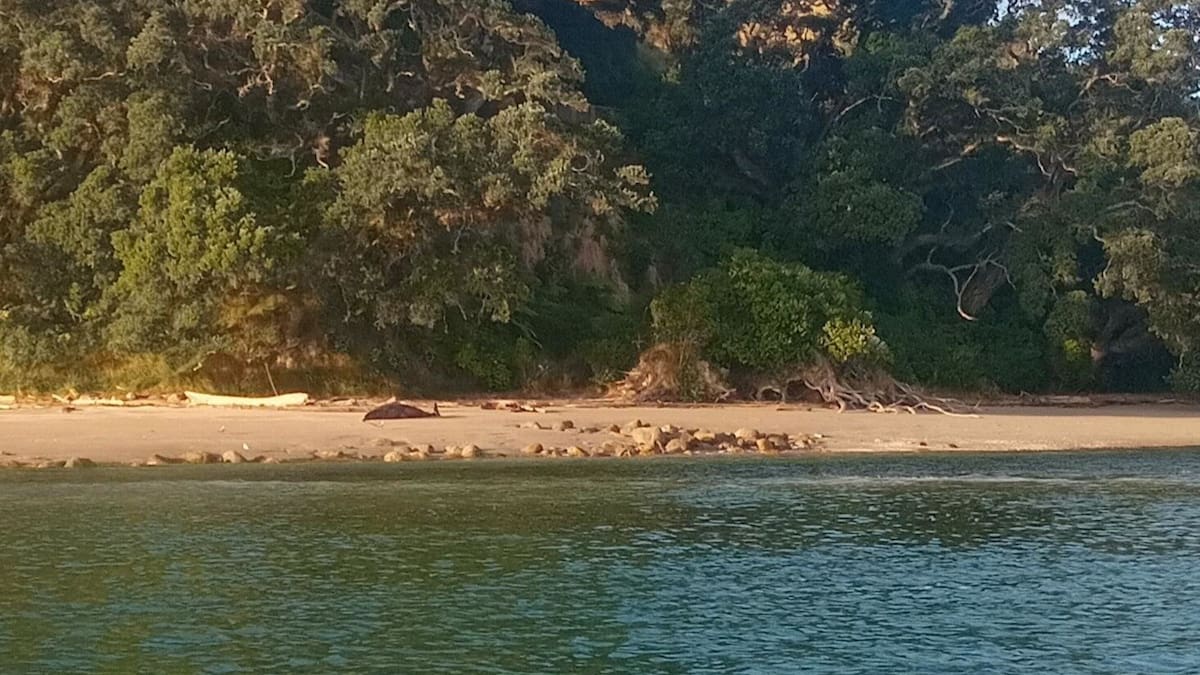
A four-metre long Gray’s beaked whale on the beach at the base of Mauao has been euthanised. A 30-metre exclusion zone applies to all vessels, paddleboarders and people from the base/shore of Mauao. Photo / Stuart James.
Heaphy said the whale re-stranded soon after on the harbour side of Mauao.
“DoC staff attended along with Ngāi Te Rangi, Tauranga City Council and geotechnical experts due to concerns about land stability at the site,” Heaphy said.
“Due to the deteriorating condition of the whale, DoC made the humane decision to euthanise the animal.
“Ngāi Te Rangi have carried out karakia and our collective focus now turns to planning for burial of the animal.”
Heaphy said that with the current rāhui on Mauao, a suitable burial plan still needs to be determined.
“That’s our work for the next day or two, given the logistical challenges,” Heaphy said.
“The public are currently not permitted to access the site. We strongly advise people not to go near the beach or the deceased animal out of respect for the rāhui and to ensure their own safety.
“There is a rāhui on both Mauao itself and the water surrounding the base of the maunga.”
The dead four-metre-long Gray’s beaked whale is on the beach on the harbour side of Mauao. Photo / Stuart James.
Local kayaker Stuart James was out fishing on Friday when he saw the response team at the scene.
“It was about 3.30pm on Friday, at low tide. There were a number of people on the beach, with two inflatables,” James said.
“It was still alive at that point; its tail was flipping up and down. When I first saw it, I thought it was an overturned kayak and wondered what the kerfuffle was on the beach. Then I could see they [DoC team] were tending to it. They put some blankets over it and were ferrying water backwards and forwards, I guess trying to keep it alive.
“We’re not allowed to be any closer than 30 metres from Mauao, but I could see it had a bit of blood on it, so we wondered if it had been chasing stingrays, injured itself chasing something, or was sick.”
In January, two beaked whales washed up in Napier on consecutive days and have since been buried.
One of the two dead whales being removed in Napier in January 2026. Photo / Sarah Paroli
Beaked whales are a little-known group of whales named for their dolphin-like beak. New Zealand is a hotspot with 13 of the 24 known species being found here, according to the Department of Conservation website.
Gray’s beaked whale, also known as hakurā, is the most common stranding beaked whale species in New Zealand.
DoC is responsible for managing strandings. When a stranded whale or dolphin dies, or when they are washed up already deceased, DoC works with tangata whenua and research partners to take information and samples to help better understand them.
Report injured, stranded, or dead whales to the DoC emergency hotline 0800 DOC HOT (0800 362 468). The public can also report a sighting online.
Due to the risk of landslip and the associated maritime safety risks around Mauao/Mount Maunganui following a storm and landslide tragedy in January, a 30-metre exclusion zone has been put in place by the Bay of Plenty Regional Harbourmaster.
The exclusion zone applies to all vessels and people and is 30 metres from the base/shore of Mauao. Image / Supplied
The exclusion zone applies to all vessels, paddleboarders and people and is 30 metres from the base/shore of Mauao.
Regional Harbourmaster Jon Jon Peters asks all vessels to keep clear of the zone until further notice, unless they are required to carry out police or civil defence operations, or have the approval of the Harbourmaster.