

Reading Time: 3 minutes
Early detection and smarter decision-making were key themes at Central Districts Field Days, with companies showcasing tools aimed at reducing labour, lowering costs, and improving on-farm performance.
Animal health was a major focus, with technologies aimed at speeding up decision-making and reducing production losses.
Among them was the GIN PCR Test (Gastrointestinal Nematode Polymerase Chain Reaction), a Beef + Lamb NZ-funded diagnostic tool that can identify multiple key worm species from a single sample in under three working days – far quicker than traditional faecal egg count testing.
BLNZ wormwise programme manager Ginny Dodunski said the tool comes at a critical time, as drench resistance continues to increase across the sector.
“In the last few years, with drench resistance getting worse, more and more farmers are monitoring, and this tool just makes it so much easier,” said Dodunski.
The project, led by principal scientist Cara Brosnahan of Animal Health Research, concluded research in September of 2025 and is currently working towards wider industry use.
The shift towards faster, more targeted intervention is also seen in dairy systems where sensor technologies help to detect disease earlier in the milking process.
Bovonic’s Quad Sense uses small sensors fitted directly into milking cup liners to analyse milk from each quarter of the udder during milking, detecting early signs of mastitis infection in under a minute.
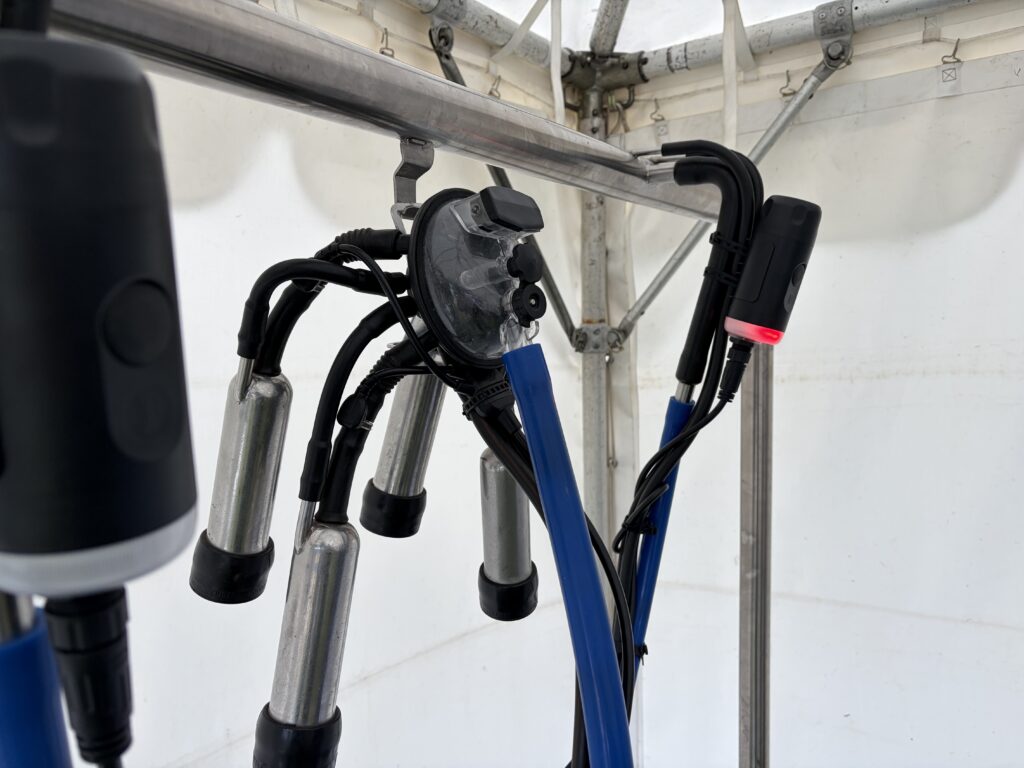 Bovonic’s Quad Sense detects mastitis during milking, alerting farmers to its presence or absence with a red light or a green light. Photo: Isabella Beale
Technical sales and customer success representative Matt Kirkland said the system is designed to be simple to use, requiring minimal training.
“Within 30 to 40 seconds, if she’s got mastitis, it alerts you to tell you, and it’s just a simple red light, so it’s very simple for staff in the shed, or farm owners,” said Kirkland.
It is already installed in close to 200 farms, Kirkland said, and recent reports show significant reductions in somatic cell counts and labour savings across a season. Earlier detection also helps reduce antibiotic use by treating infections before they worsen.
A similar approach has also been taken by smaXtec, focusing on early intervention; it uses in-cow sensors and artificial intelligence to measure dairy herd health in real time.
The tech involves a small bolus that sits in the first stomach of the cow and tracks internal body temperature, water intake, rumination and heat cycle, via app or online.
By tracking this data and changes, the technology can detect early signs of illness, such as mastitis and ketosis, even before visible symptoms appear.
SmaXtec’s tech also aids in reproduction management, with heat detection and calving alerts, allowing farmers to have a more accurate window into when the animal may be due to give birth or be in heat.
Lower North Island sales manager Melinda Little said uptake of the product at the moment is being driven by the high value of cows, and the need to intervene as early as possible.
Farmers “like to deal with [cows’] health before it becomes a problem, meaning that they’re not having to use things like antibiotics in the long term”, Little said.
While most of the innovation on display centered on animal health, sustainability solutions such as Future Post were offering long-term practical alternatives to traditional timber.
The New Zealand company, which launched in 2019, turns hard-to-recycle plastic waste into durable fence solutions and landscaping products for long-term use on farms. Amelia Hogan, Future Post salesperson at the Field Days, said uptake was gaining significant traction in sectors such as viticulture, where companies need to be organically certified.
“These are bio-friendly, so they don’t leach, don’t rot.”
Compared with traditional timber posts that last 20 years at most, “these last over 50 years”, she said.