
The investigation into the pair arose after a concerned locum pharmacist contacted Medsafe about the quantities of controlled drugs being prescribed.
Medsafe ordered an audit into the prescribing and utilisation of controlled drugs.
The pair altered patient report forms to account for their use of controlled drugs.
This included changing dates to bring historic accidents within the audit period, changing or creating treatment details – including administration or dumping of morphine or fentanyl – and changing locations and circumstances of the injuries.
The key issue at trial was what the pair intended when they altered patient report forms.
The defendants told the court they’d injected oranges and bananas with actual doses of morphine and fentanyl as training exercises, and that’s why the “training forms” were submitted as part of an audit into their use of narcotics.
They denied “ticking a box” on a form allowing them to order controlled drugs from a wholesale pharmacy, without the medical director’s knowledge.
They also claimed that forged qualifications hanging on their office wall were only intended as a type of “vision board”, not to mislead others.
In closing at trial, the Crown said there had been “deception upon deception”.
The jury found them guilty on the majority of the charges they faced, which also included administering controlled drugs when they no longer had the standing orders to do so.
Crown says blaming medical directors amounts to ‘victim-blaming’
An aspect of the trial involved the role of the three medical directors, who all have name suppression.
Several GPs who held the role, at different times, all failed to check the qualifications of the ambulance officers and had assumed they were trained paramedics.
One admitted during the trial that he hadn’t fully explored any legal responsibilities the role might have, nor made inquiries about the ambulance service, beyond what the couple provided him with.
In his closing address to the jury, and again at sentencing, Couchman’s lawyer Martin Hine pointed the finger at the medical directors – and their signing off on “standing orders” that allowed EMC to legally administer controlled drugs – stating the GPs failed to provide oversight.
The pair relied on sign-off from GPs to give them standing orders that allowed them to administer Class-B controlled drugs. Photo / 123r
But Crown prosecutors Daniel Coulson and Laura Clay submitted that to claim that as a mitigating feature was akin to victim-blaming.
“It’s rather like saying a bank robber deserves credit at sentence because the security guard didn’t do a good job, or the drug importer deserves credit because Customs didn’t stop the drugs coming in,” Coulson said.
The Crown said if the doctors were negligent, it was only because of the “deceitful actions” of the defendants.
Coulson acknowledged an appropriate starting point was likely to be about two years’ imprisonment.
But Coulson said there was “not much credit” available in the way of mitigating features.
Coulson questioned the “voluminous medical documentation” provided to the court about Lohgan’s health conditions.
Lohgan arrived at court in a wheelchair, wearing a neck brace.
His lawyer, Paul Devoy, said he was “not well at all” and had longstanding health issues.
“The Crown say that really is difficult to stack up, with the fact that he claims to be operating a building business seven days a week, regularly attending the gym, and has been sighted by Corrections, operating on that building site without the support of his wife,” Coulson said.
Coulson referred to a reference provided in support of Lohgan, which referred to him “doing an outstanding job, moving forward with military-like precision with a level of organisation and workmanship which is superb”.
Hospital notes provided after an earlier adjournment, sought because of Lohgan’s medical difficulties, made it clear his injury “was due to falling off a 4.2 metre high roof”.
“So again, that begs the question, what really is his state of health, and will prison truly be hard on him given those factors?”
Coulson acknowledged the impact on the children was usually something defendants would get credit for, but didn’t think it appropriate in this case because of concerns raised by Oranga Tamariki.
“In some ways, and this comes through in the pre-sentence reports, those children may be better off with the defendants in custody.”
However, Judge David Cameron disagreed.
A potentially ‘devastating impact’ on the children, says judge
When it came to the sentencing, Judge Cameron referred to pre-sentence reports for the pair.
Couchman and Lohgan got married in 2018.
Couchman, who is 44, emigrated to New Zealand from Donegal, Ireland, with her previous husband, in 2006.
She has eight children, five of whom are currently living with her, the youngest being nine.
Lohgan is 54, and the pair live in rural Edgecumbe, where they have been operating a building business for the last 12 months.
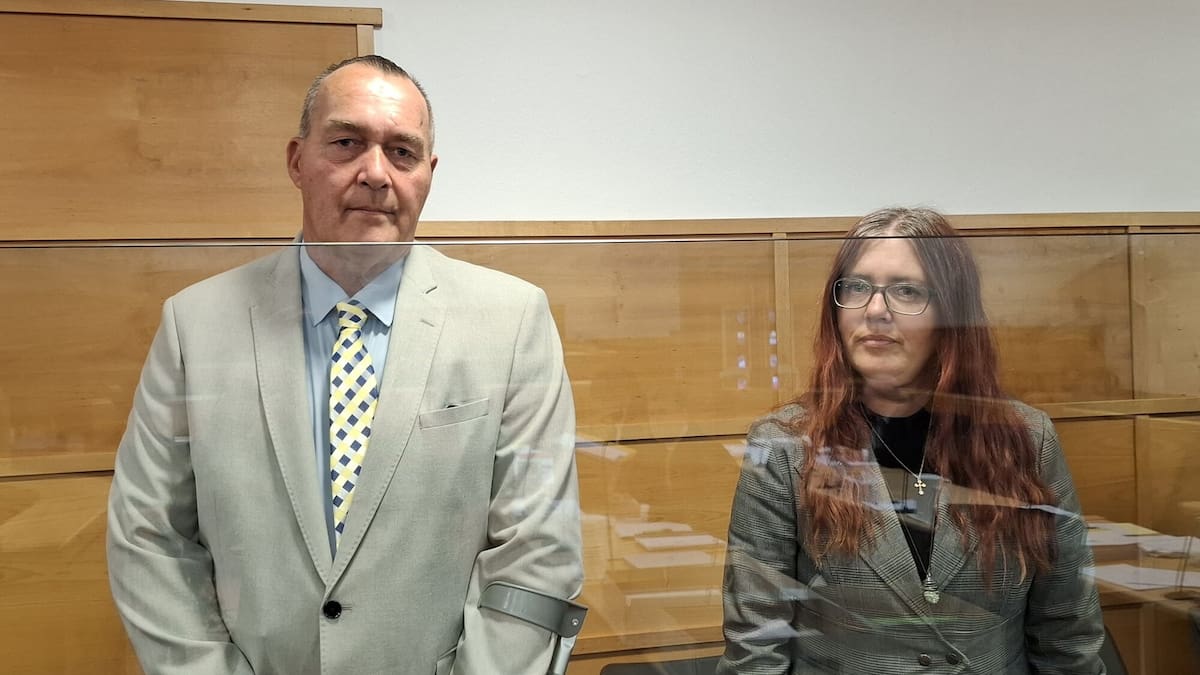
Craig Lohgan and Rebecca Couchman, pictured at their jury trial last year.
The judge said Lohgan suffered from various medical conditions, including chronic back pain “as a result of breaking his back when he fell off a ladder”.
Lohgan told the report-writer he also suffered from ongoing physical effects of having a bullet lodged in his brain, and was on multiple pain medications.
Judge Cameron said the lead offence was that of obtaining by deception, which related to the pair fraudulently ticking the controlled drugs box on a Onelink account application.
A GP had filled out the first page of the form and given it back to the pair to complete, with that box unticked. In ticking it, the pair gave themselves the ability to order controlled drugs and, through EMC, ordered 1070 ampoules of morphine and 970 ampoules of fentanyl.
Judge Cameron adopted a starting point of two years’ imprisonment for Lohgan and 18 months’ imprisonment for Couchman.
He uplifted the starting points by four months for the altering documents charges, four months for administering morphine when they didn’t have standing orders to do so, and four months for forgery.
That led to an end sentence of 30 months’ imprisonment for Couchman, and 36 months’ for Lohgan.
Judge Cameron did not consider the inaction of the medical directors to be a mitigating feature, nor did he find the defendants had fully accepted responsibility for their offending.
However, he acknowledged the defence submission that there was no evidence of on-supply of morphine or fentanyl to any other person, nor any attempts to supply drugs to a criminal enterprise for resale, distribution, or use.
The judge found it significant that the pair had the care of “five special needs children who are dependent on them”.
“The pre-sentence reports clearly disclosed that there had been multiple incidents triggering a process of the children being placed in the state care by Oranga Tamariki,” the judge said.
“Equally, the reports make it clear that one by one, each child has been returned to Ms Couchman, with the support of Mr Lohgan, between 2014 and 2023.”
Judge Cameron said he was concerned that “were either of the parents to be removed, that is imprisoned, then there is the real possibility of this having a devastating impact on the children”.
For this reason, he applied a 25% discount to their sentences.
“In respect to Mr Lohgan, the level of 27 months is reached, which I reduce to 24 months, having regard to the fact that prison would be particularly difficult for him given his ongoing medical issues.”
Couchman was sentenced to 10 months’ home detention, while Lohgan received a sentence of 12 months’ home detention.
“I comment that clearly the dynamics of the household will need to be closely monitored to ensure the ongoing safety of the children,” Judge Cameron concluded.
Hannah Bartlett is a Tauranga-based Open Justice reporter at NZME. She previously covered court and local government for the Nelson Mail, and before that was a radio reporter at Newstalk ZB.