
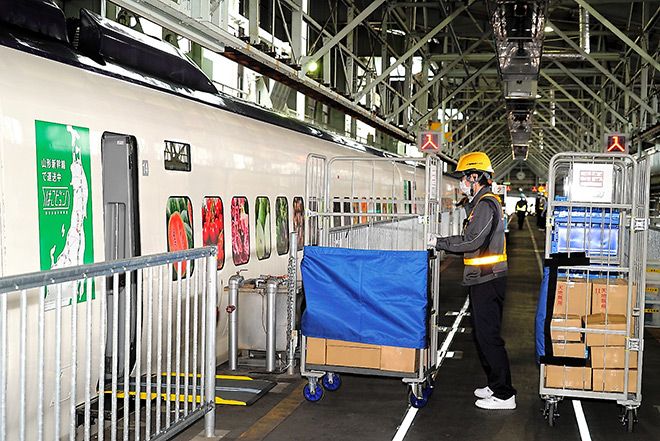
MORIOKA—The first bullet train retrofitted exclusively for freight transport started regular service from Morioka to Tokyo on the Tohoku Shinkansen Line on March 23.
Eight hundred boxes of cargo, including precision instruments, pharmaceuticals and seafood, were loaded at a rolling stock center in Morioka, the capital of Iwate Prefecture.
Daiichi Freight System Inc., a logistics company based in Yamagata, was among the clients on the first day of service.
“Given the scant vibration, there is minimal impact when transporting precision equipment,” Manabu Tomita, director of business development, said. “It also helps address the shortage of drivers (for trucks and other vehicles).”
Marutomo Shimaka, a fisheries company based in Miyako, Iwate Prefecture, shipped 30 cases of scallops harvested off the northeastern Sanriku coast along the Pacific Ocean.
President Tomokatsu Shimaka said the company wants to deliver even fresher products to the Tokyo metropolitan area.
This is the first time a Shinkansen dedicated to transporting cargo has been put into operation since the opening of the Tokaido Shinkansen Line in 1964.
East Japan Railway Co. runs one Tokyo-bound, freight-only train, coupled with a Yamabiko passenger service, on weekdays.
An E3-series train that formerly operated as a Tsubasa on the Yamagata Shinkansen Line has been converted for cargo service by removing all 394 seats from its seven cars.
The train can carry up to 1,000 cardboard boxes of cargo, which weigh about 17 tons in total.
The floors inside the cars have been fitted with anti-slip surfaces and load-restraint straps to prevent cargo from shifting.
The exterior has been repainted white, and the window areas feature photographs of marine products, fruit and medical supplies—items that have been handled in Shinkansen-based freight transport services.
Cargo is loaded and unloaded at train depots to avoid interfering with passengers getting on and off.
JR East began regular Shinkansen-based cargo transport in 2021 under the name Hako-byun, using business-purpose spaces in the vestibule areas of passenger trains.
Other JR companies have since joined the initiative, forming a nationwide Shinkansen cargo transport network from Hokkaido to Kyushu in 2024.
(This article was written by Erina Ito and Ayateru Hosozawa.)