
The catastrophic failure of the Moa Point wastewater treatment plant may have been caused by air trapped in the pipes, a report has revealed.
The Wellington plant failed last month, flooding the facility and sending millions of litres of raw sewage into the sea each day.
Wellington City Council on Friday released the first report into the ongoing saga.
Wellington Water commissioned the engineering report on 5 February – the day after the failure – to understand how the plant could be operated during the recovery.
Experts from Stantec used software to develop a hydraulic model of the plant, and replicated the likely flow of water running through the plant when it failed.
While the report was not commissioned to identify the cause, it had revealed valuable information, Wellington Mayor Andrew Little’s office said.

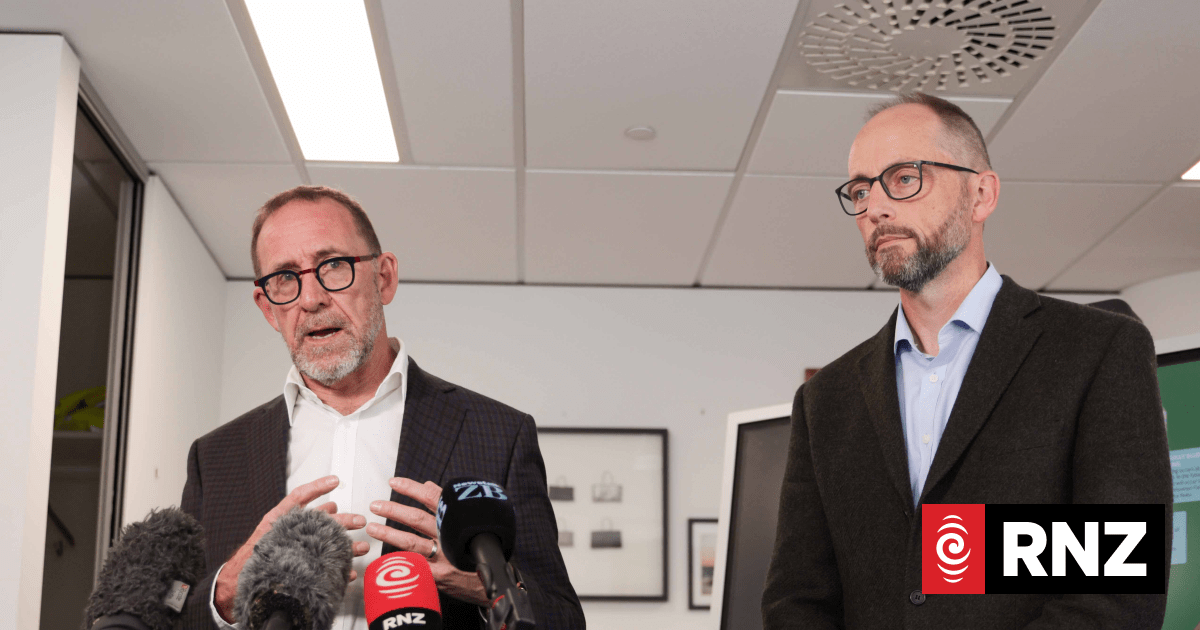
Wellington Mayor Andrew Little said the report was just one piece of the puzzle.
Photo: RNZ / Samuel Rillstone
“The report found that air can become trapped in the wastewater bypass pipeline, particularly when there is a high flow of wastewater passing through the plant.
“It is possible that trapped air could disrupt the flow of wastewater, pushing it backwards and flooding the plant.”
There was a “significant risk” of the air being trapped in the system, causing a “choke point” the report said.
And if it did happen, it would be “a likely cause of the flooding”.
The bypass system allows screened wastewater to bypass further treatment – like disinfection – and be discharged out to sea when the plant is at maximum capacity.
At a media conference on Friday afternoon, Wellington Water’s Chief Operating Officer Charles Barker said it was “clearly evident” that the air pocket problem was a factor in the plant’s failure.
He described what could have happened: “Sometimes you pull the plug out of your sink, and it doesn’t go down as fast as you think, because it starts going glug, glug, glug, glug, glug… it’s that type of effect.
“A certain amount of air is good in a steady state, when it gets all mixed up together, the water … starts behaving differently.
“It’s important to remember this is just not water trickling from a hose, this is thousands of litres per second under huge kind of speed.”
Engineers suspected that potential cause almost immediately after it happened, he said.
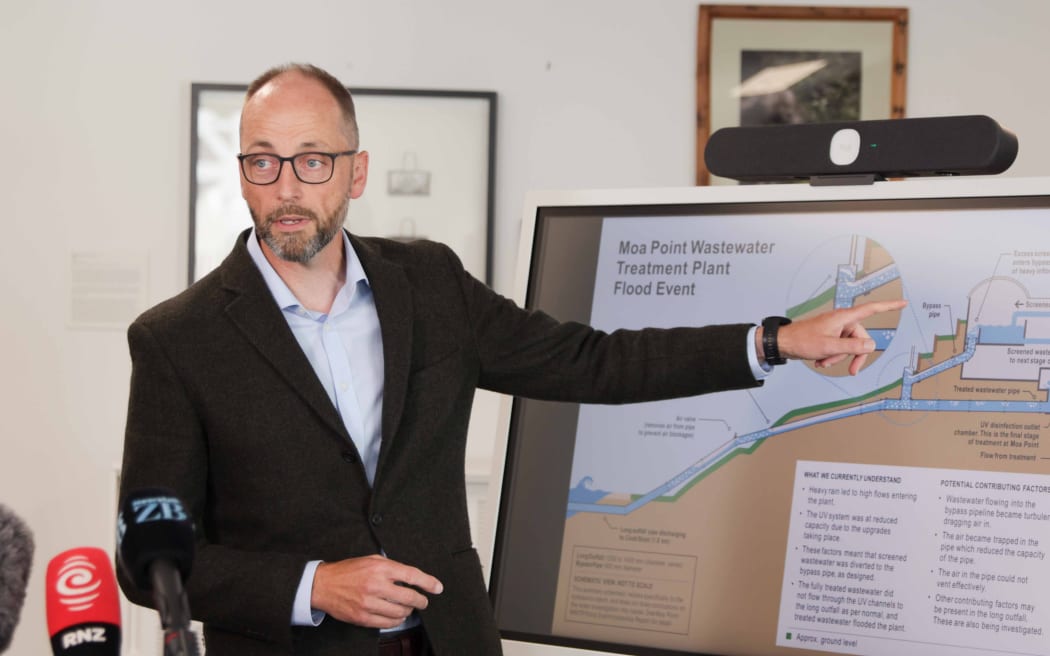
Wellington Water chief operating officer Charles Baker speaking to media following the release of the report.
Photo: RNZ / Samuel Rillstone
There were no staff on site at the time, but it was standard that it was not staffed overnight – not just at Moa Point but at plants around the world, Barker said.
He confirmed the air block was not permanent, because the air “exists in a moment” and as the water flow drops away, “pipes can breathe again”.
At the time, the plant’s UV system was being upgraded, so screened wastewater was diverted to the bypass pipe.
Water entering that pipe could have become “turbulent”, dragging in air, becoming trapped and backing up the pipe.
The report delivered at least some answers, he said.
“It gives us a lot of confidence that when we’re repairing things which are in the plant, and putting things back, that they weren’t the primary factor.
“We can now press ahead and figure out what the design solution needs to be.”
But other potential causes were yet to be ruled out, he said.
More funding for plant repair
Mayor Andrew Little said Wellington City Council’s capital funding for Wellington Water has been underspent by $15 million this financial year.
Given the urgency of the repairs, the council gave Wellington Water consent to draw down between $8 and $9 million of that to immediately order the new control systems it needed, Little said.
“That should expedite the repair and reinstatement of the plant.”
The mayor’s office later said the underspend came from a range of things.
“Wellington Water are always looking to achieve value for money, which can generate savings (for example on tenders) which adds to ‘underspend’ in the current financial year.
“Some projects occur over multiple years. When projects take longer than anticipated, some spending moves to future financial years, which creates underspends in the current year.”
Little emphasised the report released today was helpful in identifying a possible cause, but was not conclusive.
More reports would follow including expert modelling done in London, Little said.
Report suggestions
The experts suggested Wellington Water install additional air release equipment at specific locations in the system.
“This is expected to provide some improvement to the issues identified until the design of a new bypass pipeline alignment and connection can be developed and implemented.”
The report was just one piece of the puzzle, Little said.
“There are other areas of interest that require a more detailed investigation, and Wellington Water has commissioned an external specialist to conduct a wider investigation into these other factors.
“It’s natural to want a quick answer, but it’s important that we take the time to uncover all the facts and not draw conclusions too early.
“Wellingtonians deserve assurance that our recovery addresses the root cause and any related factors, so we can be confident we’re preventing this from happening again.”
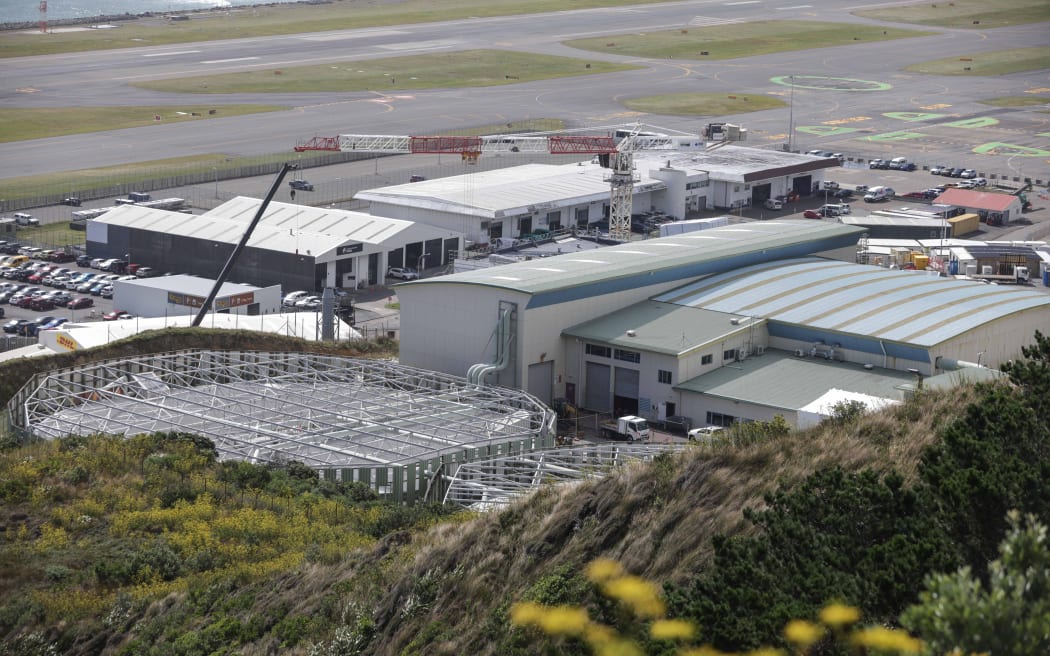
The Wellington plant failed last month, flooding the facility and sending millions of litres of raw sewage into the sea each day.
Photo: RNZ / Samuel Rillstone
Air pocket ‘burping’ seen since
The report revealed that Veolia, the plant operator, told Wellington Water at a meeting this week that crews had observed the burping of air pockets during the storm on 3 March when there was a high level of water running through the system.
“The operator … observed burping of large air pockets and large splashes from the outlet chamber during the initial pumping sequences,” it said.
That showed the air release capacity of a vent pipe downstream had been exceeded at times, the report said.
More risks identified
The experts identified other potential risks at the plant and made a number of technical recommendations.
“Wellington Water should address the potential risk of a blockage or debris in the outfall section of the pipe and implement monitoring of operating pressures in the ocean outfall (during the recovery phase at a minimum).”
The company should also review the condition of existing air and isolation valves, and replace them if necessary, the report said.
CCTV from the pipeline showed the polyurethane liner had eroded and cement mortar had potentially degraded in some sections, it said.
“This has occurred due to high velocity super-critical (shallow and fast) flow impacting on the liner.
“This flow regime presents risks to the long-term durability of the effluent pipeline liner and structural steel which warrants additional review and investigation.”
An independent Crown review into the failure is also underway, and its final report is expected in August.
Sign up for Ngā Pitopito Kōrero, a daily newsletter curated by our editors and delivered straight to your inbox every weekday.