
“I was running up the beach to tell the people because I was concerned that someone might decide to go for a swim because it was a big boy.”
He spotted the shark on March 15 at about 3pm.
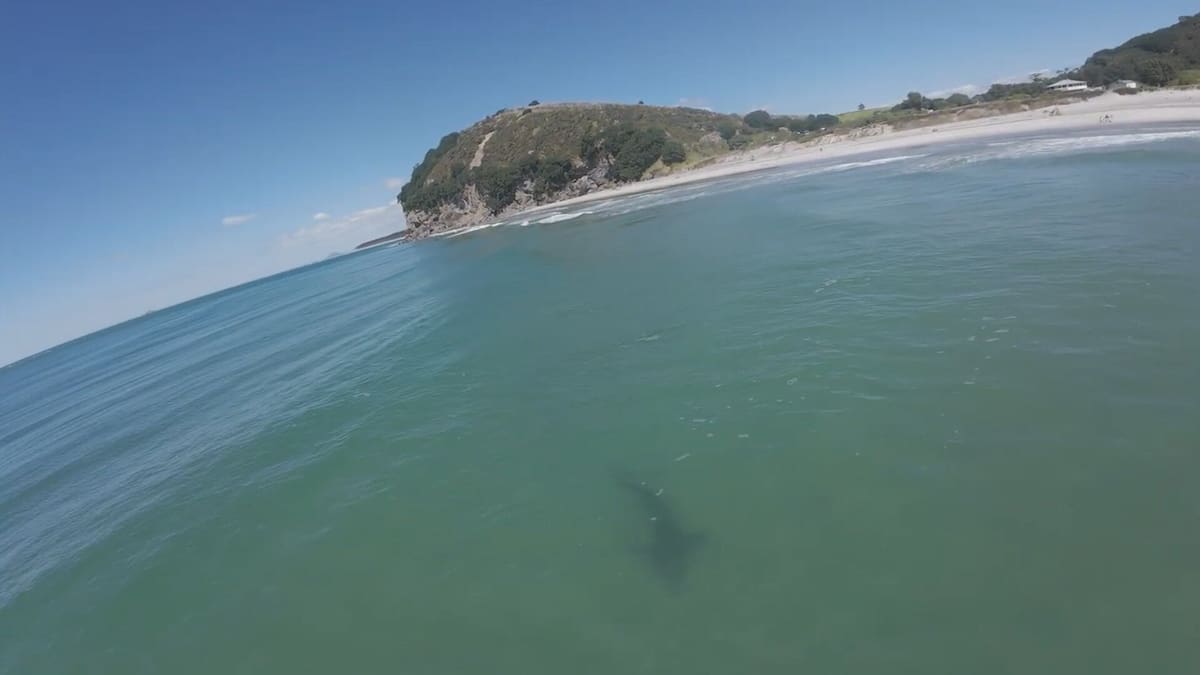
Drone footage captured off Bowentown Beach has revealed what appears to be a large shark cruising close to shore. Photo / The Traveller
Brent said he was there for about 10 minutes before spotting the shark and saw it just past the breakers “cruising” down the beach.
“There were even people in the water at about knee-depth, and I could kind of see that it [shark] was looking at them, but it wasn’t really interested.”
Brent said he couldn’t clearly tell what type of shark it was, but even a “big bronzy” could be dangerous – a risk he wasn’t willing to take.
“It is a little bit hard to positively identify it, but it’s big regardless of whether it’s a bronzy or a great white. It’s like at least three metres, I reckon.”
The latest sighting follows the fatal shark attack at Bowentown on January 7, 2021, in which 19-year-old Kaelah Marlow of Hamilton was killed.
The incident heightened awareness of sharks in the region.
Since then, sightings have become more frequent, with encounters reported as often as twice weekly by 2021–2022, and continued activity in later summers.
Drone footage captured off Bowentown Beach has revealed what appears to be a large shark cruising close to shore. Photo / The Traveller
Brent said he had previously seen bronze whalers using his drone and, on sunny days, they came close to shore, bathing in the sun.
“It was cruising along the bottom, you can see it’s not sticking its fin up out of the water.”
He said the shark was in the “exact location” where the last attack happened.
“How often is this shark there? Or is it even the same shark? I don’t know. I’m just speculating, but it’s pretty scary stuff, to be honest. I wouldn’t be swimming around there.”
Dr Riley Elliott, also known as Shark Man, confirmed the shark seen in the drone footage was a bronze whaler.
Elliott said the best way to tell was by the longer upper lobe of the tail versus the lower lobe.
The bronze whaler shark (Carcharhinus brachyurus) is a large, slender, fast-moving species recognised by its bronze to olive-grey back, white underbelly, and narrow, hook-shaped tooth structure.
Growing up to 3.5m, it features a pointed snout, moderately large pectoral fins, and lacks a prominent ridge between its dorsal fins
“It’s very common for bronze whalers to be inshore over our warmer summer time,” Elliott said.
Kaitlyn Morrell is a journalist for the Bay of Plenty Times and the Rotorua Daily Post. She has lived in the region for several years and studied journalism at Massey University.