
As part of the protocol for the 38th America’s Cup in Naples in 2027, all AC75 foiling monohulls are equipped with a pod for a guest racer. Someone who can join the team for a training session or – down the track – an actual race and share the experience with their network. Among other things, it’s a device aimed at getting the America’s Cup in front of a younger, social media-loving audience and potentially winning some new fans.
On this beautiful Saturday, spearfisherman and content creator Ollie Craig and I are the invited guests, and it comes as something of a relief when Craig also notes his concern over what we perceived to be a lack of wind.
But after changing into our uniforms for the afternoon – shoes, long-sleeved rash top, jacket and your choice of shorts or pants all provided by the team – we head down to the chase boat waiting to take us out to join the sailors, who have already been on the water for a while. It’s day four of the 45 sailing days Team NZ are allowed on their AC75 this year, and they intend to squeeze everything out of it.
Christopher Reive went on board Emirates Team New Zealand’s AC75 Taihoro for the America’s Cup guest racer experience. Photo / Hamish Hooper, ETNZ
After running back to the changing room following a decision that, you know, maybe I will need my sunglasses for a four-hour stint out on the water, our concerns about the wind are quickly brushed aside by Nick Yates of the on-water operations team, who tells us the wind is due to lift and we’ll have “glamour conditions” out on the Waitematā Harbour.
Sure enough, we get out there and are welcomed by a steady breeze of about 8-10 knots and the sight of Taihoro hooning around near Rangitoto Island. For guest racers, there is a 15-knot maximum wind limit, so we have landed right in the sweet spot.
As I’ve covered the last two cycles of the America’s Cup, the 75-foot foiling monohulls are not a new sight to me, but you get a proper appreciation for just how fast they are when you’re on a chase boat going flat-out to keep up.
After about an hour of watching from the safety boat, the call comes through and I get ready to enter the game.
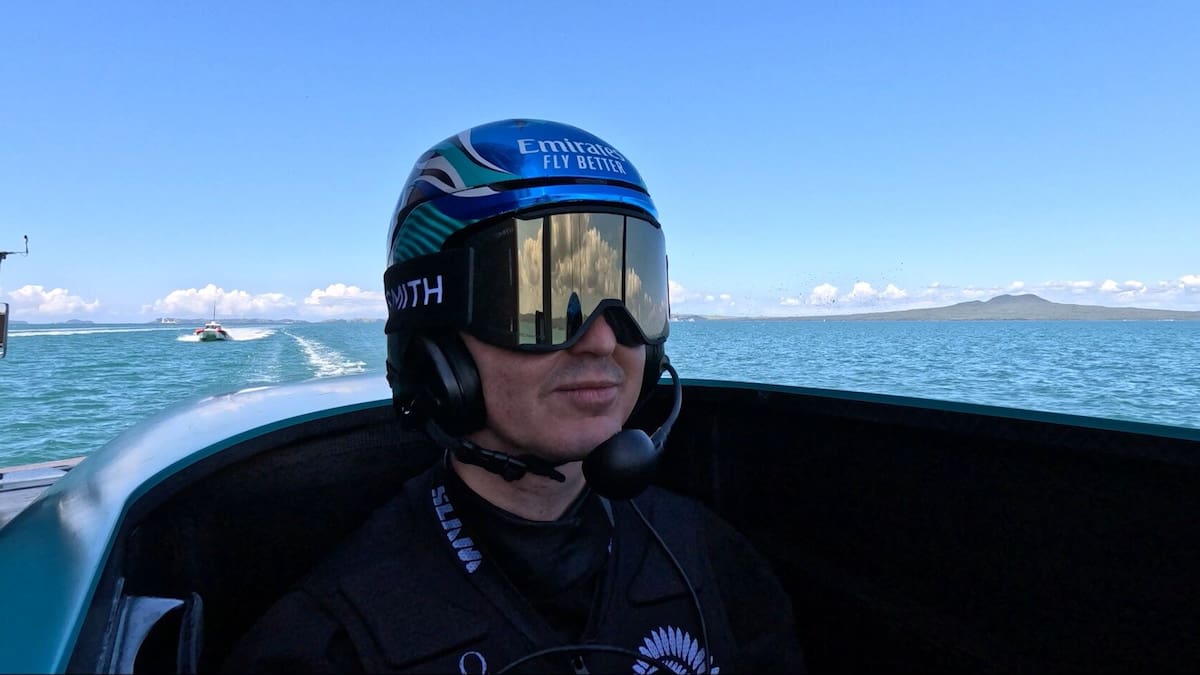
Kitted out with a team helmet – fully locked into the on-board comms – goggles, thick life jacket and a GoPro, on-water safety officer Tony Rae escorts me onto the vessel and to my station, going over the safety information I need to know. Essentially, there’s an air canister in front of me that is easily ripped from its holder in case of emergency and I’m told to tap co-helm Seb Menzies on the head or switch my microphone on and inform the team if I have an issue.
James Somerset and Tony Rae take Christopher Reive through the set-up of the guest racer pod. Photo / Hamish Hooper, ETNZ
While the guest station is port-side, skipper and starboard helmsman Nathan Outteridge comes over to welcome me on board and again stresses how good conditions are – good wind and relatively flat sea, meaning fast, smooth sailing.
“Bumpy would’ve been a bit of fun too,” I say.
“Yeah, but at least you’ll stay dry today,” Outteridge quips.
The port-side team for my block on the boat is comprised of AC75 rookies Menzies and Jake Pye, with Outteridge, Andy Maloney and Jo Aleh in the starboard team. Given it’s also day four on Taihoro for Menzies, Pye and Aleh, my expectation is that they’re still getting to grips with the vessel and there might be the odd miscue.
With a beaming grin, Menzies suggests that I should hold on.
With that, he turns to his wheel and many screens of data as the session begins. I get a good look at the video game controller Menzies will be using, with its many buttons and functions, and think, yeah, good luck to ya.
Emirates Team New Zealand helms Seb Menzies and Nathan Outteridge speak with NZME’s Christopher Reive before heading out to sail. Photo / Hamish Hooper, ETNZ
The guest pod is parked directly behind that of the port-side helm, and I can see all the information being thrown at him in the form of dozens of numbers. These screens are all off-limits for filming, with the team reviewing all footage shot by the guest to make sure secrets stay in-house.
The pod is small, but not as claustrophobic as I expected. At 192cm, I had anticipated my knees might be hard up against the front wall when I sat down, but it’s a comfortable fit and there’s room to move.
I can see over the edge when sitting down, but am encouraged to stand up if I want to get a better look at anything. I can’t imagine that’s great practice for the aerodynamics of it all when they are actually racing, but hey, that’s a future guest racers’ problem.
From the moment we start sailing, the communication on board begins. On an AC75, the team can only see out of whichever side they’re on because the sails block any view across the deck. Everything is discussed, from certain data points to preparing for tacks and gybes to any issues that might be present. It’s an eye-opening insight into exactly what it takes to sail these vessels, let alone at an elite level during a race.
The whoosh of the wind on my face indicates we’re quickly up to speed. Guests are provided three data points: boat speed, ride height and a map, and a glance down at the screen indicates we’re sailing about 35 knots – or 68km/h.
And then we turn.
Like something out of Michael Bay’s Transformers films, there’s a loud, whirring groan as the foil arm lifts out of the water. They’re right next to the pods, so I get a close-up look at the appendage as it hovers above the water at the side of the boat.
I was told I’d feel the G-Force through turns, and as I’m playfully thrown to the side of my cockpit, I can’t fight off the goofy grin trying to take over my face.
NZME’s Christopher Reive takes a good look aboard Emirates Team New Zealand’s AC75 Taihoro. Photo / Hamish Hooper, ETNZ
This happens a couple of times as, because I’m focused on making sure I get some half-decent footage, I’ve not properly tuned myself into the team comms and am blissfully unaware of the fact someone has just said “preparing to gybe”.
After a few minutes, that changes and I pay closer attention to what is being said and begin eagerly anticipating the manoeuvres. The teamwork required is not something I had properly considered before stepping on board, but just how vital trust in your fellow sailors is to getting the best out of these boats is clear.
After about 20 minutes of flying above the Waitematā, the team comms begin to move to the deflating topic of stopping.
All AC75s are required to have a guest racer pod in this cycle of the America’s Cup. Photo / Hamish Hooper, ETNZ
It was my second experience on an AC75, after getting out with a selection of other media types on the team’s previous version, Te Rehutai, during the last cycle. However, the absence of wind on that day meant we didn’t get foiling. This, on the other hand, was unlike any experience I have had on the water. While there were a few bumps, this was a much smoother ride than I had anticipated for a vessel travelling on the ocean at such a speed – topping out above the 70km/h mark.
Craig jumps on after me and is lucky enough to be treated to an extended run in which the team go through some pre-start practice. Watching on from the chase boat, a couple of things are clear.
Fleet racing in this cycle is going to be a spectacle with at least five AC75s on the water together, and anyone in the guest pod during racing – fleet or match – is going to be in for a real treat.
Christopher Reive joined the Herald sports team in 2017, bringing the same versatility to his coverage as he does to his sports viewing habits.