

First published on 

Jacob Mills Ramsay.
Photo: Open Justice / Tara Shaskey
The family of a man mercilessly killed by his farm colleagues say they are devastated after one of those responsible for his death had his life sentence overturned and is continuing efforts to quash his conviction.
Jacob Mills Ramsay was beaten, chained by his ankle to a vehicle, and dragged along a remote farm track in a murder which a judge said met the highest level of brutality.
Last week, Ethan Webster had his life sentence quashed due to his significant neurocognitive impairments, which came to light after his sentencing.
It was replaced with a sentence of 14 years imprisonment with a minimum period of seven years. His appeal against his conviction was dismissed.
However, Webster’s lawyer, Hunter Guy de Groot, has confirmed to NZME that an application for leave to appeal against the conviction has now been filed with the Supreme Court.
Webster was 18 when he and William Mark Candy, then 39, murdered Ramsay over an alleged debt he had racked up with the offenders.
After Ramsay was dragged 1km along the tanker track, they dumped his body into a manmade rubbish pit at the dairy farm in Ōaonui, South Taranaki, where they all worked.
Ramsay’s widow, Sarah Tasker, was pregnant with their third child when he was killed.
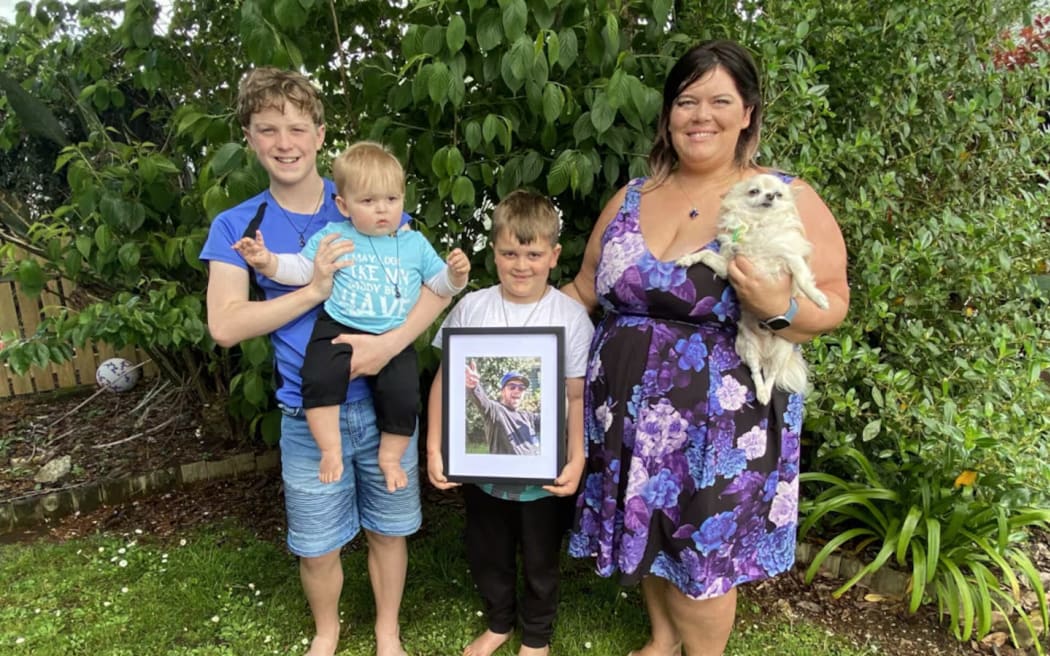
The family of murdered Taranaki farm worker Jacob Ramsay (from left): Lucus Boyd, Olliver Ramsay, Hunter Tasker-Ramsay, Sarah Tasker and Munta the dog.
Photo: NZ Herald / Tara Shaskey
Jodie Shannon Hughes, Candy’s partner at the time, was charged alongside them but was acquitted of murder at a trial and found guilty of manslaughter.
Following the Court of Appeal’s decision to overturn Webster’s sentence, Ramsay’s family told NZME they were “very disappointed” with the outcome.
“Ethan, Will and Jodie made some decisions that night that were brutal, incomprehensible, disgusting, callous, heartless, unsympathetic and without remorse,” Tasker’s stepfather Wayne Froggatt said.
“They all deserve the full force of the law.
“Unfortunately, a defence of ignorance, stupidity, unintelligence and parental negligence seems to work in favour of these oxygen-wasters.”
Froggatt dreaded the day that, when Webster was released from prison, they would have to tell Ramsay’s children that he was now walking free.
He said the aftermath of the murder never ends.
“It’s hard, it never ends.”

Ethan Webster has successfully appealed against his life sentence.
Photo: Pool
However, Froggatt said the family were united and they would get through it together. He said they were also grateful for the support of the police and the Crown.
Tasker, who supported Froggatt’s statement, told NZME that news of Webster’s new appeal to the Supreme Court was hard.
“I wish they would lay this all to rest,” she said.
“He did a crime, he needs to own it and do the time so us, as the victim’s family, can move on with our lives.”
Tasker said the wound was reopened for the family every time the matter returned to court.
“Losing a loved one is hard enough without it being in the way that we lost Jake. We are still affected by it day by day.”

William Candy was sentenced to life imprisonment with a minimum period of 17 years for his role in the murder.
Photo: Pool
Beaten, chained and dragged
Ramsay was murdered on 29 July 2022.
He was in Ōakura, about a 30-minute drive from the farm, when Candy tracked him down and confronted him about the alleged money owed.
Candy beat Ramsay and then forced him into a car, driven by Hughes.
As he was driven back to the farm, Candy continued to beat him.
When they pulled into the farm, Webster was awaiting their arrival, and Ramsay was unconscious.
Candy shoved his body from the car and on to the ground. His eyes were closed and he was limp and floppy.
Webster grabbed Ramsay by the throat and delivered several blows to his head, only stopping when he thought he had broken his hand.
Candy kicked the victim and Webster began stomping on his head.
The two beat Ramsay for a further 10 minutes. At one point, a witness pleaded for them to stop and take Ramsay to the hospital.
But Candy instead fetched a chain and tied Ramsay to the back of the vehicle.
The witness told him what he was doing was wrong but Candy warned them to back off, or they would “be next”.
After slowly driving forward, Candy stopped the vehicle and Webster jumped into the passenger seat.
“You don’t want to be in here for this, this is serious s***. He might be dead by the time we get to the end of the track,” Candy told Webster.
But Webster remained in the car and, for about 900m, Ramsay was dragged by his ankle down the track and across a muddy paddock.
The two then detached the chain from the car and pulled Ramsay at least another 20m to the edge of a rubbish pit, where they dumped his body.
Candy, who pleaded guilty to murder alongside Webster, was sentenced to life imprisonment with a minimum period of 17 years. Webster’s initial sentence of life came with a minimum period of 12 years.
Hughes was sentenced to five years and six months’ imprisonment on the manslaughter conviction.
She was released on parole in June last year, but was recalled to prison last month.

Jodie Shannon Hughes was convicted of manslaughter and has now been released from prison.
Photo: NZ Herald / Tara Shaskey
Appeal against sentence and conviction
In Webster’s subsequent appeal, the Court of Appeal’s decision detailed how he had been diagnosed with mental impairments attributable to foetal alcohol spectrum disorder (FASD) since he was sentenced.
While it was determined there were no issues with his fitness to plead before he admitted the murder charge, more reports were ordered after his
sentencing to assist in his appeal against his life sentence.
Those assessments found he met the criteria for mild intellectual disability, confirmed he had dyslexia and also led to the FASD diagnosis.
This gave rise to an appeal against his conviction, on the grounds that intellectual disability was a recognised impairment for the test of unfitness to stand trial within the Criminal Procedure (Mentally Impaired Persons) Act.
However, following further assessments, the Court of Appeal was not satisfied that the evidence proved he was unfit to plead at the relevant time, dismissing that aspect of his appeal.
On his appeal against sentence, the Court of Appeal considered that his mental impairment, attributable to FASD, was new information and materially relevant to his culpability, in addition to his youth.
It found Webster was also vulnerable to Candy’s influence, and further considered his low risk of reoffending, remorse and rehabilitation prospects, the length of his minimum period of imprisonment and lifetime parole. Webster would not have been eligible for parole until he was 32.
The court ruled a life imprisonment sentence was manifestly unjust when public safety concerns “do not loom large”.
A decision on Webster’s application to the Supreme Court for leave to apply against his conviction is yet to be released.
* This story originally appeared in the New Zealand Herald.