
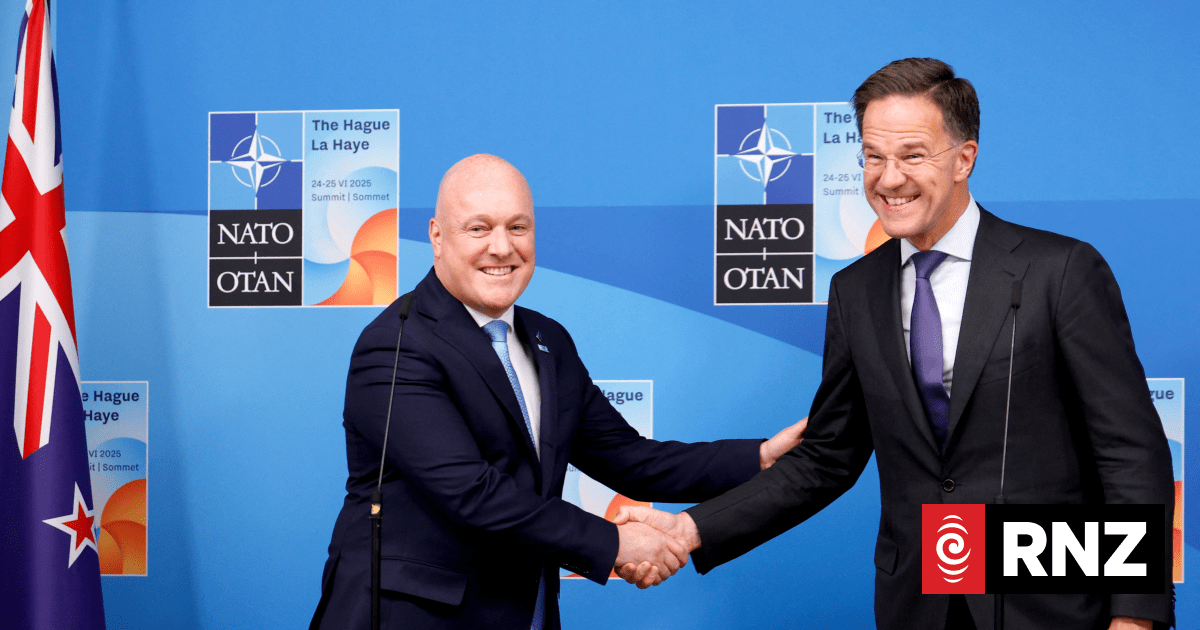
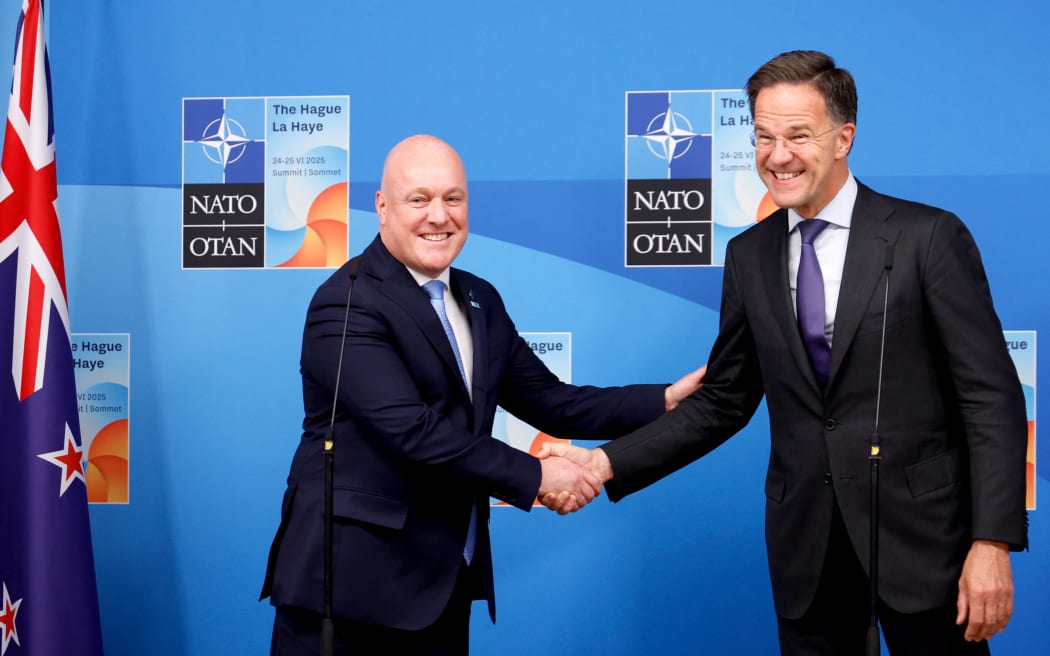
NATO head Mark Rutte with Prime Minister Christopher Luxon in 2025.
Photo: AFP / POOL / Geert Vanden Wijngaert
The government says it has not made any commitment towards military action in the Middle East, despite New Zealand being named by the head of NATO as one of 22 countries “coming together” to secure the Strait of Hormuz.
Speaking to Fox News, NATO Secretary-General Mark Rutte said countries including Japan, Korea, Australia, New Zealand, UAE, Bahrain and the NATO alliance were working to “implement [US President Donald Trump’s] vision of making sure that the Strait of Hormuz is free, is opening up as soon as that is possible”.
Iran closed the strait, a key fossil fuel transit channel, in response to the US-Israel attacks at the end of February. The move, along with attacks on energy infrastructure in the region, sent oil prices skyrocketing.
New Zealand last week joined 19 other countries in condemning Iranian attacks on commercial ships in the Gulf. Other signatories included the UK and Germany, expressing “deep concern” about the escalating conflict.
Speaking to First Up on Tuesday, Deputy Prime Minister David Seymour said no commitments had been made and it had not been discussed in Cabinet.
“The only position that New Zealand has taken publicly was in the statement that we jointly signed with the British and a number of other countries towards the end of last week. We’ve stated that we’d certainly like this to happen and that we’re open to doing it. But as far as any kind of specific commitment, we certainly haven’t made that at this point.”
He said assisting in policing the strait would be a “big commitment to make”.
“I think it would be prudent for the government to be prepared to assist in action to ensure our security and our fuel security. However, at this point, it would be an overreach to say that we’ve committed to any specific course of action on it.”
Labour leader Chris Hipkins told Morning Report he did not back Rutte’s statement.
“I think that statement is very broad and suggests that New Zealand is both ready and willing to participate in securing the Strait of Hormuz. I don’t think we should be signing up to a commitment that is as broad as that at this point.”
He said one reason would be Trump “starting to make threats about bombing civilian infrastructure”.
Trump this week threatened to “obliterate” Iranian power plants, prompting Iran to say it would do the same to those of its US-friendly neighbours, who rely heavily on electricity for heat management and water purification.
“New Zealand wading headlong into that conflict isn’t the responsible thing for New Zealand to do. It’s also not consistent with our very principled, independent foreign policy,” Hipkins said.
Trump later called off the strikes after what he said were “very good” talks with Iranian officials, which Iran denied had happened.
Sign up for Ngā Pitopito Kōrero, a daily newsletter curated by our editors and delivered straight to your inbox every weekday.