

Salutations from San Diego. This is Jonathan Wosen, West Coast biotech & life sciences reporter. We’ve got an outstanding lineup for you today, featuring a look at the tricky choice facing federal officials on vaccine policy, the search for a permanent director of the Centers for Disease Control and Prevention, and a deep dive on how regulatory changes have made it harder for patients to secure a transformative treatment for a deadly gut infection.
On a personal note, I’m taking a few months of parental leave starting today, so it’ll be a while before you see my byline again. In the meantime, please continue to read my talented colleagues’ excellent coverage. I’m looking forward to keeping up with their work from afar (when I’m not busy with the little one).
How will federal officials respond to a ruling stalling RFK Jr.’s vaccine overhaul?
 Elijah Nouvelage/Getty Images
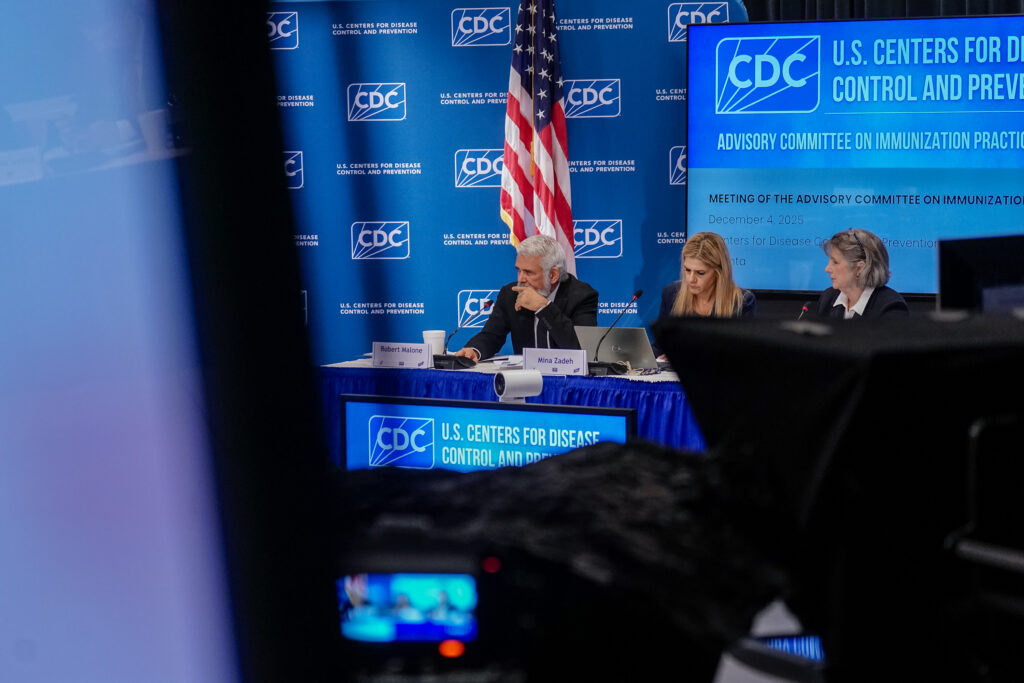
Donald Trump has kept his campaign promise to let Robert F. Kennedy Jr. “go wild on health,” appointing the outspoken vaccine critic to run the federal health department, where he has reconstituted a key vaccine advisory panel. But a federal judge recently ruled that Kennedy’s shake-up to the Advisory Committee on Immunization Practices and changes to the childhood vaccine schedule were likely illegal. And federal officials must now decide how to respond to the court order.
It’s a tough choice, writes my colleague Chelsea Cirruzzo. The White House has mostly been a strong supporter of Kennedy’s health agenda, but pollsters have said upending vaccine policy is unpopular with voters — and it’s an election year. A person familiar with the situation told Chelsea the administration hasn’t decided whether to appeal the ruling. Reconstituting ACIP yet again would be another option.
For now, the panel’s prior recommendations are void due to the court order, including calls to delay a birth dose of the hepatitis B vaccine to mothers who test negative for the virus and to split up a combined measles, mumps, rubella, and varicella shot. But while ACIP remains in limbo, Kennedy or the CDC director (a position that remains vacant for now) could make their own vaccine recommendations.
Inside the high-stakes search for a new CDC director
Speaking of the CDC director vacancy, Chris Klomp, director of Medicare and a rising star in the federal health department, is playing a key role in filling one of the most controversial and important open roles in the Trump administration. Last week during STAT Breakthrough Summit East in New York, Klomp shared how he’s approaching the task.
“I want somebody of unassailable, high moral integrity who is deeply experienced and has deep expertise and is qualified to lead a staggeringly complicated and essential government agency,” he said. Klomp lamented that trust in CDC has declined, an issue he said predates the current administration. The medicare director added that he has vetted candidates over Zoom and in-person, adding that Kennedy has been part of the process, too.
About half a dozen candidates have made it through a “more senior interview phase,” he told STAT. At this point, there’s little time to spare: If the White House doesn’t nominate a new director by Wednesday, it won’t be able to keep Jay Bhattacharya as acting director of the agency. Read more from STAT Executive Editor Rick Berke and Washington correspondent Daniel Payne.
Medicine has a trust problem. AI is making it worse
Artificial intelligence companies such as OpenAI and Anthropic are making a major push into health care, convinced their tools can help patients and providers. But some of these systems have already proven to be error-prone, and the race to implement them has the potential to further erode trust in health care, physician-researcher Oni Blackstock argues in a STAT First Opinion.
Health care is a natural target for AI companies, Blackstock writes, as the field has what their algorithms need most: data, and lots of it. But polling shows that the public has little confidence health care systems will use AI responsibly, with 58% of respondents in a 2025 study saying health systems would ensure an AI tool wouldn’t harm them.
“What needs to change is who contributes to decisions about how AI tools are purchased, governed, and used,” Blackstock writes, adding that patients who’ve experienced discrimination in health care are the least likely to trust health systems to use AI responsibly. “Patients and community members need formal decision-making roles, not just advisory positions.”
Stricter FDA rules have turned getting a fecal transplant into an odyssey
 Gilda Jones/CDC
For patients with severe Clostridioides difficile infections, one person’s stool is another person’s treasure. Fecal transplants, which amount to a hard reset of the gut microbiome, can be a lifesaver for those whose colons have been overrun by toxin-spewing bacteria. But these treatments have become harder to get due to stricter rules imposed on stool banks by the Food and Drug Administration, writes STAT’s Eric Boodman.
In 2022 and 2023, two companies secured FDA approval for human-excrement-derived drugs to prevent C. diff. recurrence. Shortly after, the agency cracked down on OpenBiome, a nonprofit that acts like a blood bank for stool, ending a longstanding practice of choosing not to enforce certain regulatory requirements. The stool bank soon stopped shipping samples.
Tighter regulation became a major problem for Blanca Morales and her son Mundo, who was suffering from a nasty C. diff infection. Approved therapies aren’t cleared for use in kids, and Morales had to go through a harrowing journey to secure off-label treatment for her child. “None of us said it, but we all feared that Mundo was going to die,” she told Eric, sobbing as she spoke. Read more to understand how this shift in policy has had real consequences for patients.
Match Day results show impact of immigration policy on budding doctors
Each year, tens of thousands of medical students nervously open envelopes to learn where they’ll spend the next several years of residency, during which they obtain specialized training. For international students, this year’s Match Day, which took place on Friday, came with an additional stressor — federal immigration policy changes, including travel bans and visa processing delays.
The National Resident Matching Program reported that, among non-U.S. citizen students who attended medical school abroad, residency match rates declined to 56.4%, the lowest level observed in five years, meaning nearly half of these applicants didn’t secure a residency position. Among international students who required visa sponsorships, the rate was even lower, 54.4%, while 67.9% of applicants with a green card who’d gone to medical school abroad matched. By comparison, the match rate among fourth-year med students at U.S. schools was 93.5%.
Diabetes outcomes worsen after patients lose insurance, study finds
Millions of people are set to lose health insurance due to last year’s passage of the One Big Beautiful Act, which contains deep cuts to Medicaid. That will likely result in worse outcomes for patients with diabetes, according to a new study led by researchers at Oregon Health & Science University. Researchers analyzed electronic health records from over 39,000 patients, more than 5,000 of whom had experienced insurance “churn,” defined as two or more consecutive visits to a community health center while uninsured. They found that, compared with those who were insured, people with unstable coverage had higher HbA1C, a measure of blood sugar, and needed more insulin to manage their disease.
Authors of the study, published in the journal JAMA Health Forum, didn’t see evidence that insurance churn was linked with serious complications, such as kidney failure or amputations, but they cautioned that it takes time to see more severe outcomes. “What we’re seeing is an early warning sign. The disease gets harder to manage after insurance loss,” said Nathalie Huguet, the study’s lead author, in a press release.
What we’re reading
Trump administration nears CDC pick as agency faces ongoing leadership changes, Bloomberg
She was in labor at a Florida hospital. Then she was in Zoom court for refusing a C-section, ProPublica
Iran war has not disrupted pharma supply chains. That could change if conflict is prolonged, STAT
Opinion: The problem with promoting ‘gold standard science,’ Undark
HBO’s ‘The Pitt’ nails how hospital cyberattacks create chaos, endanger patients and disrupt critical care, The Conversation
What’s the word? Test your knowledge with today’s STAT Mini crossword.