

By Peter de Kruijff, ABC News
For centuries ship captains have written accounts about how some of the world’s largest animals rammed each other and even sunk ships.
The 1820 sinking of the whaling ship Essex by a reported 26-metre sperm whale (Physeter macrocephalus) even inspired the epic novel Moby Dick.
But the sperm whale is a mysterious animal, despite its massive size, and biologists have long debated the extent of any headbutting behaviour.
Now scientists have said they have captured the first recorded footage of a headbutting sperm whale, as well as witnessed the behaviour in the water.
Their study, published in Marine Mammal Science, details an aerial video from the Balearic archipelago off Spain showing a juvenile male ramming into a small female.

The Azores archipelago is a global hotspot for seeing sperm whales.
Photo: iNaturalist: Wayne and Pam Osborn, Sperm whale, CC BY-NC 4.0
Quantitative physiological ecologist and study lead author Dr Alec Burslem recalled the moment at sea when his co-author Rui Prieto shouted “head ramming”.
“It was really exciting for all of us to see and document this behaviour which has been debated and speculated about for as long as people have been studying this species,” Burslem said.
Marine biologist Robert Harcourt, an emeritus professor with Macquarie University and not involved in the study, said it was probably not uncommon behaviour by the whales.
“But without the vertical perspective of a drone it’s very difficult to observe these relatively fleeting behaviours,” he said.
“No doubt tour boats that fly drones have seen this too – or will in the future.
“Given the calibre of this team I’m sure they searched the literature and this is the first scientific report.”
Why do sperm whales headbutt?
Burslem said there was not enough data yet to explain why the whales headbutted each other.
“We saw head-on contact of variable strength, and in lots of different contexts,” he said.
The study brought together separate research teams – from the University of St Andrews, Tursiops Association and University of the Azores – which were undertaking different projects but captured drone footage of sperm whales bumping heads.
The Balearic archipelago video, filmed in 2022, showed two juvenile males with penile erections repeatedly diving under each other and surfacing near a female.
One of the young males then diverts course and runs into her. The female leaves and the two males continued to interact.
Two more videos were filmed in the Azores archipelago, Portuguese islands in the North Atlantic.
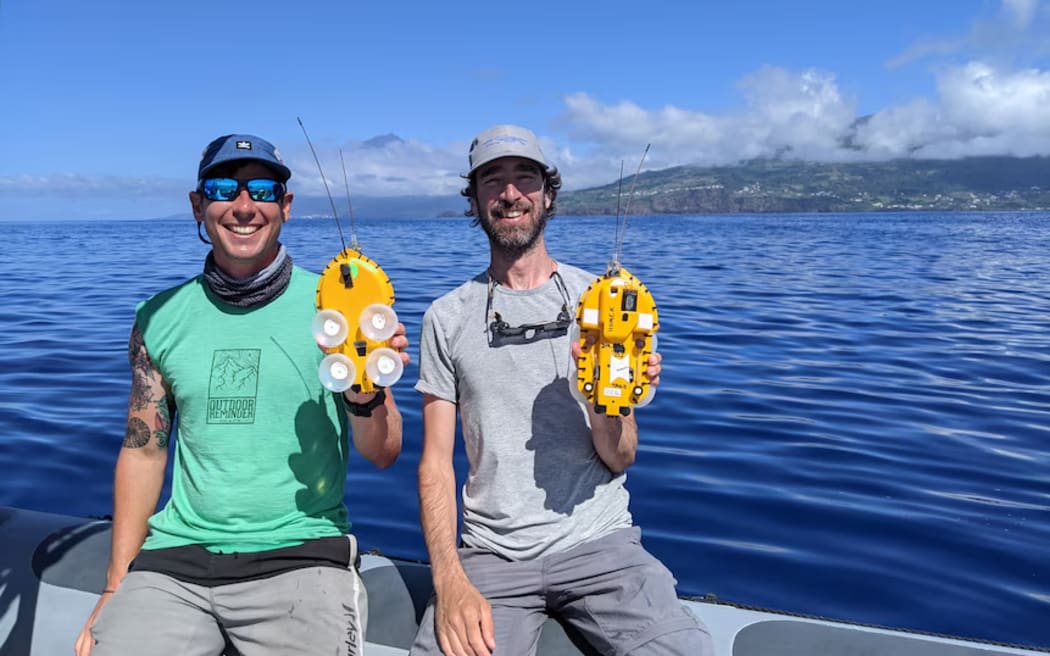
Sperm whale researchers Alec Burslem and Rui Prieto with non-invasive suction cup tags that record sound and movement.
Photo: Alec Burslem
One showed whales of unknown gender colliding head-to-head in an instance where patterned clicking was also recorded.
The other had instances of two suspected male whales either striking each other in the head or the body with both light and heavy force.
Some of the head-on interactions may have just been “rough play” with common social behaviours like rolling and jaw opening occurring at the same time.
The study’s authors hypothesised the headbutting young males could be detrimental to the cohesion of the group, which is led by matriarchs.
While females stay in their group for life, males leave when they get older.
The researchers speculated that the headbutting might annoy the matriarchs, and could contribute to the young males being forced out of the group, marking their transition to adulthood.

Photo: ABC Science
Professor Harcourt said the behaviour in the videos looked like rough and tumble play common in almost all immature mammals that live in social groups.
“All taxa from seals to deer to sheep to lions to humans spend a lot of time as youngsters knocking each other about,” he said.
“And sometimes misdirecting this behaviour at adults – whereupon they get swiftly put back in line.”
Marine mammal specialist Dr Catherine Kemper, who was not involved in the study, said she liked the proposition there was some sort of learning behaviour going on.
She said whether it had something to do with juvenile males preparing to leave a maternal group was unknown, but it was a good idea.
“Mature [adult] males only join groups in order to check out receptive females,” Kemper said.
Are the whales hurting each other?
Professor Harcourt said the forces generated by the headbutting seen in the videos was impressive but not likely to be severely damaging, unless excessively applied.
“Male whales of many species do ram each other and can produce significant injuries – but these tend to be competing for access to oestrous [in-heat] females, which is not the case here,” he said.
If you were to look at a cross-section of a sperm whale’s head, its special organs, like its brain – the largest of any living creature on the planet at about nine kilograms – sit far back in the skull.

The brain of a sperm whale is located towards the back of its head at the cranium.
Photo: PeerJ: Ali Nabavizadeh, Sperm whale study, CC BY-NC 4.0
Kemper said there was a lot of soft tissue and a spermaceti organ filled with oil between the front of a sperm whale’s head and its brain.
“The head is up to 40 percent of the body length so quite a weapon, if they want to use it as such,” she said.
“You can see that there is a lot of soft tissue there to avoid breaking the skull.”
Could a sperm whale have sunk the Essex?
There have been recent cases where orcas have destroyed yachts or breaching whales killed people on small boats.

Owen Chase was the first mate of the Essex which was sunk by a sperm whale in 1820.
Photo: Wikimedia: Nantucket Historical Association
A 2018 CSIRO study of Australian vessel strikes by whales counted 105 instances between 1840 and 2015.
The big mystery that still remains is whether large adult sperm whales sunk whaling ships.
Burslem said anyone who had studied sperm whales had wondered how much historical accounts like the wreck of the Essex reflected genuine behaviour of whales.
The first mate aboard the doomed Essex, Owen Chase, wrote in 1821 about a massive sperm whale that appeared during a hunt:
“I involuntarily ordered the boy at the helm to put it hard up; intending to sheer off and avoid him [the whale],” he wrote.
“The words were scarcely out of my mouth, before he came down upon us with full speed, and struck the ship with his head, just forward of the fore-chains; he gave us such an appalling and tremendous jar, as nearly threw us all on our faces.
“The ship brought up as suddenly and violently as if she had struck a rock, and trembled for a few seconds like a leaf.”
Chase wrote the crew looked at each other in amazement and nearly without the power of speech.
That was before they realised the ship was taking on water and the whale had made a hole in the ship.

A drawing by Thomas Nickerson, who was aboard the ill-fated Essex, sunk by a sperm whale in 1820.
Photo: Commons: Thomas Nickerson; licence
The whale reportedly thrashed in the water before charging head-first into the ship again, its body half out of the water.
Burslem said he was not a historian but had no doubt a sperm whale could put a hole in a wooden ship.
He said future research looking at headbutting in adult whales was a key piece to understanding the full behavioural puzzle.
“For example, if we were to start to see lots of headbutting between sexually mature males in the presence of females, that would tend to support the hypothesis that it is used in sexual competition,” Burslem said.
“What these observations do seem to confirm is that sperm whales do, at least occasionally, strike with considerable force using their heads.”
– ABC News