
New Zealand has one of the highest rates of skin cancers globally, making annual skin checks a must. But what is available, and how much do they cost? Our beauty editor found out.
Let this sink in: more people die from skin cancer than on our roads.
That’s the confronting statement on the Melanoma NZ website, an organisation which champions melanoma prevention, detection and patient care in New Zealand.
In 2025, provisional data on the Ministry of Transport website showed 272 people died on New Zealand roads, while Melanoma NZ noted more than 320 people died from melanoma and other forms of skin cancer.
Now for the good news. If caught early, MoleMap NZ says 90% of skin cancers can be cured with simple surgery alone.
Early detection requires regular full body skin checks, whether that’s through a private dermatologist or by booking in with a specialist clinic like MoleMap or Skin Institute. Most GPs offer spot checks, too.
Here are the different types of skin checks available in New Zealand, the technology behind them, and how much you can expect to pay.
Skin Check 101
What’s the difference between a full-body skin check and spot check?
The former is a thorough, head-to-toe skin cancer assessment using a handheld dermascope (a hand-held visual aid to help examine and diagnose skin lesions) or full-body scan technology (more on that below), while the latter is a brief appointment to check up to three moles or lesions that may be concerning.
How often should you be getting a full-body skin check?
Annually is recommended by Melanoma NZ, or more often if you are considered high risk (for example, those with fair skin or a weakened immune system) or notice a change to a freckle, mole or lesion.
Most clinics factor in personal or family history, age and history of sun exposure to personalise skin surveillance, and recommend checks anywhere between six-monthly for a higher risk individual to a follow-up every two years for people at a lower risk.
Self-checks can be performed at home every 1-3 months, says Molemap NZ.
What are you looking for during a self-check?
Remember the ABCDEs of melanoma:
Asymmetry (irregular shape), Border (jagged edge), Colour (varied shades), Diameter (larger than a pencil eraser), and Evolving (changing).
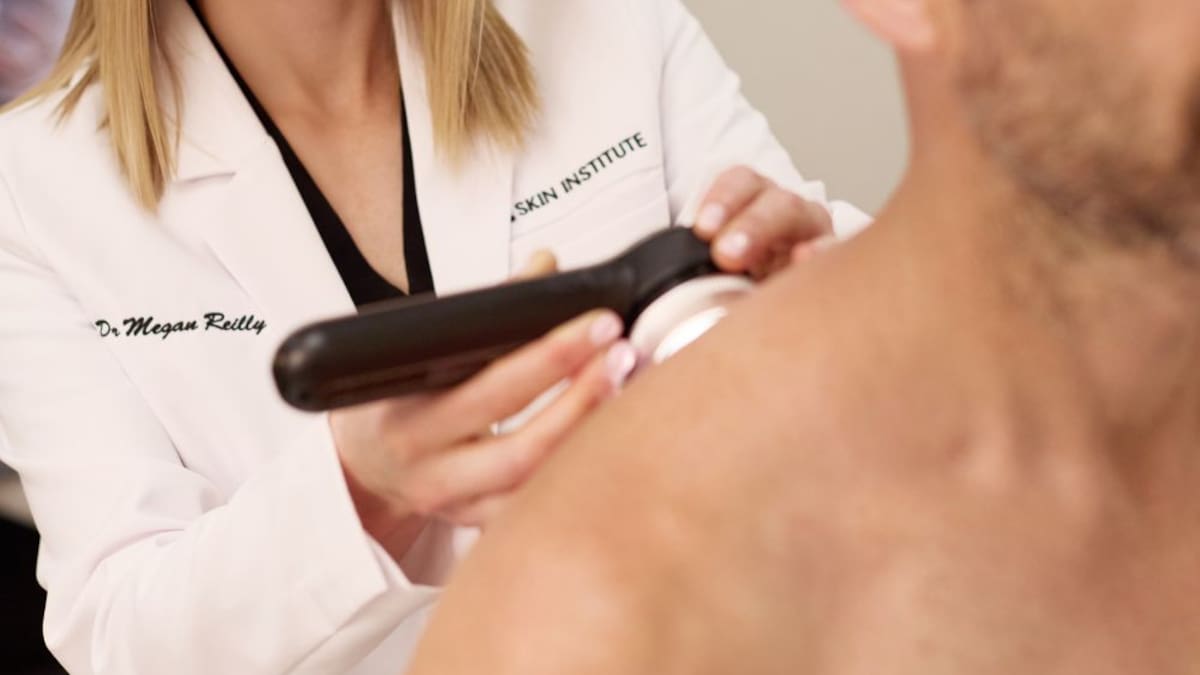
Photo / Skin Institute
SkinTracker at Skin Institute
How it works: SkinTracker is Skin Institute’s newest and most advanced skin monitoring system, which creates a clear, trackable record to detect changes – even those not visible to the naked eye.
Developed in New Zealand by a network of skin cancer doctors, dermatologists and surgeons, SkinTracker combines total body imaging and a comprehensive skin examination with AI technology, to detect and track changes to skin over time, including early signs of melanoma.
According to Queenstown-based skin cancer specialist Dr Megan Reilly, the kind of long-term monitoring SkinTracker offers is instrumental in supporting early detection of melanoma.
Reilly believes technology like SkinTracker is the “gold standard” for higher-risk patients. “It is recommended by many international dermatology and skin cancer organisations, which has helped drive the introduction of this AI-assisted approach in New Zealand,” she says.
She adds the efficacy of SkinTracker lies in its precision – where some skin cancer checks call for handheld cameras or smartphone use, SkinTracker’s automated camera system utilises laser positioning to capture high-res, accurate images of skin that can be interpreted using AI tools to track and highlight changes.
“One of the biggest advantages of SkinTracker is that it creates a detailed baseline of a person’s skin. Once this baseline is established, clinicians can monitor for subtle changes over time, which is often how early melanomas are detected,” Reilly says.
Patients can book in for their SkinTracker starting with the AI imaging, followed by the skin check appointment with a nurse dermoscopist or skin cancer doctor. Reilly says the imaging and AI analysis are not diagnostic on their own, so this dual-approach with a full clinical skin examination ensures lesions that require closer assessment are also checked.
“Additionally, some areas are difficult to image accurately, such as between the toes, within body folds, the scalp, and areas of dense hair, and clinicians also need to assess the overall pattern of a patient’s skin and clinical history,” Reilly says.
“SkinTracker works best when advanced imaging, AI support, and a thorough clinical examination are combined.”
How long it takes: The first Baseline Skin Tracker imaging takes approximately 20 minutes, which combines the AI imaging process and a physical exam by a skin cancer expert. During the appointment, you’ll be led through a series of nine body positions to ensure every angle is covered. This complete skin record is stored securely for future comparison. Follow-up imaging takes around 15 minutes.
How much it costs: Baseline SkinTracker imaging is $199, while a skin cancer consultation with a nurse dermoscopist is $159, or $249 with a skin cancer doctor. Subsequent imaging (approximately 12 months later) is $199. SkinTracker patients receive unlimited free spot checks in between appointments.
Available from: Skin Institute clinics are located in Albany, Remuera, Richmond, and Queenstown. See Skininstitute.co.nz for more information or to find your nearest clinic.
Photo / Skin Institute
Dermascopy at Espy Skin
How it works: Espy Skin founder Katy Doherty has more than 20 years’ experience as a registered nurse, and just shy of a decade in dermoscopy and skin cancer surveillance.
Doherty is adept at detecting the many forms of skin cancer and precancerous growths, including actinic keratoses, basal cell carcinoma, squamous cell carcinoma and melanoma.
You don’t need a referral to visit her clinic in Auckland’s Takapuna. There, Doherty uses the latest dermoscopy technology to conduct a full-body skin check. This hand-held magnifying lens and lighting system allows for a closer look at skin structures and patterns, which Doherty uses over a patient’s body from a sitting or lying position.
Clinical and dermoscopic images of any lesions of clinical concern are taken for surveillance or surgical or non-surgical treatment, and Doherty works with a network of skin cancer GPs for direct referral if required.
While her pricing is considerably lower than others on this list, Doherty says this aligns with her personal mission to prioritise early detection and prevention of skin cancer.
“I believe full body skin checks should be affordable and thus more accessible for people – cost should not be a barrier to having your skin checked,” Dohertysays on her website.
How long it takes: 30 to 45 minutes for a full-body skin check.
Available from: Espy Skin, Level 2, BDO Building, 19 Como St, Takapuna. Espyskin.co.nz.
Dermascopy is one of the most popular methods of manual skin checks, and is also available from multiple clinics across the country, including Skinspect, Skintel, Skinsite and more nationwide.
Photo / MoleMap NZ
MoleMap
How it works: MoleMap operates more than 50 dedicated clinics and partner clinics throughout New Zealand, offering comprehensive skin cancer checks, including full-body mole mapping, spot checks and specialised melanoma detection.
MoleMap uses a network of trained melanographers and dermatologists to conduct its three in-house services, known as a Full Body MoleMap, SkinCheck+ and SkinCheck.
All three services include AI-assisted diagnostic technology, helping to recognise if a mole or lesion has changed and requires treatment.
A Full Body MoleMap is recommended for those with a high number of moles, previous sun damage, or a family or personal history of skin cancer. An experienced melanographer performs a thorough skin check using a dermoscope, checking everywhere from your scalp to the soles of your feet (even between toes). The service also includes a set of up to 28 reference images that serve as a baseline to track and monitor new or existing moles. Proactive monitoring of potentially high-risk moles are catalogued and reimaged at every appointment.
SkinCheck+ is for those with a small number of moles, but still want a full body record. The service is much the same as a Full Body MoleMap, minus the proactive monitoring and lesion catalogue that offer a side-by-side comparison of changes.
SkinCheck is still a comprehensive full-body skin check using a dermoscope, but without the full-body photography or proactive lesion monitoring.
How long it takes: A Full Body MoleMap takes 50 minutes, SkinCheck+ and SkinCheck take 20 minutes.
How much it costs: A Full Body MoleMap is $399, with an annual follow-up between $339–$425 (based on lesion count). SkinCheck+ is priced at $279, while SkinCheck is $229.
Available from: Dedicated MoleMap clinics and partner clinics nationwide. See Molemap.co.nz for more information or to find a clinic near you.
Photo / Skinscape360
Skinscape 360
How it works: Skin cancer specialist and surgeon Dr Richard Martin and his wife Geri have unveiled Skinscape 360, New Zealand’s first 3D whole body imaging system designed to screen and detect melanomas early.
Situated at the couple’s Takapuna clinic, Skinscape 360 utilises Vectra WD 360 technology, which uses 92 high-definition cameras to photograph the body in less than a second, creating a detailed 3D avatar to map every mole and lesion.
The avatar acts as a permanent record of skin that can be updated with every scan, ensuring no spot is missed over time.
Patients are able to book in for a 3D total body avatar scan only, or combine their appointment with a full-body skin cancer check using a dermoscope. Together, Martin claims this new screening system offers a more complete approach to skin cancer detection and treatment.
Martin says Skinscape 360 aims to reduce the pressure on the healthcare system, with the 3D mapping reducing the need for biopsies unless absolutely necessary.
“Knowing exactly where a lesion is and how it has changed will lead to more efficient, less invasive surgeries, reducing hospital stay times and recovery costs,” Martin says.
“It’s not tech for tech’s sake. It’s tech that has the potential to transform skin cancer care and what humans can do. By blending human expertise with the best scanning technology and artificial intelligence, we can bring Kiwis a better, future-proofed model of skin cancer care.”
How long it takes: The 3D total body avatar skin scan takes 15 minutes, or 40 minutes when combined with a skin cancer check using a dermoscope.
The 3D scan technology produces 92 polarised images, alongside a 3D movable avatar and DermaGraphix Visualiser report of spots that need extra investigation using a dermoscope.
Photo / Skinscape 360
How much it costs: $349 for a full-body digital scan, or $449 for a full-body scan and in-person consultation with a dermoscopist.
The 3D avatar imagery is able to be shared with healthcare practitioners, including GPs, dermatologists or skin specialists for ongoing surveillance and treatment.
Found an odd-looking spot you’d like checked out? Melanoma NZ hosts complimentary spot check events nationwide throughout the year. Find your nearest spot check event at Melanoma.org.nz/spot-check-events.
More beauty
From trending nail art designs to an injectable moisturiser said to hydrate skin from the inside out, discover all the best beauty reads here.