
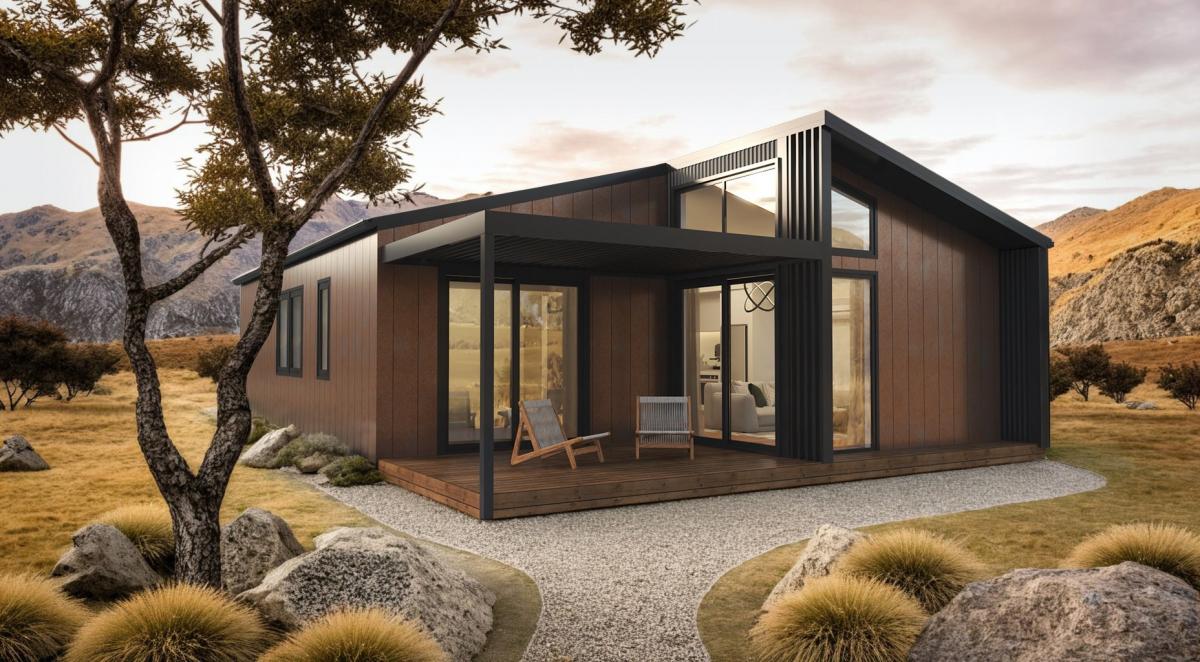
Seventy Squares co-founders Tristan Penrose and Jason Bint have ambitions to go nationwide with a new business building architecturally designed small houses nationwide from Wānaka.
Their homes fit within new rules allowing standalone dwellings no larger than 70sqm to be built without consent, provided they meet building code standards.
Kitset homes will be delivered in stages under a flat-pack system.
Both of them have been builders for 20-plus years constructing architectural homes more latterly in Central Otago, but have bigger plans for the compact Seventy Squares designs.
They follow a design checklist of efficiently built homes within buyers budgets in a simple design without compromising on quality.
Mr Penrose said their timing was good as new minor dwelling reform this year had opened up the construction of standalone homes under 70sqm conforming with the building code on a site with an existing building on the title.
He said the business idea had been in the pipeline for nine months with their website going live six weeks ago.
Since then they had received 1300 inquiries, giving them confidence this would result in orders.
The first compact home is being built in Wānaka.
‘‘I am building this for myself and it is the perfect scenario for the kitsets and putting my money where my mouth is and I’m proving it actually works. I might even look at Airbnb-ing it out potentially so people can stay in one prior to buying.’’
Mr Penrose said they were differentiating their designs from tiny homes as 70sqm was a good size without the maintenance or running costs of a larger home.
‘‘This isn’t about trailers or short-term fixes. It’s about creating well-designed, permanent homes that families can actually live in — homes that are efficient to build, realistic to finance, and suitable for long-term use.’’
Mr Penrose is the director with Mr Bint having a business interest and continuing to be co-owner of Bespoke Builds. The other Seventy Squares shareholders are an architectural designer and a quantity surveyor.
Flat packs will be built in a partnership at local Placemakers sites with new owners commissioning their own builders to put them up.
Mr Bint said their concept came from talking with building clients and realising the housing market was missing a lot in this area.
‘‘We will always build larger architectural homes — that market isn’t going anywhere. But what we’re seeing on the ground is a widening gap. Clients want smart designs and quality finishes, but they also need cost certainty. The industry needs a repeatable format that works within today’s construction realities.’’
He said there was a growing gap in the market between tiny homes and full architectural builds and their model sat in between that space.
Unlike tiny homes or temporary dwellings, the 70sqm model was designed as a permanent, code-compliant solution under building standards, he said.
The designs are expected to appeal to first-home buyers, people wishing to downsize or families wanting a sleepout and those seeking a studio and rental or worker accommodation.
The most expensive design, clad usually in pre-painted steel, would cost about $180,000 with add-on options.