
By ABC Americas editor John Lyons in Washington DC
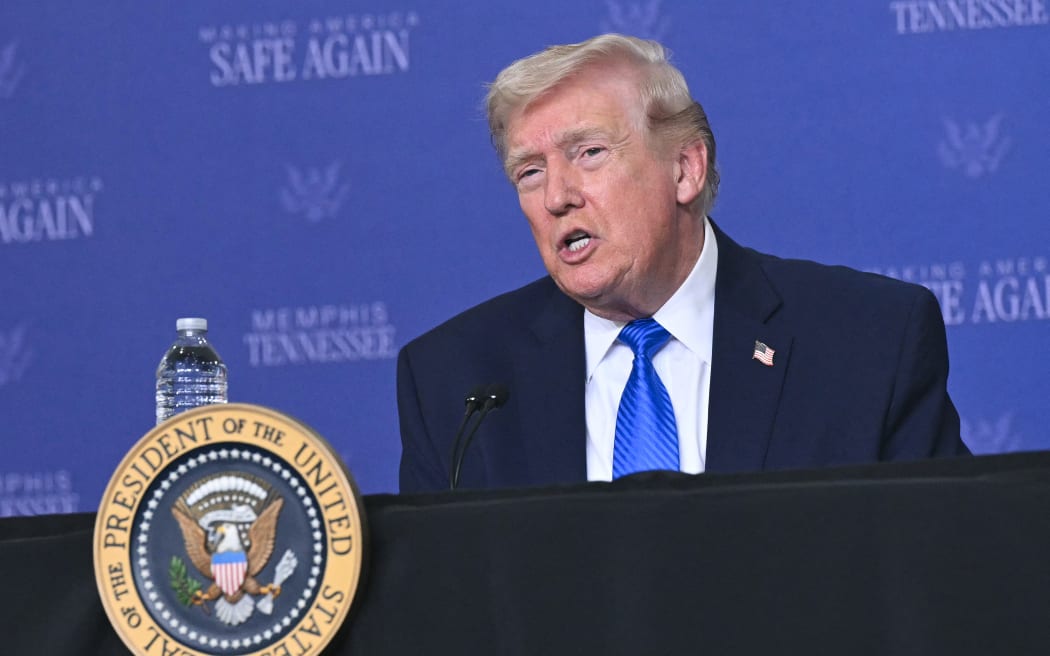
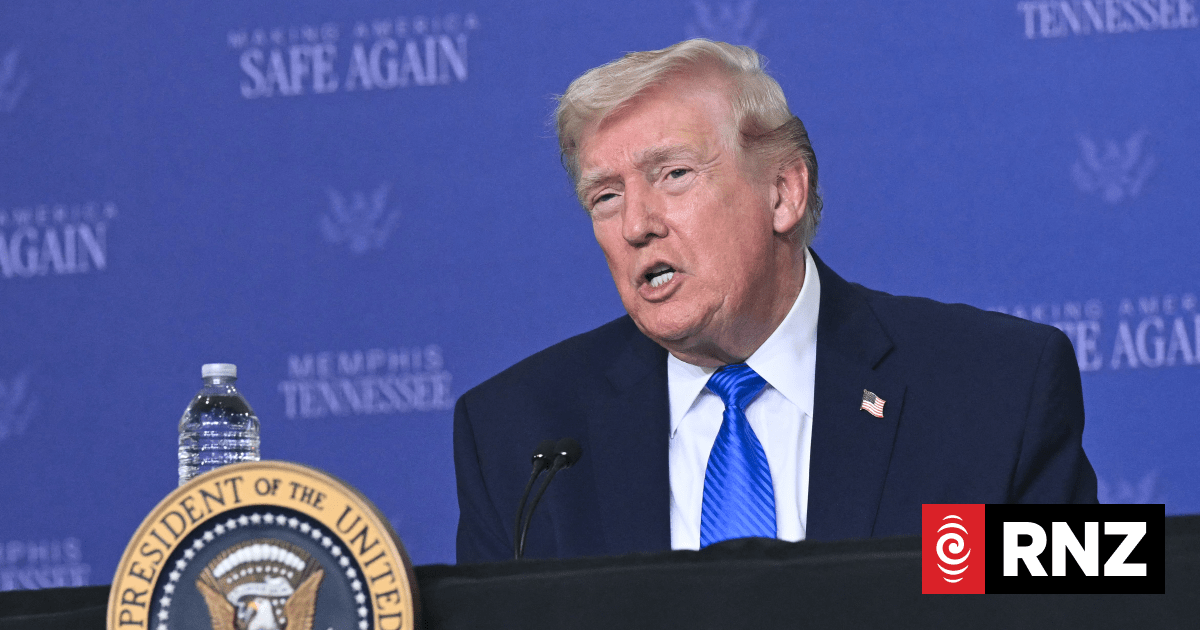
Donald Trump faces increasing pressure as Iran emerges emboldened.
Photo: AFP
Analysis – The world has moved back from the brink of an escalated war in the Middle East – for five days, at least – but one new reality has emerged: Iran appears to have realised it has a power that can be wielded against the president of the United States.
In the battle between the US and Iran, US President Donald Trump has blinked: He has given Iran an additional five days to agree to reopen the Strait of Hormuz or else the US will begin bombing Iran’s power plants and energy infrastructure.
Trump is changing his rhetoric, appearing to acknowledge that he expects the theocracy to remain in control of Iran.
After he announced he was postponing any attack on power plants, he was asked who would control the strait in future.
“Maybe me!” he replied, adding: “Me and the ayatollah, whoever the ayatollah is.”
Iran has always known it has some leverage with the Strait of Hormuz. But until this war, it had not tested just how strong that leverage was.
Likewise, the US hadn’t realised the vulnerability of this thin strip of water – a passage just more than 30 kilometres across at its narrowest point, through which about 20 percent of the world’s oil flows.
Securing the strait
In 2012, the US military permitted me to spend two days on the aircraft carrier USS John C Stennis as it patrolled in and around the Strait of Hormuz.
Its mission was clear: to make sure Iran could not close the strait.
It was obvious from talking to the captain at the time that no Iranian ship or boat had any chance of impeding oil tankers from travelling through the route.
But what was also apparent was that even the might of this huge aircraft carrier – with a capacity of 6500 officers and crew – could not prevent the Iranian military from installing various anti-ship missile systems along the Iranian coast near the strait.
No US carrier could police the strait 24 hours a day to ensure no mines were planted.
While Trump argues he is preparing a coalition of various countries to assist in ensuring free passage for ships through the strait, what he cannot guarantee is that insurance companies in Zurich, New York and London will give the approval for ships to travel through it in a time of conflict.
Even if Trump declares the strait safe, it is these insurance companies that will ultimately decide which oil tankers pass.
Iran knows, therefore, that if it creates enough doubt about safety, these insurance companies will avoid the risk and opt on the side of non-insurance, making any travel for most ships a non-starter.
The International Energy Agency’s website explains the significance of the Strait of Hormuz, saying it is “the primary export route for oil produced by Saudi Arabia, the UAE, Kuwait, Qatar, Iraq, Bahrain and Iran”.
“Apart from physically disrupting oil shipments from these countries, any prolonged disruption in the Strait of Hormuz could also render unavailable the vast majority of the world’s spare production capacity – most of which is held by Saudi Arabia,” it says.
“The bulk of the oil leaving the strait heads to Asian countries, with China, India and Japan being the main importers.”
In conventional military terms, Iran has taken a pounding from the US and Israel, and had it not been for the fact it has effectively closed the strait, it would have virtually no leverage.
In the early days of the conflict, when Trump was asked what a bad result would be, he said, for him, that would be the US carrying out a war and then Iran ending up with a leader more hardline than the former and now dead Ayatollah Ali Khamenei.
Well, Khamenei’s son, Mojtaba, is indeed seen as a more hardline leader. His father had approved negotiations with the US, including the nuclear deal done under then-president Barack Obama. This is something that his son is unlikely to ever have done.
Mojtaba Khamenei is much more a creature of the Islamic Revolutionary Guard Corps (IRGC), the hardline security machine that runs the country and is opposed to any deal with the US.
An asymmetrical war
In terms of the military battle, this is an asymmetrical war. Iran is fighting this war indirectly. First, by attacking US allies in the Gulf, Iran is hoping these countries, whose economies are taking a major hit, will put pressure on Trump to stop the war.
And second, by effectively closing the strait, they are pushing up the price of oil, and therefore petrol, around the world.
This leverage is the reason Trump is feeling pressure. The rising petrol price in the US is causing a backlash against Republicans around the country.
One-time loyal Trump supporters such as Marjorie Taylor Greene, Steve Bannon, Tucker Carlson and Megyn Kelly are arguing Trump has abandoned his America First commitments to avoid foreign wars and assist working-class Americans with lower costs.
A subtext of this MAGA backlash – said explicitly by some – is that being America First means withdrawing unconditional support for Israel.
People such as Greene argue the US should not be providing billions of dollars in support each year to a country where the average Israeli has better health care than the average American.
Trump would be a mean poker player, and if he thinks he has an edge on his opponent, he wants to do more than win. He wants to crush.
And so when he issued his 48-hour ultimatum to Iran to open the Strait of Hormuz, he thought he had a much stronger hand.
But he underestimated Iran and it stared him down.
As long as Trump is in the White House the world is in for a wild ride, and his unpredictability is being highlighted by this war.
His language alone is loose and not at all presidential. He said, for example, that if a deal to open the Strait of Hormuz is not made in the next five days, the US will “keep bombing our little hearts out”.
Even for a president who has thrown out the rule book, this sort of language demeans the severity of the actions of the US and Israel, which, while it clearly is hitting many military targets, is also killing an unknown number of civilians.
“My life is a deal,” he said. “That’s all I do is deals.”
Later, he said: “My whole life has been a negotiation.”
“I would say at the end of this period, it could end up being a very good deal for everybody.”
Trump has said that the postponement of his threat was due to discussions with Iran. Asked who the US had been speaking to, he at one point said “a representative” and at another point “a top person”.
Iran’s official state news agency Fars denies any contact.
In many conflicts there will be back channels. Trump makes a valid point when he says that any Iranian leader talking to the US at the moment may not want anyone to know.
His life could be in danger from both hardliners inside Iran, who don’t want any end to a war they see themselves as winning, or from the US and Israel, who may later list this person as someone worth “eliminating”.
Trump now says the US and Iran have “major points of agreement”.
Certainly, in the short term, these words are more reassuring than his other rhetoric, such as “bombing our little hearts out”.
The US and Israel would argue that even if the war stopped now, it has seriously degraded Iran’s military apparatus and capability. Without question, more than three weeks of bombing military and paramilitary sites has weakened the regime.
The issue of how much enriched uranium Iran may have hidden remains a live one. If the US or Israel are able to locate where this material may be, they are likely to engage in special forces operations to try to seize it.
That could happen well after this war finishes. In fact, the Iranians will probably be less alert to such an operation than they are now.
So while Iran’s military capability has been seriously weakened in the short to medium term, in the longer term, the world now faces a new problem.
Iran now knows that it has a potent new weapon on the global stage: the ability to shut the Strait of Hormuz and hold the world’s oil supplies hostage.
– ABC