
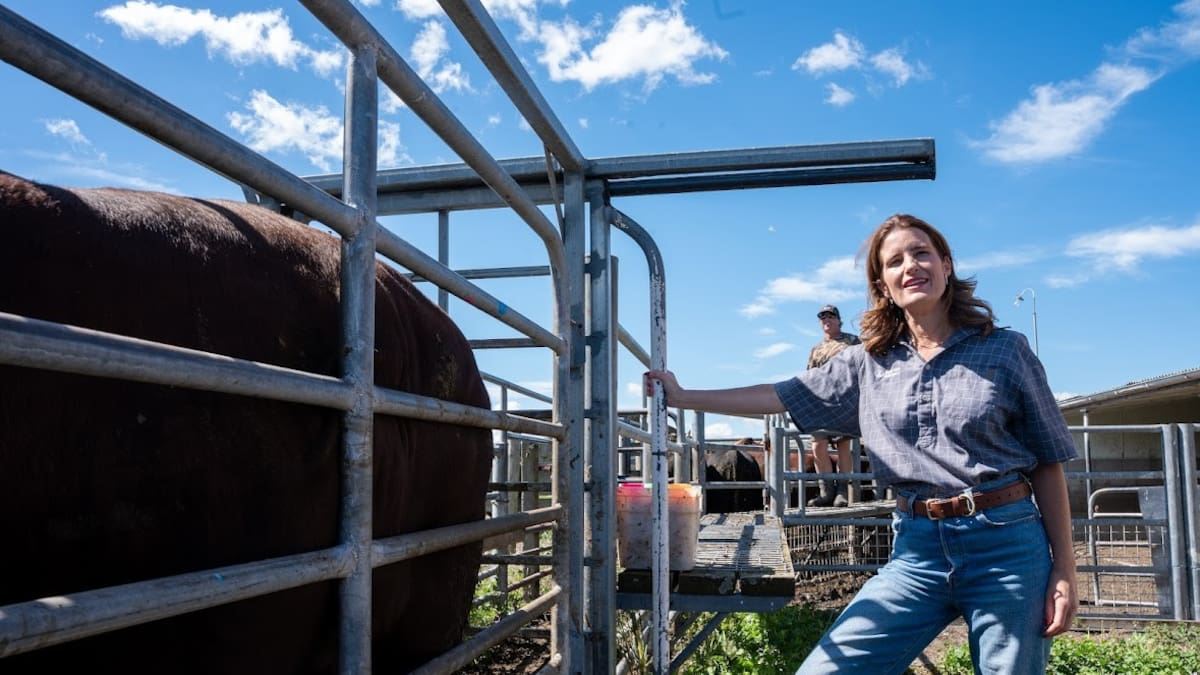
There’s very much a new sheriff in town.
And the differences don’t stop there. Willis has funded this entirely from her $2.4 billion operating allowance in this year’s Budget. That means that it’s not being funded with borrowing that wasn’t already planned (although the Government is still borrowing to fund its large deficit).
How is she doing that? Well, what it will mean is that a new initiative worth $373 million or so will need to come out of the “new” spending planned in the Budget or Willis and the Cabinet will have to look to some existing baseline spending and cut that – or some combination of those two things.
This strategy means that the payment won’t change the Government’s fiscal trajectory, although, unfortunately for Willis, the declining economic conditions almost certainly will.
There are two stories to this payment: what the payment actually is, and how the Government plans to pay for it. Both stories tell you quite a lot about how this Government is different from the last. Let’s start with the latter.
Paying for the payment from her allowance demonstrates a level of conviction both from her and the Government that its fairly tight crisis response is the right thing to do.
It means that despite razor tight polling, there’ll be no room for election-year goodies in the Budget. In fact, there’ll be even deeper cuts.
As of Budget 2025, there was only $928m left in Willis’ 2026 allowance (the rest was pre-committed to health and defence). That means that today’s announcement shredded the remainder by a third, leaving about $500m for Budget day itself.
That’s an enormous change from the Labour years, particularly during Labour’s second term, when operating allowances were $3.8b, $6.4b , and $4.8b respectively – figures that don’t include the Government’s $60b Covid fund which was managed outside the ordinary allowance system. In order to visually signal this change, the Government is deliberately avoiding announcing these measures in the Covid-cursed Beehive Theatrette.
Each year during Labour’s second term (and in the first term too), then-Finance Minister Grant Robertson increased his self-imposed allowances, allowing greater room for new spending. This was meant to be paid for by eventual economic growth lifting the tax take, dragging the books into surplus next year. Sadly, that economic growth still hasn’t arrived, meaning large portions of every Budget since 2020 have been borrowed.
Finance ministers set their own rules and, so long as Parliament continues to pass their budgets, finance ministers also have sole discretion over whether they follow those rules in light of events.
Labour tended to change these spending limits as conditions changed, responding more generously to crises but getting bogged down by a big deficit when the economy went south.
Willis has stuck rigidly to her spending limits, sending a powerful signal to the market that she means what she says when it comes to fiscal discipline, even though a declining economy has meant she is on track to miss several of her fiscal targets.
The Government has used the Covid-19 Royal Commission and a bevvy of other reports to build a case that Labour was profligate in its disaster response, blurring the line between necessary stimulus and pork-barrel electioneering. Today’s package is strong evidence that the coalition is capable of more than just criticism, but a new approach.
Labour leader Chris Hipkins did not mention beneficiaries in his press release. Photo / Mark Mitchell
Labour isn’t taking that criticism lying down.
Labour, for its part, has built a case that this Government is tight to the point of cruelty.
When the Herald asked Willis if increasing benefits in line with the now higher-than-expected inflation had been considered in the package, she didn’t wait until the question had finished before answering “no”.
The detail of what the package does and doesn’t do explains Labour’s argument. Working for Families is comprised of two main tax credits for low-to-middle income families: the Family Tax Credit, which goes to all families including those on a benefit and the In-Work Tax Credit, which only goes to families that do a minimum of 20 hours a week of work.
This much-criticised arrangement is a creature of the original mid-2000s scheme and is designed to both encourage people into work and to recognise that people who work face higher costs like transport and childcare.
The flaw, which critics of the scheme have attacked for two decades, is that many families don’t have much of a choice about whether they’re working or not, particularly not during an economic downturn. These critics argue that designing a system like this doesn’t encourage people into work as much as it tethers a family’s income to the ups and downs of the economy at large.
The other criticism is that the package only goes to people with children. Plenty of childless households also face cost-of-living pressures. That’s why the Government, more than a decade ago, invented the Independent Earner Tax Credit, a $10-a-week boost to middle-income people who worked but did not get any other income support.
The Government pointedly went against using the Family Tax Credit and the IETC to deliver income support. Had it done so, about 330,000 families would have received support via the FTC, plus an additional 725,000 individuals via the IETC – far more than the comparatively slight 150,000-odd families who will benefit from this package. That’s a large number of people to ignore in an election year. While the coalition may intuit that beneficiaries are unlikely to vote for them anyway, people on the IETC are very much in marginal voter territory. National admitted as much when it targeted them in its 2024 tax cuts.
Labour is ever so slightly wedged by the issue. There appears to be some sensitivity about highlighting the fact that beneficiaries, vulnerable to inflation shocks, will get nothing. Labour’s press release, potentially fearful of talking too much about beneficiaries, mentioned only “those who aren’t eligible for the in-work tax credit”.
One thing no one appears to have picked up on, not even Labour, is that these changes only briefly exceed what both Labour and National promised on the 2023 election campaign.
Then, Labour promised to raise the IWTC, and then lift the income threshold for the tax credit to $50,000, a change that would mean that more people got the credit and that they would keep more of the credit as their incomes rose.
National matched that policy (many observers suspected it was matched because Working for Families is notoriously difficult to calculate and National lacked the in-house expertise), but swiftly dropped the promise when it got into government.
If the change had been kept, people would get about $27 a week permanently, rather than the temporary $50 a week payment under this package. Critics of Labour’s 2023 policy argued that it didn’t go far enough because Working for Families is not completely indexed to inflation, meaning the value of the scheme has been heavily eroded over time.
This means that whenever this temporary package eventually ends, IWTC recipients will be worse off in nominal terms than National (and Labour) had promised at the election – and even worse off in real inflation-adjusted terms.
That’s the challenging thing with fiscal consolidation, and one of the reasons why ratings agencies like Fitch have some scepticism of the Government’s ability to achieve it: rebuilding the books in the interest of the future means depriving ourselves of spending in the present – and in an election year, with inflation running hot, that is very, very difficult to do.