
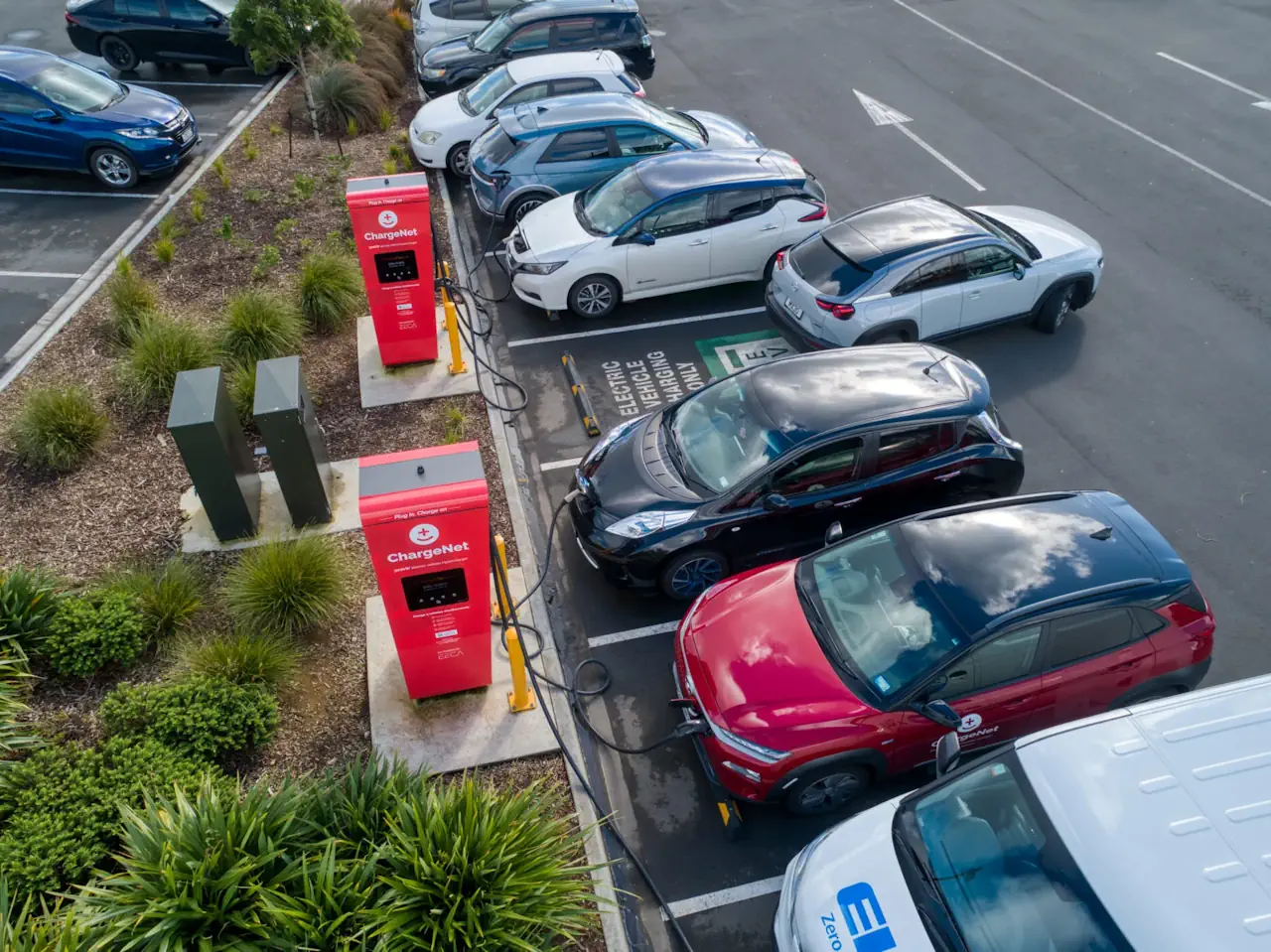
The New Zealand government has struck a co-funding deal with to key private operators to spend more than $110 million to deliver more than 2,500 additional EV chargers across the country.
The government said on Monday it will make available $NZ52.7 million in zero-interest loans, while a further $NZ60 million in investment will be split between public EV charging programs being delivered by ChargeNet, New Zealand’s leading EV charging network, and 100 per cent renewable electricity utility Meridian Energy.
The two companies are expected to install 2,574 new charge points, including 1,374 DC fast chargers and 1,200 AC chargers, effectively doubling the number of EV chargers in New Zealand.
ChargeNet has been awarded $NZ37.7 million, which it will match dollar-for-dollar, for its “PowerUp” rollout of over 1,700 new charging points, set to be rolled out across the country by 2030.
Meridian will take home $NZ15 million from the government in matched concessionary loans to fund the rollout of 900 charge points.
“Many New Zealanders have thought about getting an EV, even before the fuel challenges we’re currently facing. But research shows that the lack of public chargers is holding many back from making the switch to an EV,” said Chris Bishop, New Zealand’s transport minister.
“The private sector is reluctant to invest in charging infrastructure until there’s sufficient demand, but demand won’t grow until the lack of public chargers stops putting buyers off. Just as the previous National-led government did with the ultrafast broadband network rollout, we’re taking action to break that deadlock.”
Around half of the new chargers are set to be installed across New Zealand’s main population centres including Auckland, Hamilton, Tauranga, the Wellington region, Christchurch, and Dunedin, with the other half set to be spread throughout the regions.
“New Zealand currently has a bit over 1,800 public charge points, which is among the lowest charger-to-EV ratios in the OECD,” said Bishop.
“Another 161 charge points are also in progress. Combined with the investment being announced today, the national total will be around 4,550. The Government is working towards 10,000 charge points by 2030, roughly one for every 40 EVs.”

Joshua S. Hill is a Melbourne-based journalist who has been writing about climate change, clean technology, and electric vehicles for over 15 years. He has been reporting on electric vehicles and clean technologies for Renew Economy and The Driven since 2012. His preferred mode of transport is his feet.