
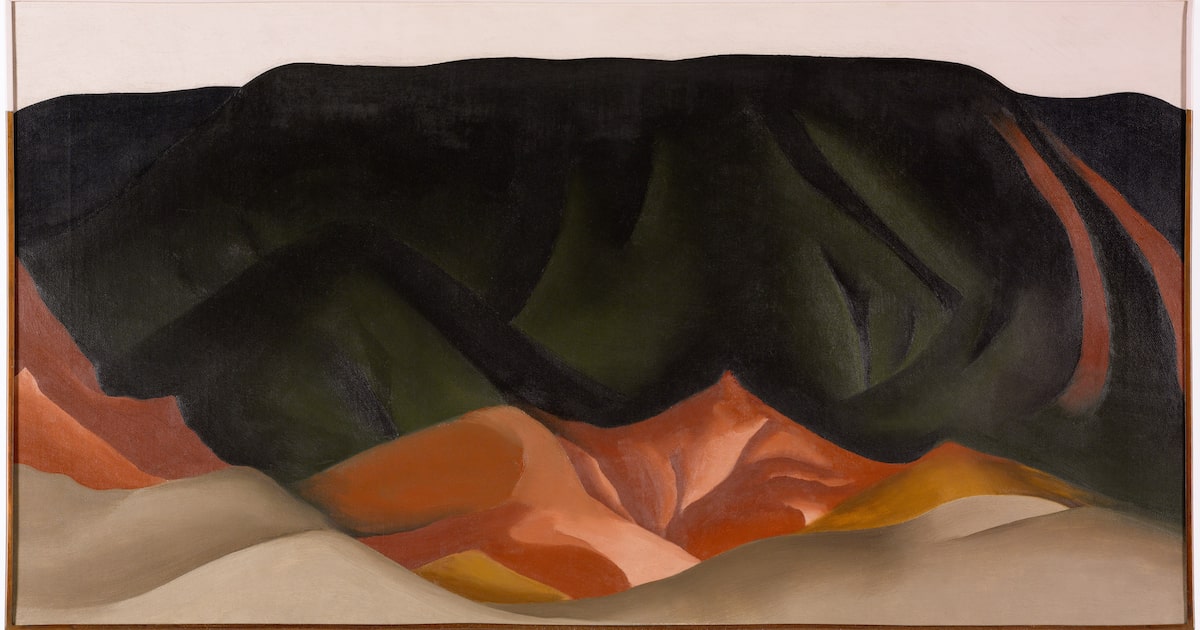
Hung side by side in the mezzanine gallery at the Amon Carter Museum of American Art, two thematically related exhibitions present a range of approaches to interpreting the rugged landscape of the American West — and the places that humans have carved out for themselves within it.
To the left as you come up the staircase, “Georgia O’Keeffe and the Carter” deftly places the world-famous painter into her context, as well as providing some absorbing background on her relationship with the museum, with which she was connected from its beginnings in the early 1960s. To the right, “New Horizons: The Western Landscape” presents an assortment of works by 10 contemporary artists, each offering its own spin on the titular topic, ranging from a full absorption in natural beauty to a preoccupation with human-made artifacts. The two shows complement each other and provide for many stimulating comparisons.
For any longtime art lover, O’Keeffe’s work, particularly her paintings of red canna lilies, is so familiar that it can be a challenge to see it afresh. So for the purpose of comparison and reference, it is helpful that the show includes paintings by some of O’Keeffe’s peers, her fellow American modernists Marsden Hartley, Arthur Dove and John Marin. All of these artists wanted to simplify their subjects into underlying forms, stripping away superficial details to reveal the core structure underneath.
This approach is clearly evident in O’Keeffe’s New Mexico paintings depicting the San Francisco de Asís Mission Church in Taos and the Black Mesa outside the San Ildefonso Pueblo. Eliminating everything unnecessary from the pictures, their central forms become solid, looming presences.
News Roundups
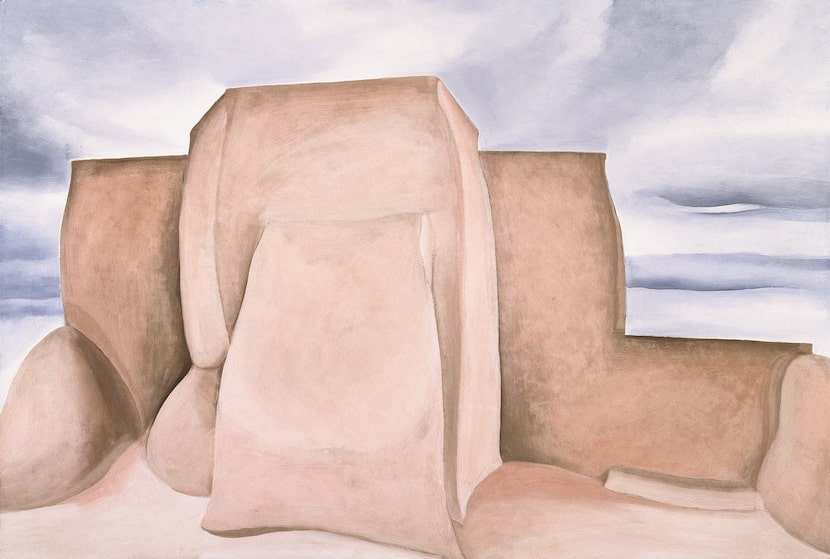
Georgia O’Keeffe’s 1930-31 oil-on-canvas painting “Ranchos Church, New Mexico” is featured in the exhibition at the Amon Carter Museum of American Art in Fort Worth.
Amon Carter Museum of American Art
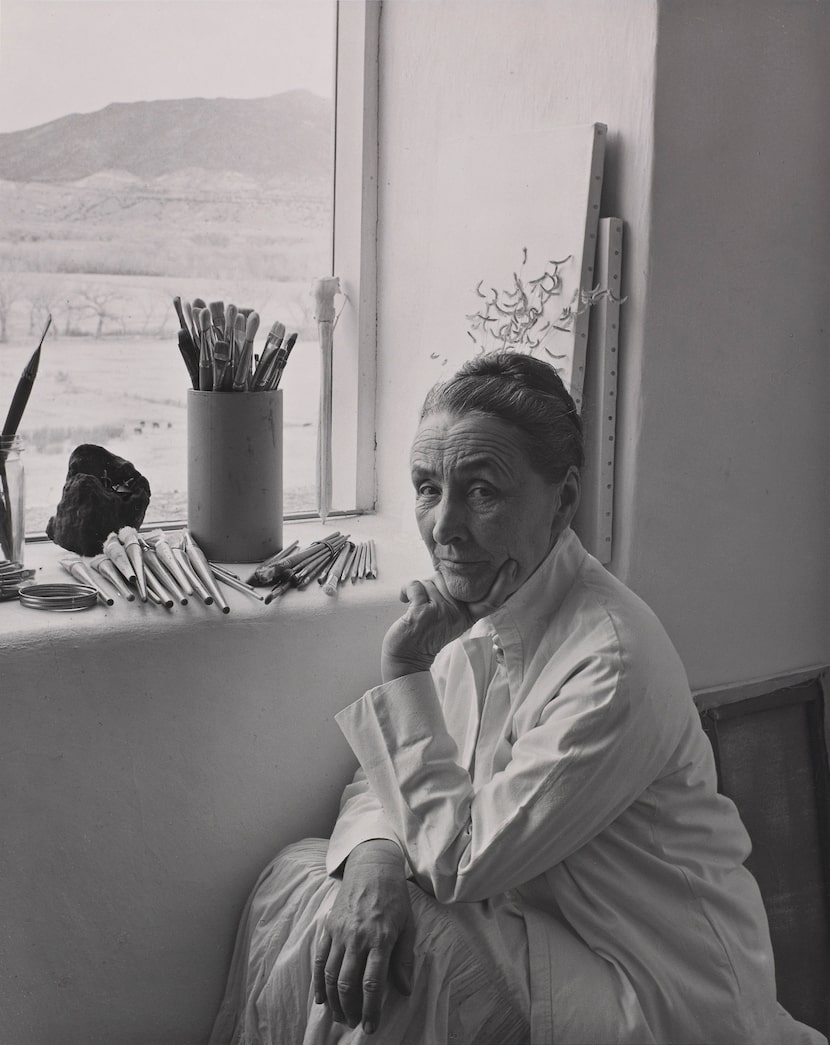
Laura Gilpin’s 1953 photo of artist Georgia O’Keeffe shows the painter in her New Mexico studio.
Amon Carter Museum of American Art
As much as her work in painting, O’Keeffe’s charismatic personality contributed to making her a celebrity in her day, and the photographs of her by Alfred Stieglitz, Laura Gilpin and Todd Webb suggest something of her public appeal: She appears serious and uncompromisingly devoted to her work.
Along with the paintings and photographs, the show presents correspondence showing the behind-the-scenes work that went into O’Keeffe’s career, planning for her home to be featured in the April 1963 issue of House Beautiful and for a major 1966 exhibition of her work orchestrated by Mitchell Wilder, the Carter’s first director, and Ruth Carter Stevenson, the museum’s founder and daughter of its namesake. “I enjoyed your visit — enjoyed drinking beer with you,” O’Keeffe wrote to Wilder during the planning process.
In contrast with O’Keeffe’s uncompromising modernism, the contemporary artists in “New Horizons” take a range of approaches, as can be seen in a comparison of works by three different Diné (Navajo) painters in the show. While Tony Abeyta and Steven Yazzie both create intense, semiabstract works reflecting the power of nature, Craig George’s thoroughly urban work is based on his upbringing in downtown Los Angeles, home to one of the largest Diné communities outside the Navajo reservation.
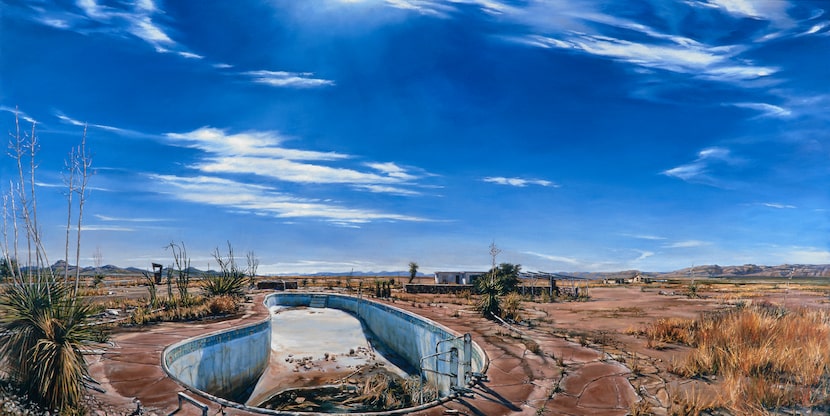
In the “New Horizons” exhibition, paintings like Don Stinson’s 2000 work “Lone Star and Pool: Lobos, Texas” suggest the power of human determination to make a home in an unforgiving environment and the limits of that determination.
Don Stinson
Other painters fall somewhere in between these two poles. Oil paintings by Don Stinson and Dean Mitchell show somewhat beleaguered man-made structures surrounded by barren desert, suggesting the power of human determination to make a home in an unforgiving environment and the limits of that determination.
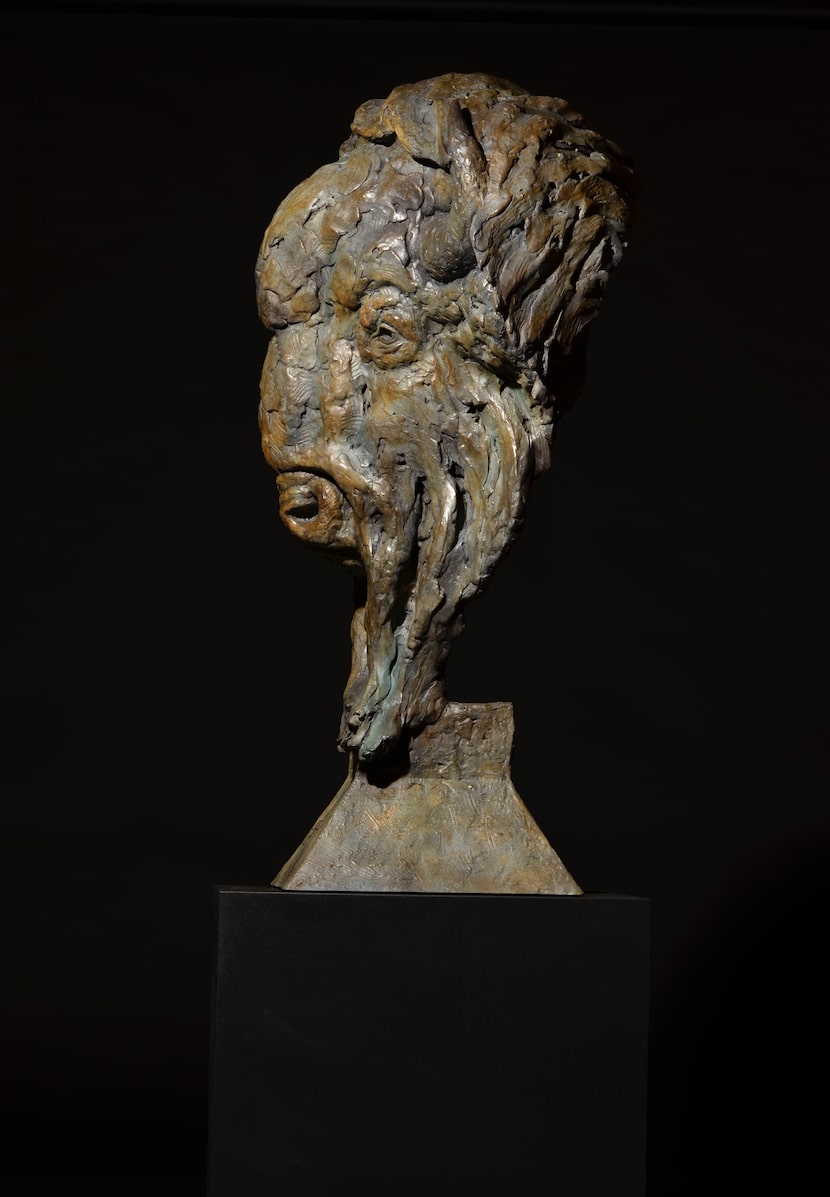
“American Icon,” a 2020 bronze bust of an American bison by sculptor Mick Doellinger, is among the exhibition’s highlights.
Mick Doellinger
In terms of art-world recognition, by far the most famous artist in “New Horizons” is Kay WalkingStick, a member of the Cherokee Nation and professor emerita at Cornell University whose work has been shown throughout the United States and abroad since the 1960s. In her landscapes, WalkingStick combines picturesque views of the Southwest with repeated American Indian geometric motifs that appear to hover in the foreground as apparitions from another level of reality. Juxtaposing real and invented forms, WalkingStick’s painting fits within the broad category of postmodernism, but it is more grounded in a specific place and culture than that of most postmodern artists.
For visitors of all ages, the exhibition’s showstopper is American Icon, a hulking bronze bust of an American bison by German-Australian-American sculptor Mick Doellinger. It placidly presides over the gallery as viewers circulate, suggesting what must have been the awe-inspiring scale of vast bison herds before the near-extinction of the species.
What stayed in my mind after leaving the gallery is the contrast between the ancient Southwestern landscape and the comparatively brief periods of human settlement in it: one or two millennia for the Navajo and Pueblo peoples, a few centuries for the Spanish and just a few decades for the Old West of the American frontier.
While the unyielding vastness of nature in this part of the world might cause some to retreat to more comfortable climates, the artists here model a different approach: an effort to come to terms with the country on a human level.
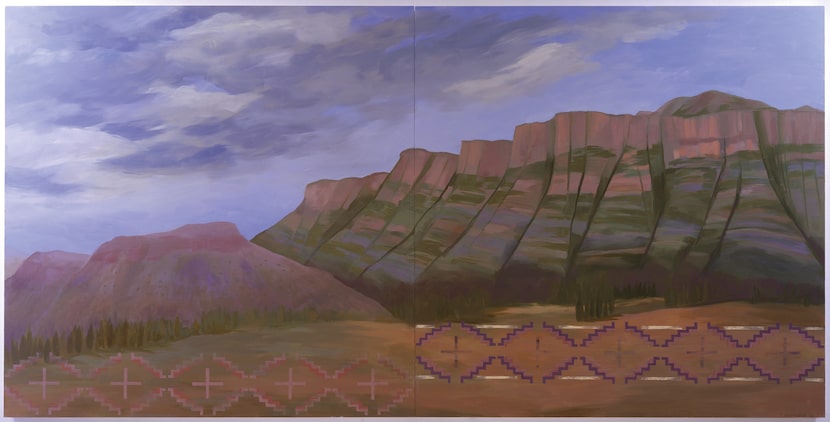
Kay WalkingStick’s 2012 oil painting “The Pecos” is featured in the “New Horizons” exhibition.
Gochman Family Collection
Details
“New Horizons: The Western Landscape” continues through May 24 and “Georgia O’Keeffe and the Carter” continues through September 2027 at the Amon Carter Museum of American Art, 3501 Camp Bowie Blvd., Fort Worth. Tuesdays through Saturdays from 10 a.m. to 5 p.m., Thursdays from 10 a.m. to 8 p.m., and Sundays from noon to 5 p.m. Free admission. Call 817-738-1933 or visit cartermuseum.org.
 Look inside Dallas’ new art-inspired fine dining restaurant
Astra Kitchen + Lounge replaces Hall Arts Hotel’s former restaurant, Ellie’s, and offers a mix of elevated American cuisine and contemporary art.
 Colorful floral displays return to NorthPark this week — for a limited time
What to know about this year’s Fleurs de Villes at the Dallas mall.