
2000 farms, 1 million collars
Speaking from Halter’s office in Colorado, founder Craig Piggott also gave the Herald a rare customer update.
He said Halter now has more than 2000 farms and ranches in its stable, and more than one million head of cattle wearing its smart collars, each of which generates monthly subscription fees – up from around 500,000 at the time of its Series D.
South America, UK push
Piggott said the new funds would go towards product development, expanding Halter’s operation in the US and Australia and entering new markets including South America, the UK and Ireland.
“We’re going to fast-track our global expansion,” Piggott said.
He sees a lot more room to grow in NZ, too, for Halter’s products, which have expanded to pasture management. AI is now heavily in the mix.
Halter is now incorporated in California (home of its largest investors over its last two rounds) but its management and R&D – and most of its 350 staff – remain in Auckland.
Piggott says staff numbers have been doubling each year. He expects that trend to continue with the latest injection of capital.
The “Series E” round is Halter’s fifth raise. That’s where the venture capital alphabet typically stops.
Is Halter starting to think about a public listing?
“We have one eye on what an IPO could look like in the future. We don’t have any timeframes,” Piggott said.
Founders Fund principal Peter Thiel. The billionaire and New Zealand citizen is best known for his early backing of Facebook, PayPal and Palantir, but has also invested in Kiwi companies including Xero and Vend during their formative years. Photo / Getty Images
The Halter founder says he talked directly with Founders Fund principal (and on-again-off-again Trump supporter) Peter Thiel directly over the Series E raise.
“It was amazing how quickly he understood the product and the industry. He’s clearly a very smart human,” Piggott said.
“And Founders Fund is one of the best VCs in the world. They back generational companies, which we get excited about like SpaceX, Airbnb, Spotify, OpenAI and Facebook. And when they back these companies, they back them with a lot of conviction.”
Asked when Halter could hit profit, Piggott said, “The priority is growth and expansion.”
First, we’ll take Morrinsville
The Auckland-based maker of smart collars for cows – designed to support a “virtual fencing” system and monitor the animals – was founded in 2016 by ex-Rocket Lab worker Craig Piggott after his boss Sir Peter Beck gave him his blessing and financial backing.
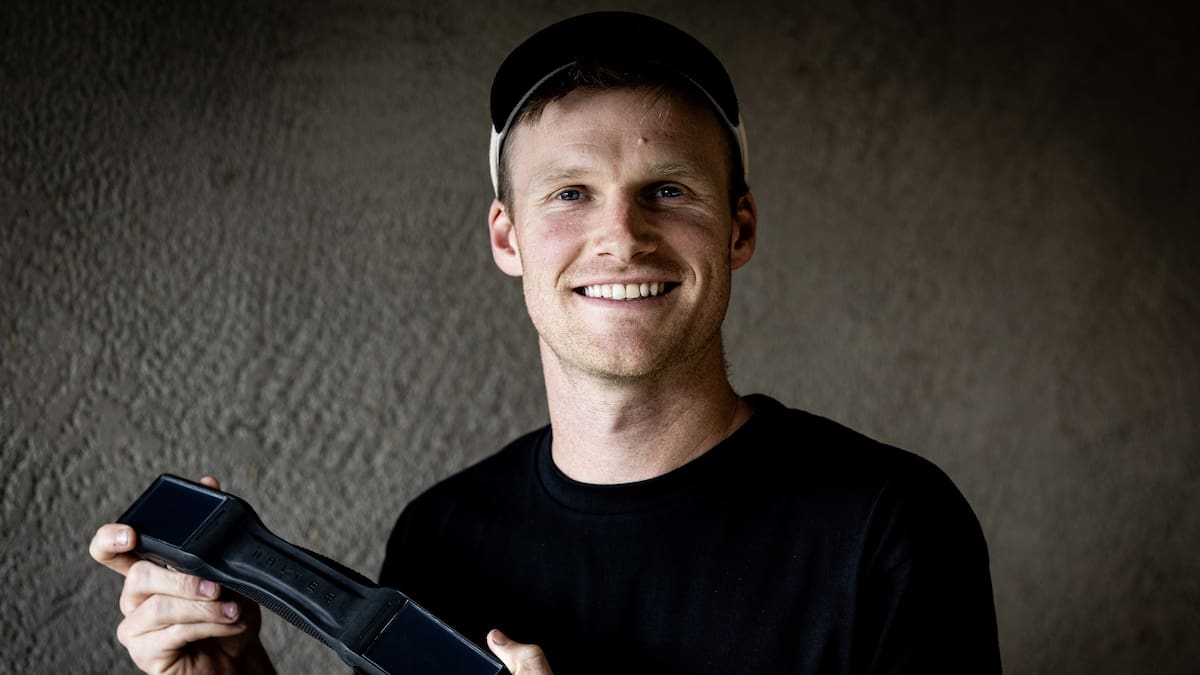
Halter founder Craig Piggott with the solar-powered Halter collar.
Other early backers included Sir Stephen Tindall’s K1W1 fund and Thiel’s Founders Fund, which both put money into a $7m Series A round in 2018.
Beck also introduced Piggott to two of Rocket Lab’s key Silicon Valley investors, Bessemer, DCVC and Promus, who all put money into Halter, too.
Piggott, the son of Waikato sharemilkers who often clocked 100-hour weeks, tested his first smart collar start-up on the small farm his parents later bought in Morrinsville.
Halter founder and chief executive Craig Piggott (left) with beef specialist Phathisa Khumalo in the R&D lab at Halter’s Auckland offices. Photo / Jason Oxenham
Halter has recently expanded into the US, where huge Texas cattle ranches are among its targets, and into Australia, where now-updated animal welfare rules in some states have previously inhibited its progress.
Craig Piggott (right) with three of his key backers (from left): David Cowan, a partner at US venture capital firm and major Rocket Lab shareholder Bessemer, mentor and investor Sir Peter Beck (also Piggott’s boss during his stint at Rocket Lab) and Bessemer partner Tess Hatch.
While Halter’s collars use electric pulses as one of their cues, Piggott says they deliver a tiny fraction of the charge of an electric fence.
Halter’s product has been approved by the AgResearch Animal Ethics Committee, among other bodies.
Tracking to pass Fonterra within 3 years
Halter has not published global financials, and Piggott told Herald NOW Business that its NZ subsidiary financials, which showed the firm breaking even on a drop in revenue from $89m to $71m for the 2025 financial year “are really hard to unpick given intercompany transfers and whatnot, but obviously you don’t do rounds like this withotu the business being in a really healthy spot.”
“At the pace they’re growing, it will take Halter 11 quarters to be worth more than Fonterra,” Icehouse Ventures’ Paul said.
“It’s a great testament to the impact tech can have on New Zealand.”
4x return
Icehouse Ventures, one of Halter’s earliest backers, has put progressively more money into the smart-cow firm over multiple rounds – from the $100,000 it chipped in to Halter’s seed round to follow-ups of $500,000, $1m, $4m, $10m, $20m and larger investments.
“We’ve invested $105m to date,” Paul told the Herald this morning.
His firm’s stake in Halter currently has a holding value of $409m.
The huge gains have made Halter the fund’s top-performing investment. That made it Icehouse’s largest investment by a factor of three.
“Halter is worth as much as our next 10 largest investments combined.”
Icehouse’s top 10 investments include its minority stakes in Crimson, Tracksuit, Dawn Aerospace, Partly, Hnry, Sharesies and OpenStar.
Paul wouldn’t comment on the Bloomberg report or Halter’s possible private equity valuation for its next raise.
Thiel, the first outside investor in Facebook and a co-founder of the hugely successful and controversial data-mining and “spook” software firm Palantir – shares in which have tripled in value over the past year as its market cap has hit US$360b – has been a New Zealand citizen since 2011.
Thiel has invested in multiple local start-ups and has bought land in Queenstown.
The billionaire has rarely been sighted in New Zealand and has recently been winding down local investments, but Founders Fund partner Scott Nolan has made annual visits to New Zealand and is well known in the local start-up and venture capital communities.
Innovator of the Year
Piggott was named Innovator of the Year at the 2026 Kiwibank New Zealander of the Year awards on Thursday.
READ MORE: Could Raglan start-up be the next Halter?
With his privately held firm now incorporated in the US, his holdings are not public. By the time of a Series D round, dilution has usually whittled a founder’s stake down to between 10-20%, but it can vary by company.
Chris Keall is an Auckland-based member of the Herald’s business team. He joined the Herald in 2018 and is the technology editor and a senior business writer.