
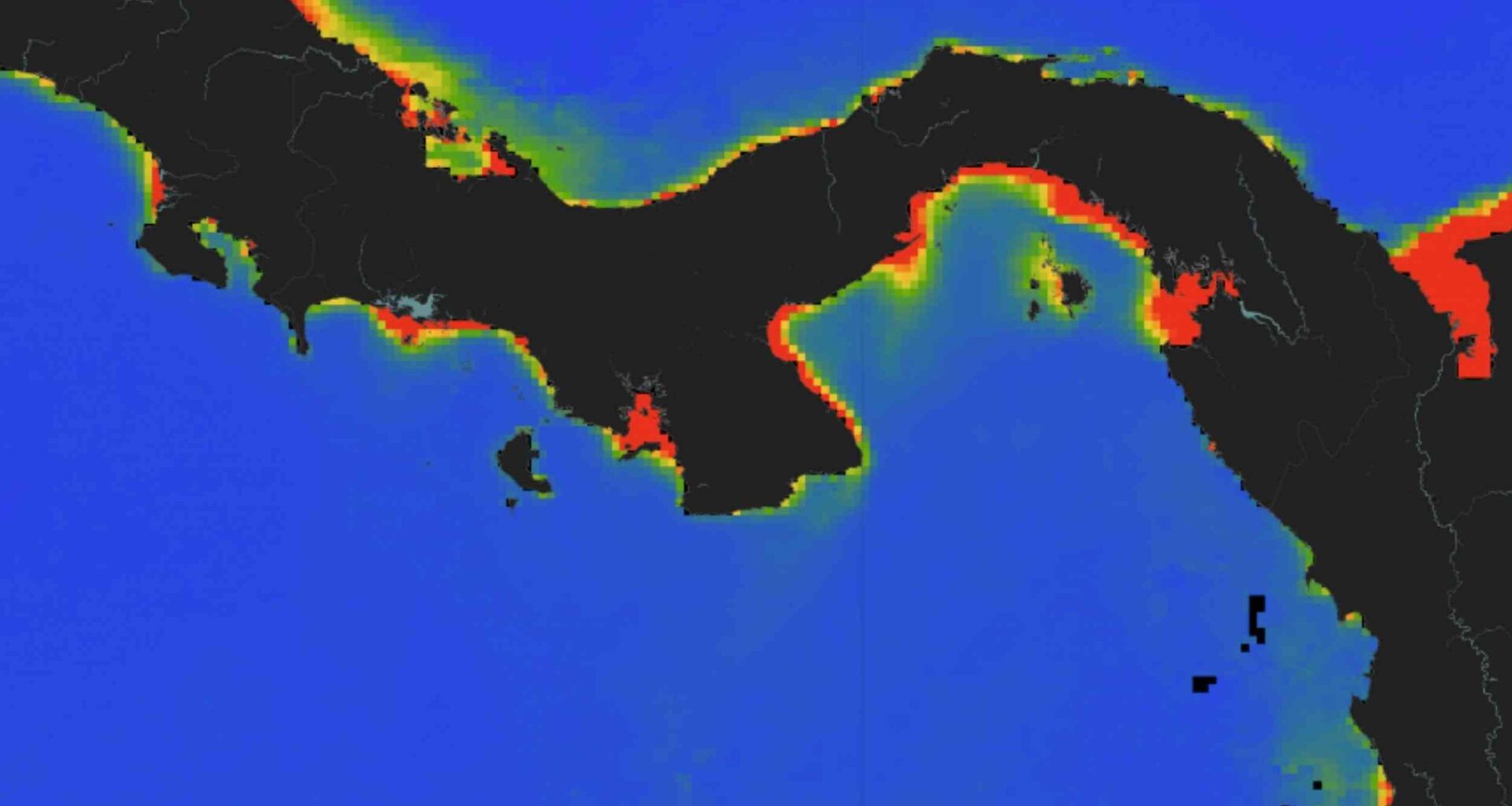
Researchers have documented that the Gulf of Panama’s seasonal upwelling failed in 2025 for the first time in at least 40 years, breaking a long-standing ocean pattern.
That absence removed a critical seasonal cooling and nutrient pulse, leaving marine ecosystems exposed during a period they have reliably depended on.

That missing surge removed a seasonal food boost and left reefs in warmer water for longer.
Where records broke
Along Panama’s Pacific coast, waters that typically cool each dry season remained unusually warm instead.
Analyzing long-term observations, Aaron O’Dea documented that the expected drop in temperature and surge in productivity did not occur in 2025.
Across four decades, this seasonal shift had arrived predictably each year, making its complete absence in 2025 a clear break from the historical pattern.
That disruption points to a change in the forces that drive this cycle, raising the need to examine what failed and why.
How the cycle works
Each dry season, strong northerly winds push surface water offshore, and that opening lets colder deep water rise.
Scientists call that rise upwelling, when deep ocean water reaches the surface and brings nutrients with it.
Those nutrients feed phytoplankton, tiny drifting plants that feed the sea, and the bloom spreads energy through the food web.
Because that process also cools nearshore water, fish and corals usually enter Panama’s dry months with extra help.
What the ocean showed
History made the anomaly easy to spot, because the seasonal drop had arrived by January 20 in every earlier year.
In 2025, the ocean did not cool until March 4, more than six weeks later than usual.
The cooler period lasted only 12 days instead of about two months, and the water never reached the colder temperatures seen in past years.
Profiles through the water column showed layered warmth instead of the usual cold rise, leaving little doubt that something broke.
Why the winds failed
Wind strength was not the main surprise, because the bursts that did arrive were close to normal.
Frequency crashed instead, with north-blowing winds occurring 74 percent less often across the season overall.
Lulls between winds also lasted longer, cutting the total push on surface water even when individual gusts stayed strong.
Once that repeated force weakened, cold water stopped reaching the surface, which helps explain the missing season.
Why reefs worry
Coral reefs lost a yearly cooling buffer when the annual supply of deep cold water failed to arrive.
Earlier work on Panamanian reefs found that seasonal cooling helped many corals escape the worst heat during El Nino.
Without that relief, thermal stress, heat that pushes corals beyond normal limits, can build faster and last longer.
A single warm season will not erase a reef, but repeated years like this could make bleaching harder to avoid.
Why 2025 differed
A weak La Nina was in place, but the gulf had endured stronger swings before without losing its yearly cooling.
That contrast suggests this was not a simple rerun of a familiar Pacific climate cycle.
“Panama’s 2025 upwelling failure underscores that regional-scale dynamics, rather than blanket global predictions, are essential for understanding these tropical upwelling systems,” wrote O’Dea.
Local monitoring becomes crucial, because broad climate labels alone cannot tell coastal communities what their next dry season will bring.
Human stakes ashore
Life along Panama’s Pacific shore has been tied to these productive waters for far longer than modern records.
A 2025 review of the southern Central American Pacific coast describes a deep human history built around marine resources.
When cold water fails to rise, the first effects reach plankton and small fish that support bigger catches.
That means families who sell or eat coastal fish can feel the damage before any long-term trend is formally measured.
Thin monitoring network
Many tropical upwelling zones stay poorly watched, which means a failure like this could pass without clear proof.
Panama stood out because STRI scientists had satellite data back to 1985 and direct temperature logs reaching to 1995.
Measurements from the S/Y Eugen Seibold, a sailing research vessel used to study ocean conditions, showed warm water stacked in layers where cold water would normally rise.
Because records this long are rare across the tropics, scientists may be undercounting how often vital ocean rhythms fail.
What comes next
Researchers now need to learn whether 2025 was a one-off shock or the first sign of a changing pattern.
A public monitoring page shows the STRI team closely tracking the 2026 season week by week.
Early 2026 updates reported strong cooling again, a reminder that one failed year does not prove permanent collapse.
Even so, better forecasts and denser monitoring will matter, because fishing towns cannot plan around a vanished season.
What it means
Panama’s missing cooling showed how quickly a familiar ocean system can falter when the winds that drive it stop repeating.
For a coast where food, reefs, and livelihoods depend on seasonal timing, that lesson is immediate, not theoretical.
The study is published in Proceedings of the National Academy of Sciences.
—–
Like what you read? Subscribe to our newsletter for engaging articles, exclusive content, and the latest updates.
Check us out on EarthSnap, a free app brought to you by Eric Ralls and Earth.com.
—–