
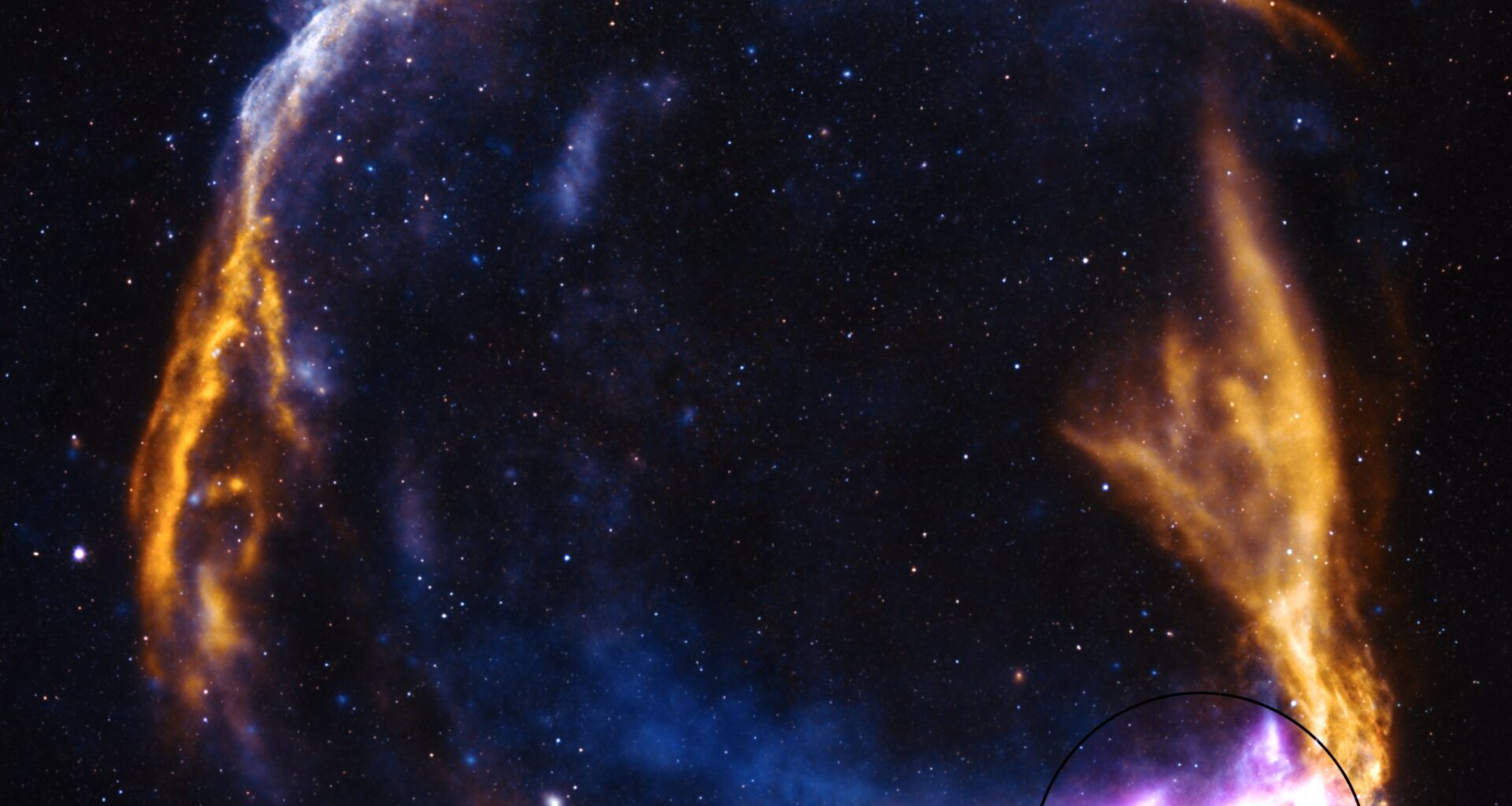
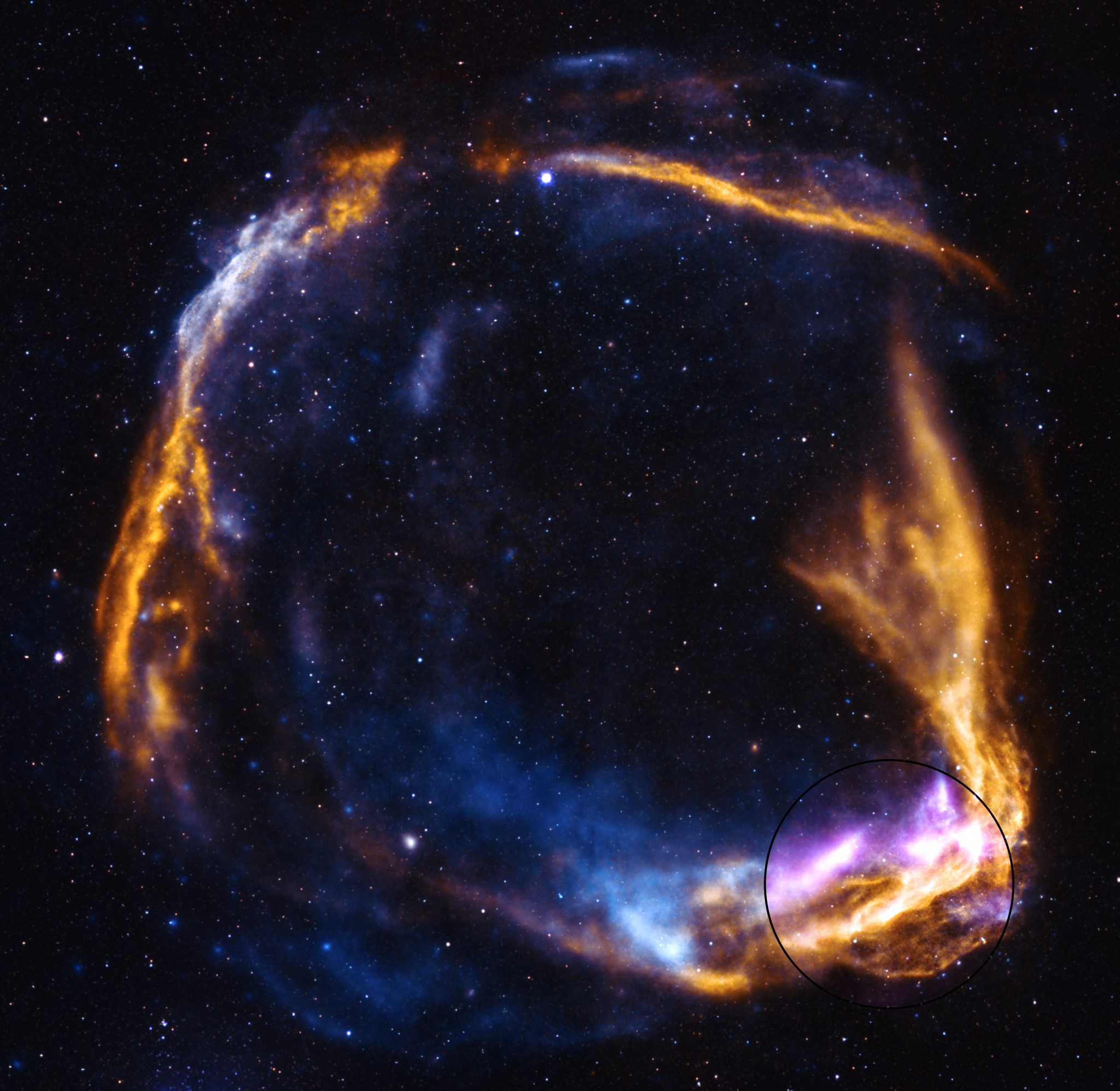
NASA’s IXPE observed the outer rim of the supernova remnant highlighted in purple in the inset. Data from IXPE is combined with data from NASA’s Chandra X-ray Observatory and ESA’s XMM-Newton. The yellow represents low-energy X-rays, while blue shows high-energy X-rays detected by Chandra and XMM-Newton. The starfield in the image comes from the National Science Foundation’s National Optical-Infrared Astronomy Research Laboratory (NOILab).
NASA/ X-ray: Chandra: NASA/CXC/SAO, XMM: ESA/XMM-NEWTON, IXPE: NASA/MSFC; Optical: NSF/NOIRLab; Image Processing: NASA/CXC/SAO/J.
NASA’s IXPE (Imaging X-ray Polarimetry Explorer) mission has taken a new observation of a supernova, RCW 86, helping fill in a fuller picture of what other telescopes have observed.
When astronomers using NASA’s Chandra X-ray Observatory previously targeted RCW 86, they discovered that a large “cavity” region around the system led the supernova to expand more rapidly than expected. The low-density cavity region could have led to RCW 86’s unique shape as well. Now, IXPE has observed the outer rim of this supernova, where its expansion is suspected to have halted at the edge of the “cavity,” creating the reflected shock effect highlighted in purple.
The full image combines IXPE’s data with legacy observations from two other X-ray telescopes: NASA’s Chandra and the ESA (European Space Agency) XMM-Newton telescope. The yellow represents low-energy X-rays, while blue shows high-energy X-rays detected by Chandra and XMM-Newton. The starfield in the image comes from the National Science Foundation’s National Optical-Infrared Astronomy Research Laboratory (NOIRLab).
More about IXPE
/Public Release. This material from the originating organization/author(s) might be of the point-in-time nature, and edited for clarity, style and length. Mirage.News does not take institutional positions or sides, and all views, positions, and conclusions expressed herein are solely those of the author(s).View in full here.