
That sentence needed reading twice. A rating downgrade would have been a real shock … a downgrade to the outlook is unwelcome but not nearly as bad.
Fitch maintained our AA+ rating but was effectively saying that we are on thin ice.
The negative outlook is a concern because it implies any further deterioration of our debt position could result in a full downgrade.
Credit ratings matter because the worse they are, the more of a risk a country is deemed to be for lenders.
Higher risk means a higher cost of borrowing, which can further compound a debt problem.
In some cases, for some countries, this can become a downward spiral. Rising interest costs make it harder to pay debt, which means further rating downgrades and so on … until the debt becomes unmanageable and the country is forced to default.
Just google “debt spiral” and “Greece” for a textbook example.
That’s a situation New Zealand very much wants to avoid.
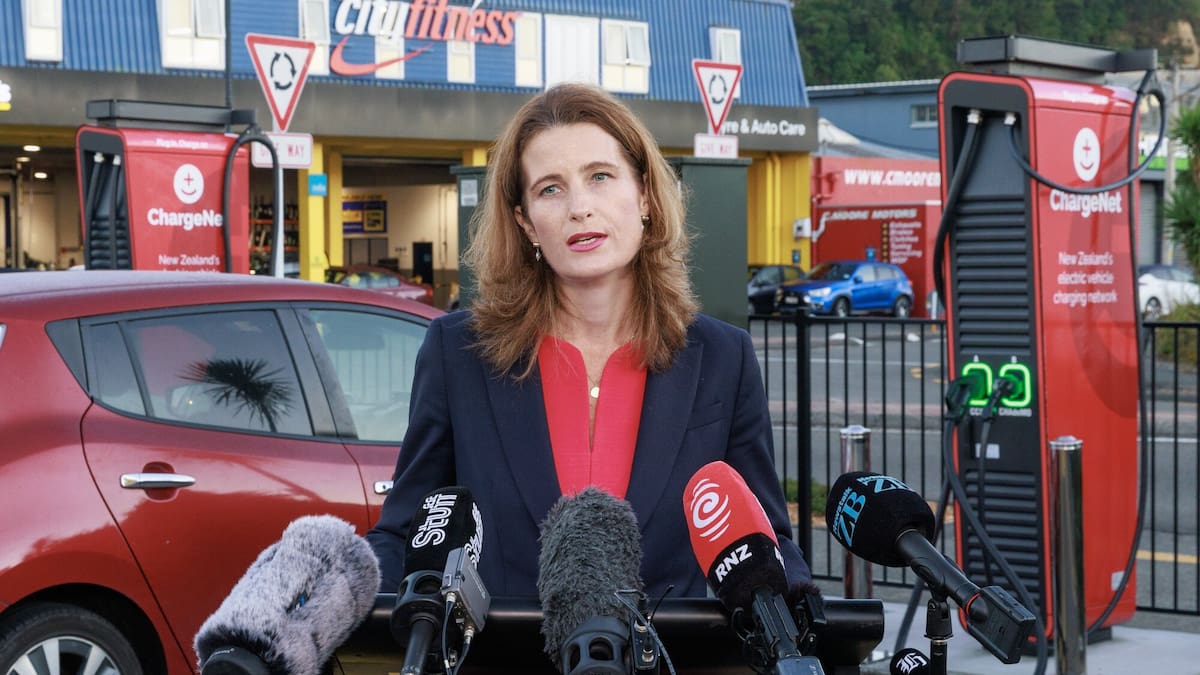
Finance Minister Nicola Willis is well aware of this and has referred to the importance of New Zealand’s credit rating as a defence for running a conservative fiscal policy.
The trouble is, Fitch clearly doesn’t see it as conservative enough.
“A substantial debt reduction is becoming more difficult to envisage, as fiscal consolidation has been delayed in the past few years,” Fitch said.
“The general government debt-GDP ratio has increased substantially over the past six years as the economy has been buffeted by a number of shocks.”
Fitch noted that government debt would rise to 56% of gross domestic product (GDP) in the fiscal year ending June 2027, and only return to 2025 levels by the end of the decade.
This outlook is now substantially worse than when Fitch last upgraded our rating in 2022 – at that time, it forecast debt to reach 36.1% of GDP in fiscal 2027.
The warning really puts the spotlight on our fiscal position at a time when there are demands for the Government to go further with cost-of-living support.
Limited options
Yesterday’s support package was probably the bare minimum that the Government could get away with politically.
But it still puts a squeeze on the May Budget.
Willis said yesterday that the policy represented a one-off $373 million cost (if it runs for the full year and less if it does not).
The cost will count against the Government’s operating allowance, so it has already been factored into Treasury’s fiscal forecast.
“Funding the policy this way will not add to forecast debt or inflationary pressures,” she said.
That means that it won’t add to the debt forecasts that are already worrying Fitch.
However, it does technically involve borrowing, which the Government had already allowed for.
That might have been spent in other areas, like infrastructure upgrades or social policy.
In other words, it will form part of the $2.4 billion of new operational expenditure the Government has already pencilled in for Budget 2026.
Borrowing costs
The Iran war has rattled financial markets. Oil futures and equities are understandably getting most of the attention, but the heightened risk is also pushing up wholesale borrowing rates.
The benchmark two-year swap rate for New Zealand banks has crept steadily up since the war began – from 2.95% on Friday, February 27 to 3.67% yesterday morning.
So, regardless of what the Reserve Bank (RBNZ) does with the Official Cash Rate (OCR), that is already pushing up retail mortgage rates.
Yesterday, KiwiBank lifted its one-, three- and four-year rates by 10 basis points.
Last week, Westpac, BNZ and ANZ increased their longer-term mortgage rates.
Also, as of yesterday morning, financial markets were pricing 20% odds on an OCR hike in April and had a hike by July as a 100% certainty.
That seemed quite unrealistic given central banks are allowed to look through short-term shocks, and the economy still technically has spare capacity.
New RBNZ Governor Anna Breman came to the rescue yesterday with a speech that pushed back on overly apocalyptic market expectations.
Reserve Bank Governor Anna Breman speaks about the impact of the Iran war has on the New Zealand economy. Photo / Dean Purcell
“We should try to avoid reacting too early to near-term inflation pressures that monetary policy can do little about – or reacting too late if above-target inflation becomes embedded in the economy,” Breman said.
That saw swap rates fall by about 10 basis points and trimmed rate-hike odds. For how long, who knows?
But Breman got the thumbs-up from local economists, who were also bothered by the financial market pricing.
“One thing is certain, the RBNZ will hold the OCR in two weeks’ time. That doesn’t sound like news, but tell that to wholesale rates implying nearly four rate hikes this year,” KiwiBank chief economist Jarrod Kerr said.
Breman’s comments threw water over these heated views, causing swap rates to fall immediately following her speech being published.
To their credit, the RBNZ, Treasury, the Ministry of Business, Innovation and Employment and other agencies were reaching out to banks and businesses to gather insight, Kerr said.
“It’s not often we see such communication, and it reminds us of the Covid period. It’s serious,” he said.
“Given the information they have collated, the RBNZ expects higher inflation (obviously) and weaker growth (both offshore and onshore) from here.”
Deficit dilemma
Q: I opened my mailbox and skimmed a StatsNZ release. Bad news, we spent more money than we made in February. We exported $6.6 billion worth of goods, and we imported $6.9b of goods – meaning we had a monthly trade deficit of $257 million.
Keeping up with the news, I have a feeling New Zealand, most of Europe and the United States all run a trade deficit. This does not compute with my brain. As a human being, I think of the world through human eyes. And if I spend more than I make every month, I’ll go broke.
That doesn’t seem to happen with countries. Is it because they have central banks that can print money? But splitting a dollar into 100 cents doesn’t make more money … What’s going on here? Are we screwed?
Jack M.
Hi Jack,
It does seem like the whole world is in deficit. But there are some major nations that run big surpluses.
Top of the list is China, which ran a record surplus of US$1.2 trillion ($2.05t) last year.
Germany, Ireland and Switzerland also run sizeable surpluses as well as the oil-producing nations like Saudi Arabia, Russia and Norway.
Interestingly, though, the total of trade surpluses and deficits around the world doesn’t actually balance out as it should in theory.
So you are right, the world does have a weird mystery deficit (of several billion dollars) in its overall trade balance.
The gap (known as the global current account discrepancy) is monitored by the IMF, which offers these reasons for it:
As to the reason New Zealand doesn’t go broke (even though you probably would) it is important to look at the current account (which includes trade in goods, services and income flows) in context with the capital account (which includes investment flows, borrowing, and asset purchases).
These are the major components of what we call the Balance of Payments.
The current account and capital account do have to balance, so if you run a current account deficit, you run a capital account surplus by definition.
That surplus will consist of international investment, asset purchases and debt.
So we basically get away with our deficit because we still have a good credit rating (see Fitch warning above).
GDP revisited
Last week’s GDP figure – a disappointing 0.2% growth for the December quarter – was not what we wanted to see as we head into a new crisis.
A few readers noted that I forgot to highlight per capita GDP in my news coverage, something many see as a better indicator of economic performance.
That’s a fair cop.
The importance of per capita GDP came to the fore during the post-Covid immigration boom.
When the population grows rapidly, it can flatten the topline GDP rate when, in fact, as you say, we are not seeing growth on an individual level.
But the net migration rate has dropped dramatically in the past two years as large numbers of Kiwis have departed and fewer migrants have arrived.
The annual rate briefly dropped to a gain of just 10,000, although it has bounced back to about 20,000.
The upshot was that per capita GDP was actually flat in the fourth quarter ie 0% growth.
The four quarters of 2025 produced +0.5%, −1.1%, +0.9%, and 0.0% per capita growth.
That gives us an average of 0.3% per capita growth for the full year, which (as Westpac noted) is the first full year of per capita GDP growth since 2022.
You’ve got to say it is looking pretty marginal though, and with net migration numbers rising and growth expected to stay slow, we might be back into negative territory again soon.
Bring back green shoots, I say …
Liam Dann is business editor-at-large for the New Zealand Herald. He is a senior writer and columnist, and also presents and produces videos and podcasts. He joined the Herald in 2003.
To sign up to his weekly newsletter, click on your user profile at nzherald.co.nz and select “My newsletters”. For a step-by-step guide, click here. If you have a burning question about the quirks or intricacies of economics send it to liam.dann@nzherald.co.nz or leave a message in the comments section.
Tags:
- about
- back
- bank
- burning
- Business
- Click
- comments
- debt
- deeper
- dive
- economic
- Economics
- Economy
- every
- Fitch
- governor
- have
- here
- inside
- into
- intricacies
- leave
- leftfield
- liamdannnzheraldconz
- market
- message
- missed
- more
- New Zealand
- News
- newsletter
- NewZealand
- nicola
- NZ
- on
- panic
- pressure
- pushes
- puts
- question
- quirks
- reserve
- section
- send
- sign
- some
- take
- warning
- week
- weekly
- welcome
- willis