
The amount of nanoplastics in drinking water in the U.S. has been wildly underestimated. That’s according to a new study that found the amount of plastic in both tap and bottled water was 10-100 times higher than previous estimates.
For the new study, researchers used more advanced methodology and found more plastic. “It is like the difference between looking at the stars with and without a telescope,” lead author Megan Jamison Hart, an environmental science researcher at The Ohio State University, and her adviser, John Lenhart, an environmental engineering professor at the same institution, told Mongabay by email.
“Like the stars, plastics are there either way, but the analytical technique we used let us see a lot more than what previous studies have been able to quantify, similar to seeing more stars with a telescope,” they added.
They also found that concentrations of nanoplastics — particles smaller than a micron, or one-thousandth of a millimeter — were three times higher in bottled water than tap. Overall concentrations of micro and nano plastics (MNPs) were twice as high in bottled water compared with treated tap water.
While microplastics in water have been extensively studied, research on nanoplastics is much more challenging and still poorly understood.
To analyze the drinking water, the researchers used a technique called optical photothermal infrared spectroscopy to determine the chemical composition of particles smaller than 500 nanometers, or 0.0005 millimeters, roughly the size of a large virus.
Then, paired with scanning electron microscopy, which uses a focused beam of electrons instead of light to image samples in extremely high detail, they were able to determine the size, shape and number of particles smaller than 300 nanometers.
“The results suggest that previous studies have underestimated the [micro and nanoplastic] particle concentrations in both treated tap and bottled water,” Jamison added. Nanoplastics “accounted for over 50% of the detected particles in both sample types.”
Little is known about the health impacts of tiny bits of plastic in drinking water, and it’s hard to study since the particles have become ubiquitous throughout our ecosystems and bodies. Plastic particles have been detected everywhere scientists have looked for them — in brain tissue, bone marrow, lungs, placentas, breast milk, liver, testes and blood.
Some studies have also associated the presence of plastic with colon and lung cancer as well as cardiovascular disease and hormone interference.
“While we don’t really fully understand the human health risks associated with nanoplastic exposure, it’s still better to try and mitigate that risk because evidence indicates that they do cause problems, even if we’re not fully aware of what those are yet,” Hart said in a statement.
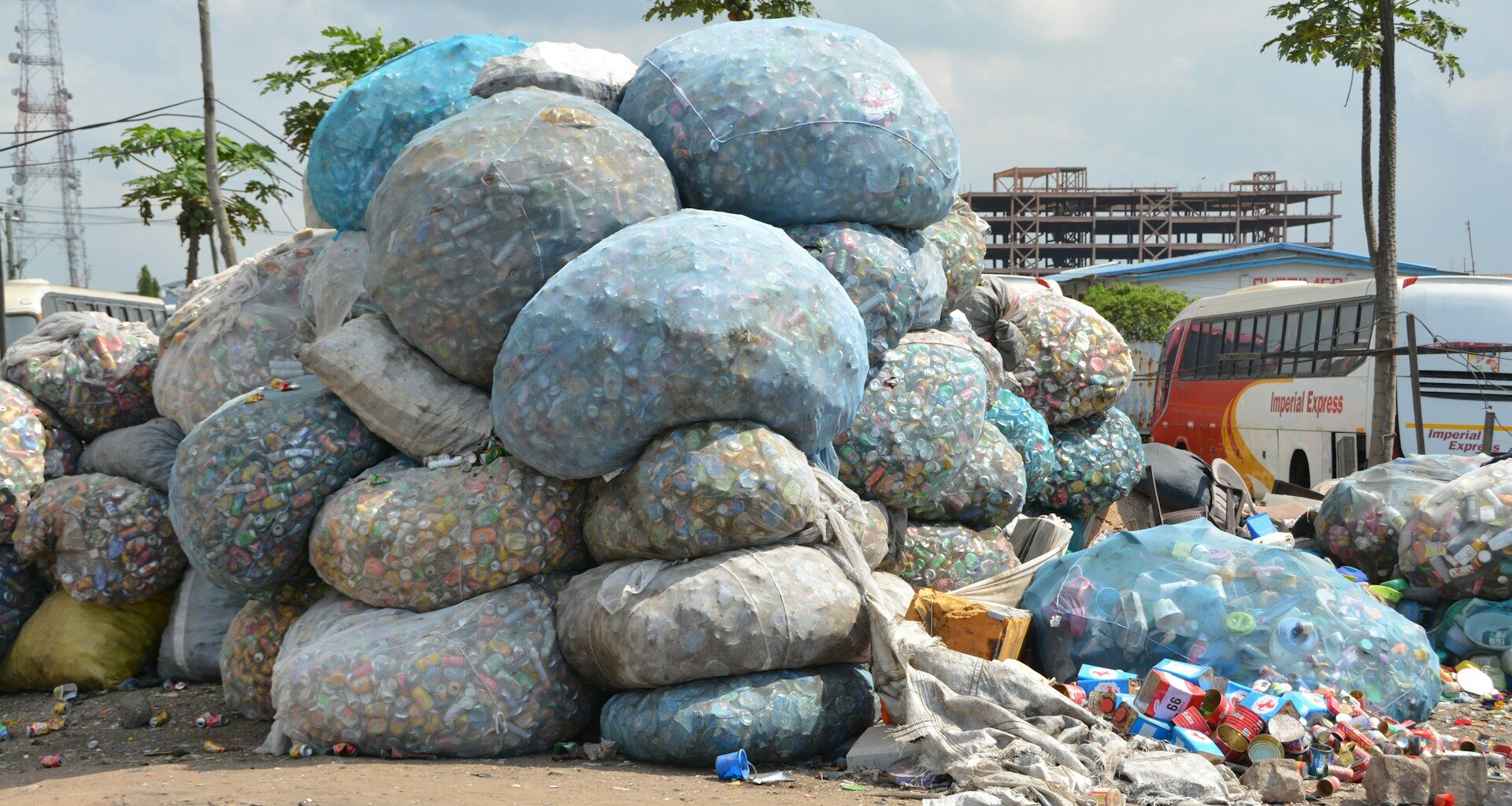
Banner image: Trash bags full of discarded plastic. Image by Adil Edin via Unsplash (Public domain).
