
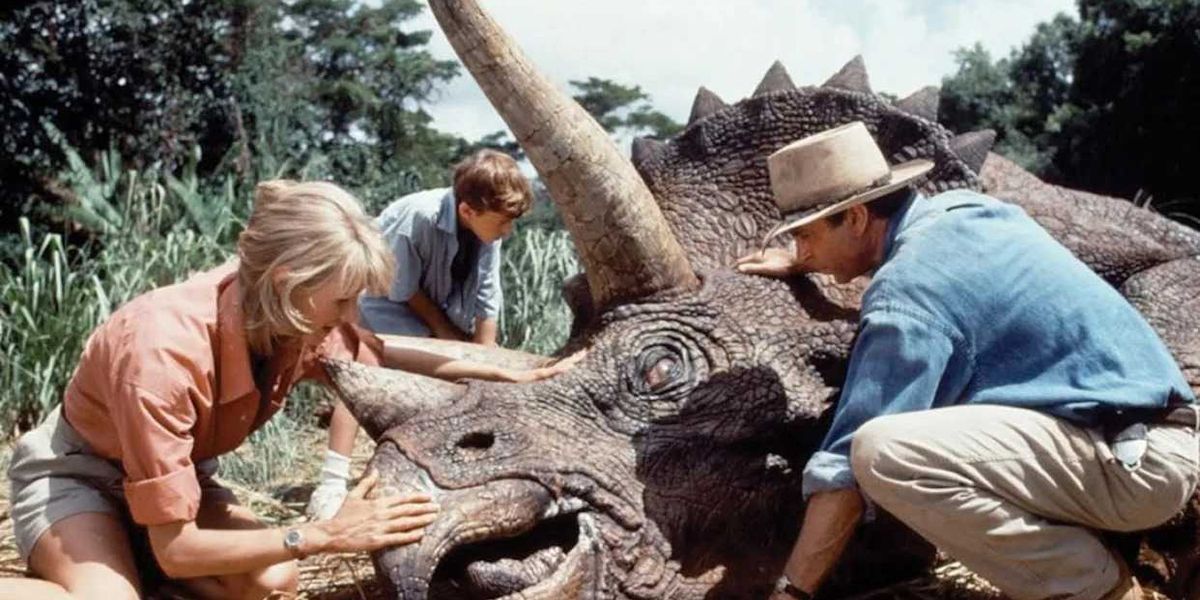
Rick Carter, Jurassic Park’s production designer, said, “I remember the first time we all saw [Jurassic Park] with an audience. It was so much fun to just go … to sit in the front row and just look at people.”
And as a filmmaker, I don’t think I’ve ever related to anything more. Isn’t that why we want to become filmmakers? At least, my dangling carrot is that.
Truth be told, I’m jealous (in a good way) of filmmakers such as Steven Spielberg who dare to dream bigger than what’s possible, technicians such as Steve Williams and Mark Dippé, who make it happen, and producers such as Kathleen Kennedy, who support it with a conviction so strong that you work fearlessly.
The result? Magic would be an understatement.
I guess that’s how something groundbreaking gets created—a group of believers, extremely good at their job, who just don’t know the meaning of the words, “Give up!” In their case, it was Jurassic Park—a movie that showed the world that creating fantasy was now at their fingertips.
In this article, we’re going behind the scenes of Spielberg’s Jurassic Park to unveil how a visual-effects experiment and digital dinosaurs revolutionized cinema forever.
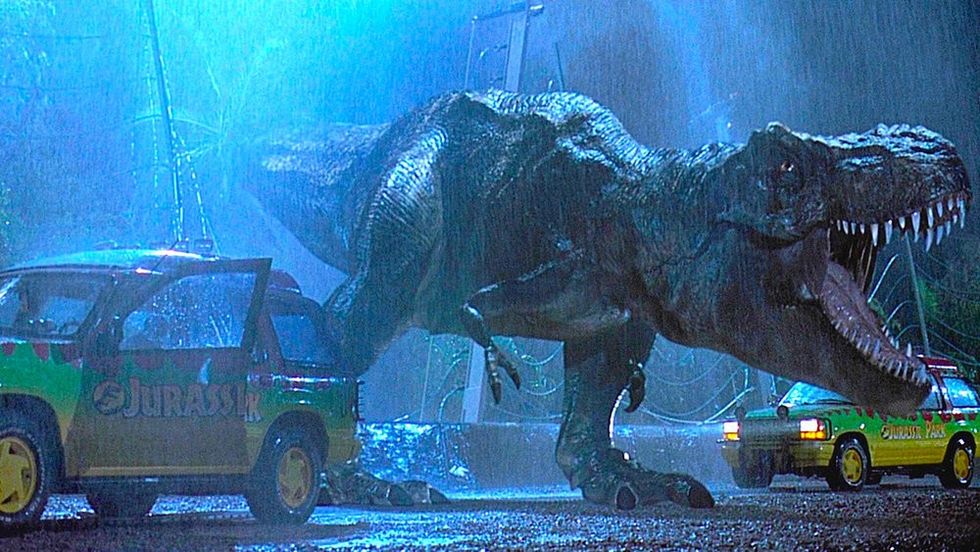 ‘Jurassic Park’ Credit: Universal
The Initial Plan for the Dinosaurs
After the success of Jaws, Spielberg was aware that he didn’t need too much screen time with the dinosaurs to induce fear in the audience. The dinosaurs in Jurassic Park barely have 15 minutes of screen time in total. However, 15 minutes of dinosaur visual effects are quite a handful, especially in an era without modern CGI.
Practical effects such as mechanical robots (the shark in Jaws or the 180-degree head spin in The Exorcist), puppetry and body suits (E.T.), miniature (Die Hard 2 and Back to the Future Part II), and stop-motion (Ghostbusters II) were the primary techniques used in sci-fi and horror.
Even for Jurassic Park, the initial plan was to use animatronics, puppetry, and a variation of stop-motion to bring the dinosaurs to life. In fact, Phil Tippett of Tippett Studio, who pioneered go-motion, was already halfway through his work on the film when a meeting between producer Kathleen Kennedy and Industrial Light & Magic (ILM) sparked an experiment with CGI.
At the time, ILM had just begun to do some remarkable work in movies such as The Abyss, the Star Wars trilogy, the Indiana Jones movies, and Terminator 2.
The Day That Changed Everything
Kennedy and Spielberg, with Dennis Muren, the VFX supervisor of Jurassic Park, met Steve Williams and Mark Dippé from ILM to discuss the scope of motion blur needed for the go-motion footage prepared by Tippett.
That’s when Williams asked the makers for an opportunity: he wanted to try his hand at digitally creating dinosaurs with fluid movement. The entire table was skeptical, but both Spielberg and Kennedy are known for their love of experimentation, and they knew that if Williams succeeded, cinema would be changed forever.
While there was no official collaboration yet, the team was definitely interested—it was one of the most beautiful, most impossible dreams at the time.
CGI Dinosaurs: Stage 1
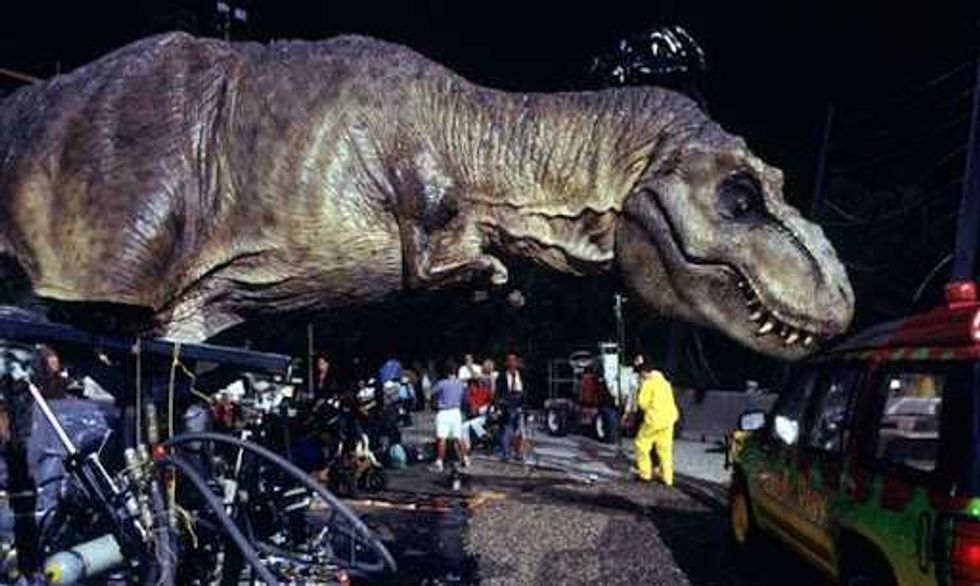 Behind the scenes Jurassic ParkSource: Universal Pictures
When Williams began his experiment with CGI to create dinosaurs, Spielberg and Tipett were at least 30 to 40% into designing and building dinosaurs with Stan Winston’s group. Their modus operandi consisted of animatronic puppeteering, sculptures, and other techniques to recreate the age of extinct reptiles.
The biggest problem with traditional stop-motion was the lack of fluidity in movements. Because every frame is basically a photograph, footage lacks smoothness. Go-motion addressed this.
ILM came on board for Jurassic Park to help with the motion blur required for go-motion. However, Dippé and Williams were especially excited to make a breakthrough, now that they had a movie that demanded something as iconic as CGI dinosaurs, but couldn’t present it directly until they had something concrete in their hands.
Williams did most of the work in the first couple of weeks, secretly, to create a digital skeleton of a T. rex that could move seamlessly. While Muren had a hint that the men were experimenting with the digital dinosaurs, he didn’t think that, technologically, they were ready.
So he kept pushing Tippett’s work to minimize risks. After all, Jurassic Park was a huge project. However, little did anyone realize that they were writing history.
Williams’ digital experiments brought positive results, and they had a few seconds of footage of a Tyrannosaurus skeleton walking across the screen.
The next time the producers, Kennedy and Frank Marshall, visited ILM, he left the footage playing on his computer screen. One look at it, and the producers knew that they were holding the golden goose.
“It was immediately very clear that we were gonna get realistic movement to these dinosaurs that was gonna be far advanced from what we were doing with stop motion,” Kennedy said in an interview with The Academy.
CGI Dinosaurs: Stage 2:
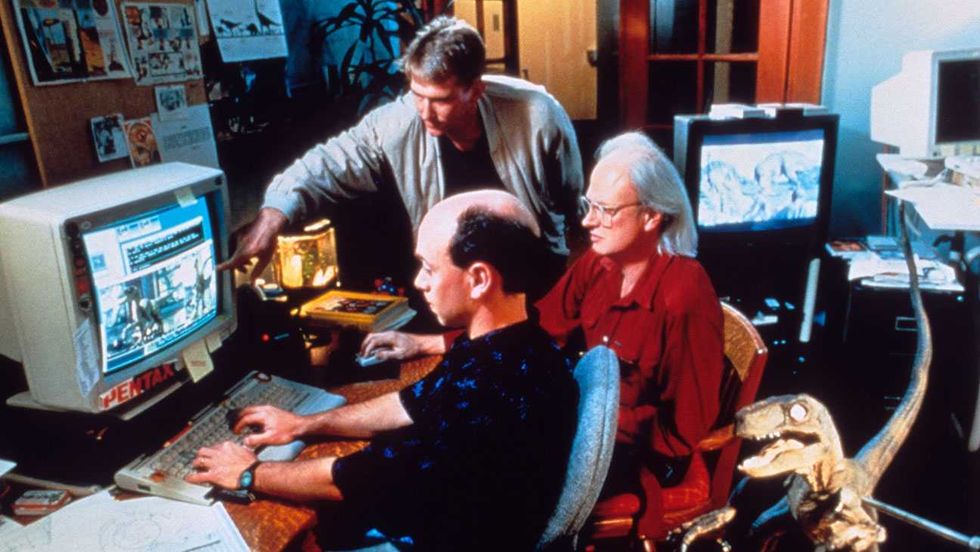 Behind the scenes Jurassic ParkSource: Universal Pictures
That one dinosaur walk became the fuel to what came next.
Williams and Dippé burned the midnight oil working closely with Fangmeier and Muren over a couple of weeks until they figured out how to add flesh and skin to the dinosaur skeleton to make it look real. The results blew their minds. It was time to present it to the producers and director.
So Muren arranged for an intimate screening with only five or six people at the Amblin screening room. The reaction?
They knew what they were seeing was “incredibly groundbreaking and it was gonna change everything.”
“Every single one of us jumped to our feet because we couldn’t believe what we were looking at,” Kennedy said.
Once everyone was convinced that CGI could seamlessly handle about 15 minutes of dinosaur footage, they called Tippett to inform him they wished to use CGI rather than stop-motion.
CGI Dinosaurs: Stage 3
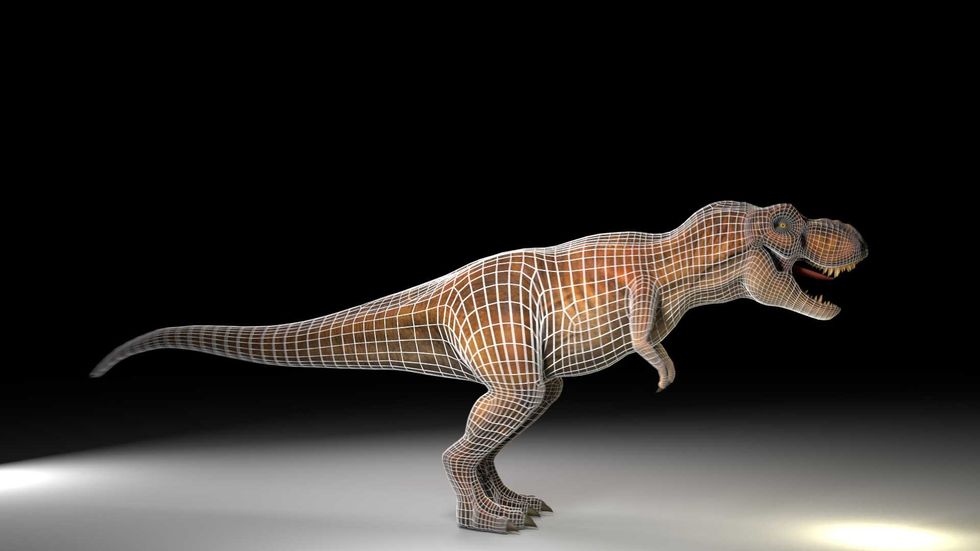 CGI modelling for Jurassic ParkSource: Universal Pictures
While ILM took over Jurassic Park’s visual effects, Tippett remained in collaboration because his vast study of dinosaurs, their bodies, and movement was essential to creating them digitally.
Kennedy said it started with a few shots, and then more and more sequences were added because CGI gave them confidence they could achieve even the most complex choreography seamlessly.
“By the end of the show, Steven rewrote the ending of it so that we could do a close-up of a T. rex, and it takes place in this rotunda where these two raptors and the T. rex come in. It pans down. A raptor jumps on it. He lifts it up. That’s the most amazing thing, and we had no idea two weeks before that that we could do a shot that close,” Muren said.
Out of the 15 minutes, nine minutes feature practical dinosaurs created by John Rosengrant and his team at the Stan Winston Studio, and the remaining six minutes feature CGI dinosaurs created by ILM’s Williams and Dippé.
Behind-the-scenes stories like these remind us why we became filmmakers in the first place. Jurassic Park kickstarted an era of CGI—one of the reasons why we should take our job of challenging established creative systems very seriously as filmmakers.
When was the last time you watched Jurassic Park?