
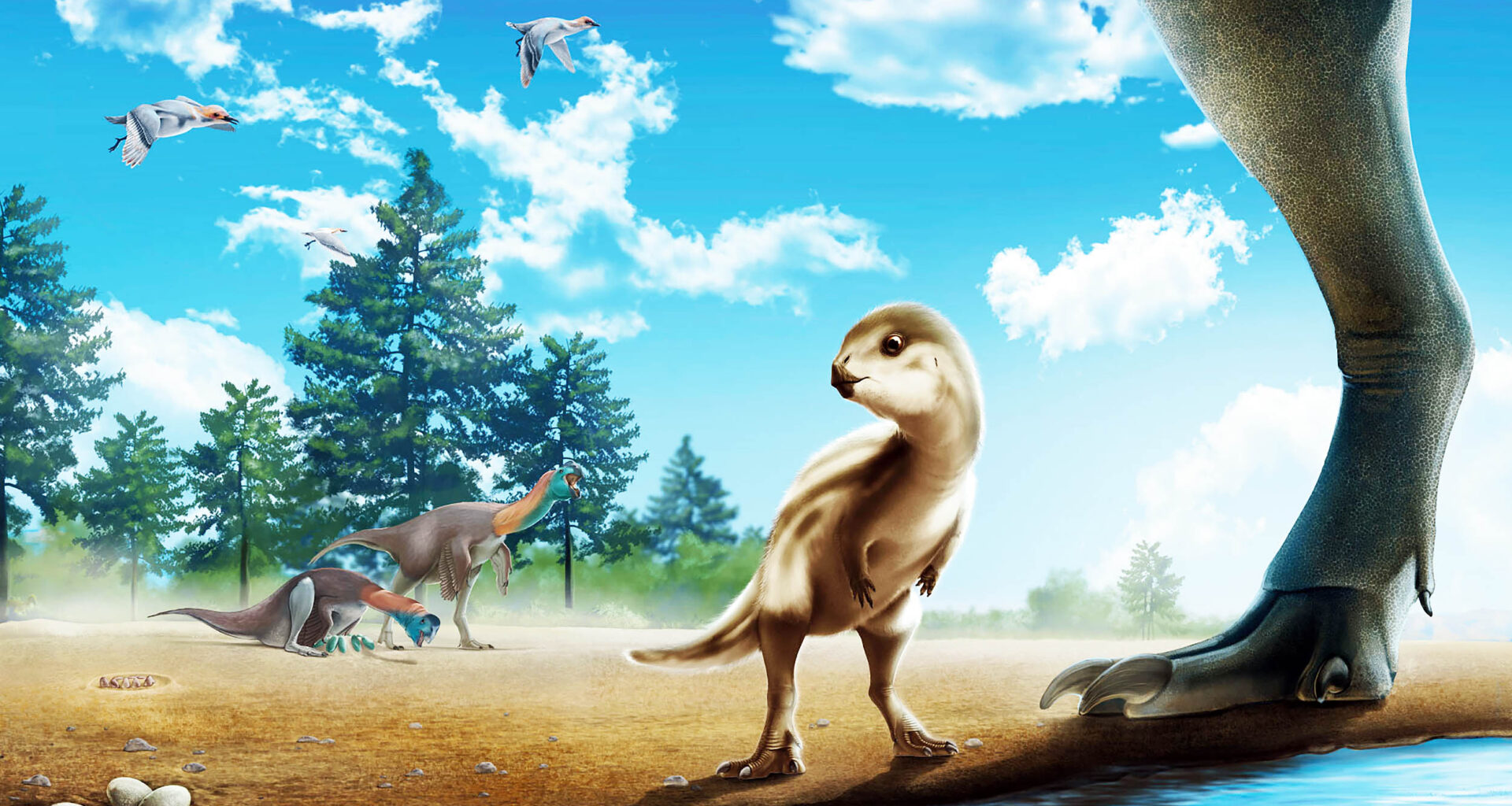
South Korea has a famous dinosaur of its own – not from a museum, but from television. Dooly, a mischievous green baby dinosaur with two little sprigs of hair, is essentially a national cartoon icon.
So when paleontologists uncovered a brand-new species of juvenile dinosaur on Korea’s Aphae Island, they didn’t have to think long about a name. They called it Doolysaurus.

“Dooly is one of the very famous, iconic dinosaur characters in Korea. Every generation in Korea knows this character,” said Jongyun Jung, a visiting postdoctoral researcher at the University of Texas at Austin who led the research.
“And our specimen is also a juvenile or ‘baby,’ so it’s perfect for our dinosaur species name to honor Dooly.”
The dinosaur’s full scientific name is Doolysaurus huhmini. It is the first new dinosaur species reported from Korea in 15 years and a particularly exciting one because it includes something Korean dinosaur fossils rarely preserve: parts of the skull.
Hidden dinosaur inside rock
When the fossil was first discovered, it didn’t scream “complete dinosaur.” Jung said that at the start, researchers could see leg bones and some vertebrae.
That’s already a good sign in paleontology, but nobody expected what was still hidden inside the rock.
“When we first found the specimen, we saw some leg bones preserved and some vertebrae,” Jung said.
“We didn’t expect skull parts and so many more bones. There was a fair amount of excitement when we saw what was hidden inside the block.”
The big reveal came after the fossil underwent a micro-CT scan at the University of Texas High-Resolution X-ray Computed Tomography facility (UTCT).
The dinosaur is still largely encased in hard rock that could take years to remove by hand, but the scan made it possible to see what was there without waiting a decade.
Julia Clarke, a professor at UT’s Jackson School and a co-author on the study, said CT scanning has become essential for fossils like this.
These include small dinosaurs or early birds trapped in tough rock, where traditional preparation is slow and risky.
Turkey-sized dinosaur was still growing
The specimen was discovered in 2023 by Hyemin Jo, a researcher at the Korean Dinosaur Research Center and a co-author on the paper.
Researchers estimate the dinosaur was about two years old and still growing when it died. They believe it was roughly turkey-sized, and that an adult Doolysaurus could have reached about twice that size.
“I think it would have been pretty cute,” Clarke said. “It might have looked a bit like a little lamb.”
That idea comes from its placement in a group of dinosaurs that may have had filament-like coverings rather than the scaly look most people imagine.
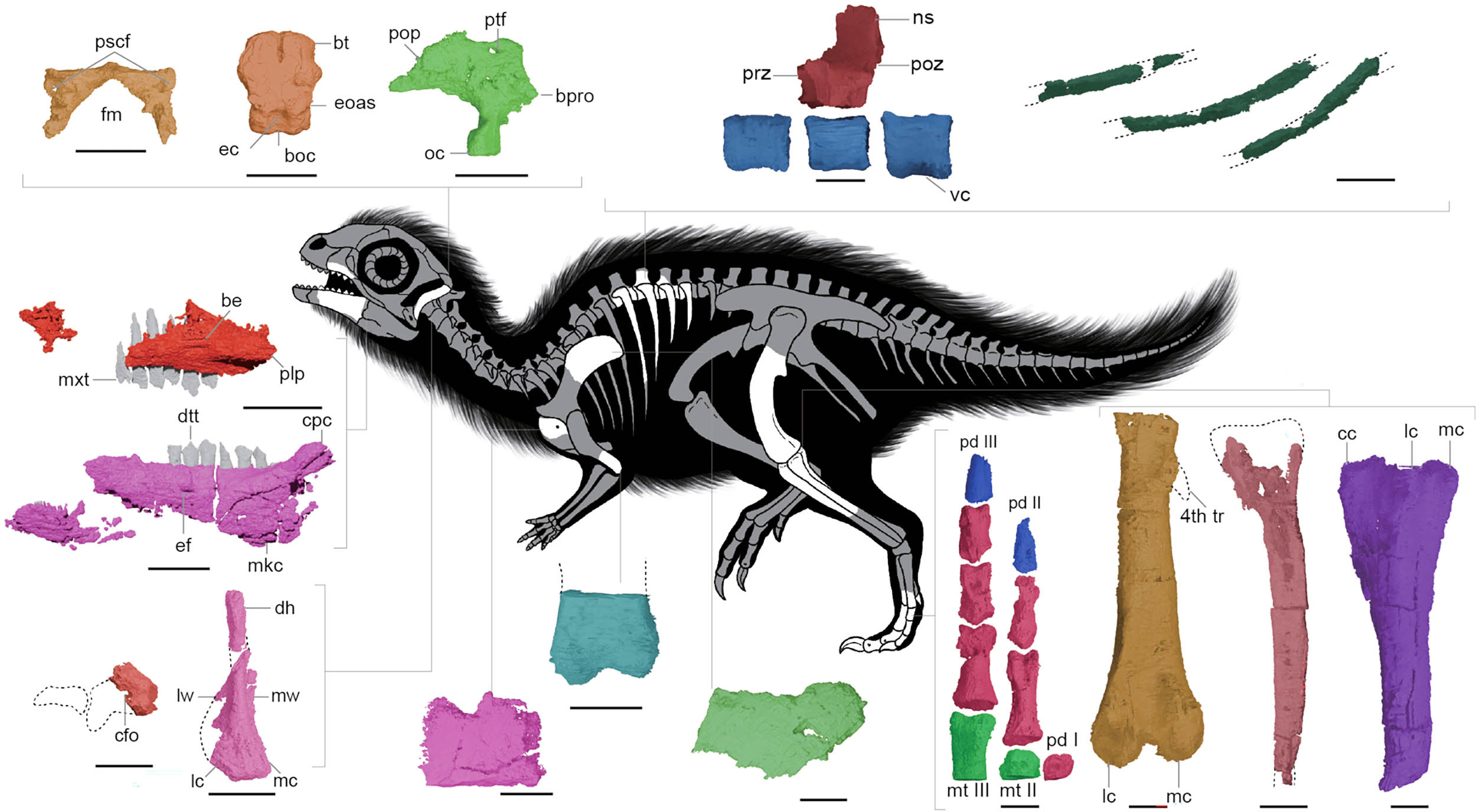 The skeletal anatomy of a juvenile Doolysaurus huhmini. The graphic highlights the fossil bones that were found with the dinosaur. Credit: Janet Cañamar. Click image to enlarge.What kind of dinosaur was it?
Doolysaurus lived roughly 113 to 94 million years ago, during the mid-Cretaceous. Based on its anatomy, the researchers classify it as a thescelosaurid, a type of small, bipedal dinosaur known from East Asia and North America.
It wasn’t a giant predator. It was more the quick, two-legged, scrappy type.
The team confirmed it was a juvenile by looking at growth markers in a thin slice of femur bone, a standard way paleontologists check whether an animal had reached adulthood.
The species name “huhmini” honors Min Huh, a prominent Korean paleontologist who has studied Korean dinosaurs for decades. He also founded the dinosaur research center and worked with UNESCO to help preserve Korean dinosaur fossil sites.
Stomach stones spark closer look
One of the coolest details in this story is what prompted the researchers to take a closer look in the first place.
The fossil contained dozens of gastroliths – pebbles the dinosaur swallowed to help grind up food in its stomach.
Those stones suggested the dinosaur ate a mixed diet: plants, insects, and small animals. But they also acted as a hint that the fossil might be more intact than it appeared.
Gastroliths are small and light, so if scavengers had ripped apart or heavily disturbed the carcass after death, the stones would likely have scattered. Because the stones remained clustered, researchers suggest the body did not fully dismantle before it fossilized.
“A little cluster of stomach stones, with two leg bones sticking out, indicates that the animal was not fully pulled apart before it entered the fossil record,” Clarke said.
“So, I encouraged [Jung and co-authors Minguk Kim and Hyemin Jo] to visit Texas and the UTCT to try scanning the fossil.”
New hope for Korean fossils
South Korea is famous for dinosaur trace fossils – footprints, eggs, and nests – but actual dinosaur bones are much rarer. This find suggests bones are often present but hidden in tough rock that doesn’t easily give up its secrets.
Now that Kim and Jo have trained with CT analysis at UT, they’re planning to use those skills on more Korean fossils.
Jung is also heading back to Aphae Island to search for additional specimens. He suspects there could be more “invisible” dinosaurs waiting inside the rock, and that scanning technology could be the key to finding them.
“We’re expecting some new dinosaur or other egg fossils to come from Aphae and other small islands,” he said.
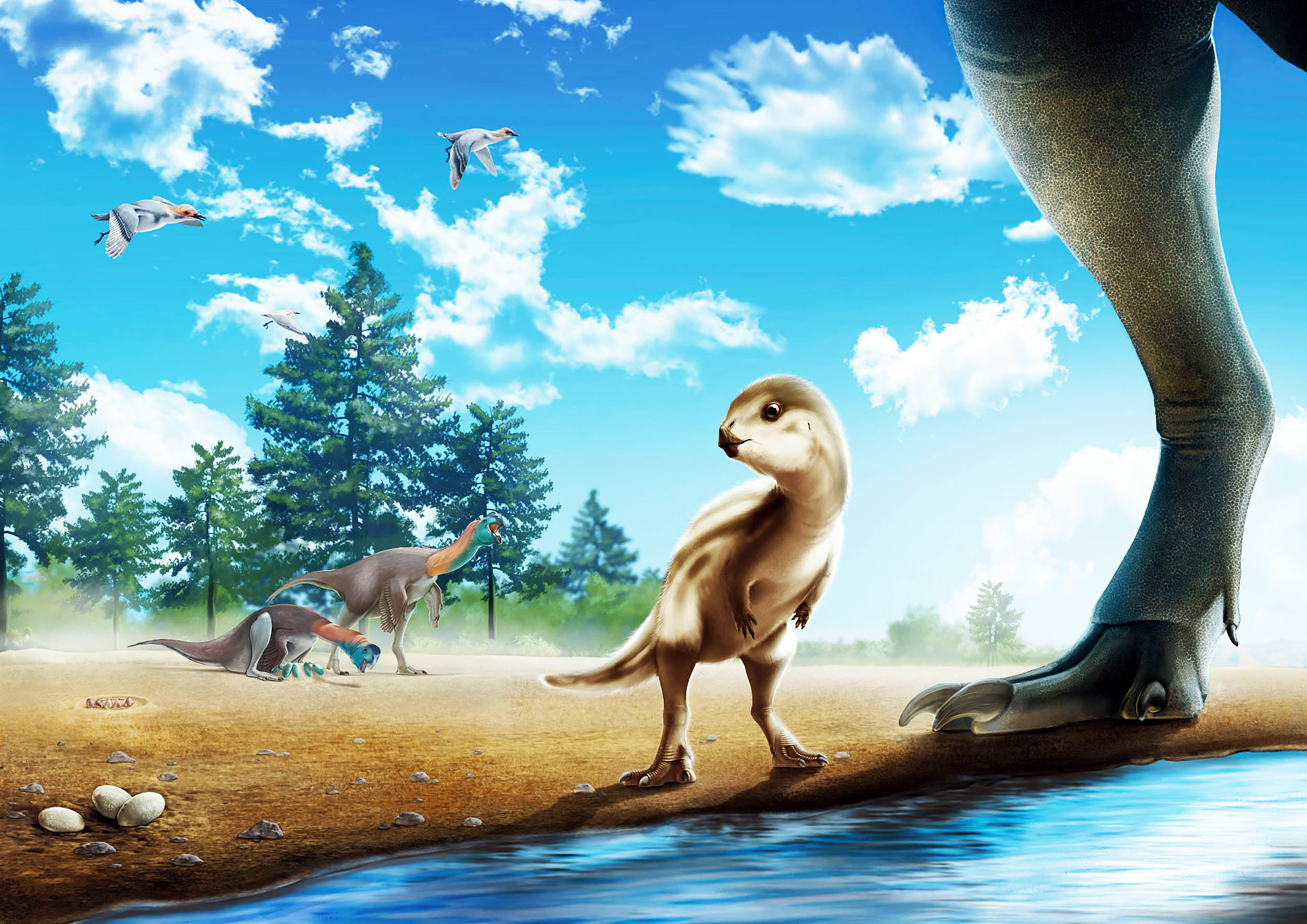 An artist’s interpretation of a juvenile Doolysaurus huhmini. It is depicted alongside birds and non-avian dinosaurs that lived during the Cretaceous in what is now South Korea. Credit: Jun Seong Yi. Click image to enlarge.Cartoon link gives unique name
There’s something fun about the name Doolysaurus, but it’s also fitting in a deeper way. This wasn’t a monstrous movie dinosaur. It was a small, juvenile animal – and likely a cute one.
The name links a real prehistoric creature to a piece of modern culture that millions of people already love.
Scientifically, it’s a big step for Korean paleontology: a new species, skull material, and a demonstration that micro-CT scanning can uncover fossils that would otherwise remain locked away for years.
A “baby dinosaur” named after a cartoon might end up changing how researchers look for real dinosaurs in Korea.
The study is published in the journal Fossil Record.
—–
Like what you read? Subscribe to our newsletter for engaging articles, exclusive content, and the latest updates.
Check us out on EarthSnap, a free app brought to you by Eric Ralls and Earth.com.
—–