
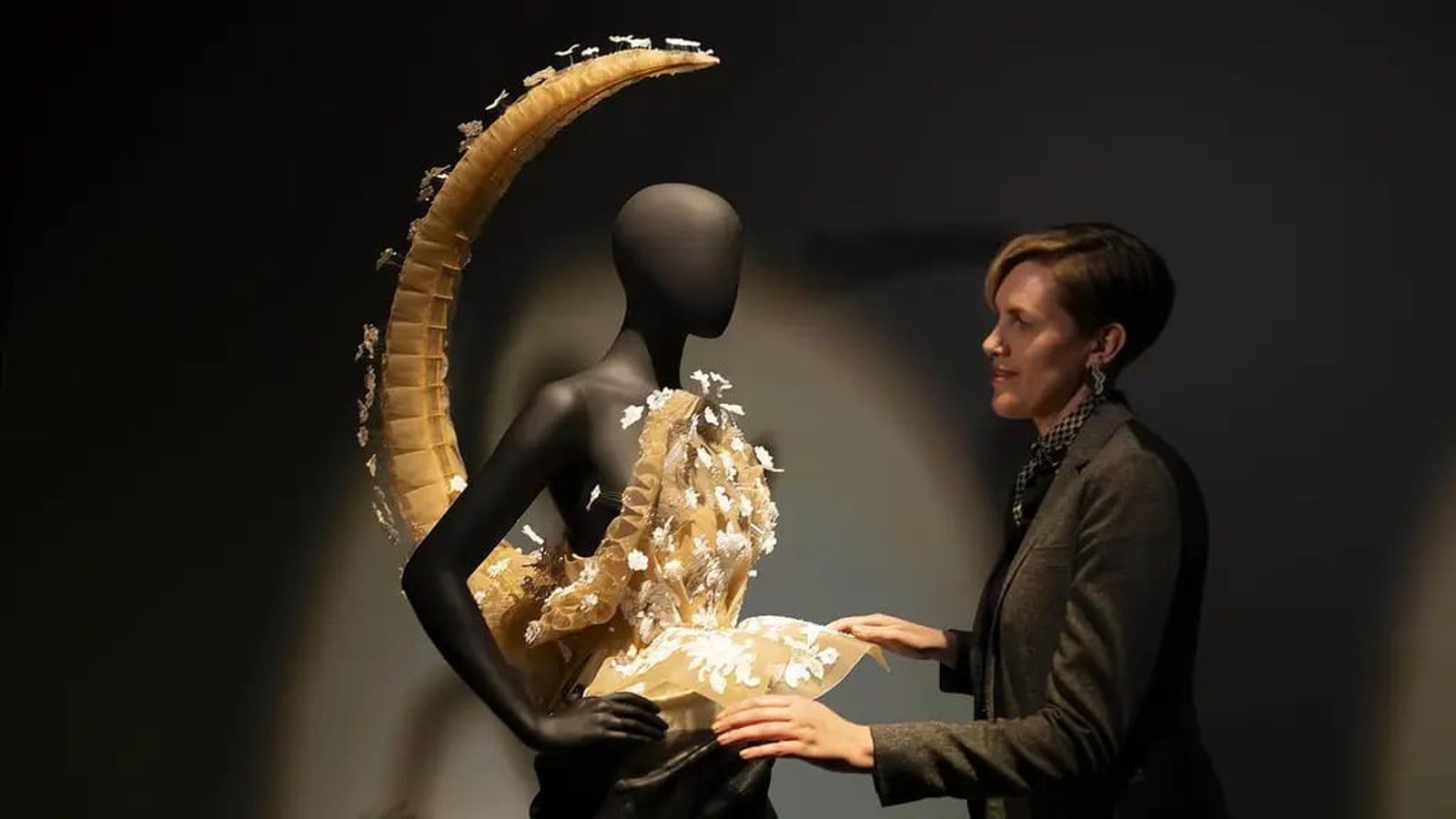
From red-carpet gowns worn by Ariana Grande to surrealist skeleton dresses, Elsa Schiaparelli’s designs have long blurred the line between fashion and art.
Now, a new exhibition at the Victoria and Albert Museum brings that legacy into focus, pairing historic couture with contemporary looks worn by figures including Dua Lipa, Ariana Grande and Kendall Jenner.
The exhibition, Schiaparelli: Fashion Becomes Art, traces the work of the Italian-born designer, who established her Paris couture house in the late Twenties and became known for bold, unconventional designs that challenged traditional ideas of dress.
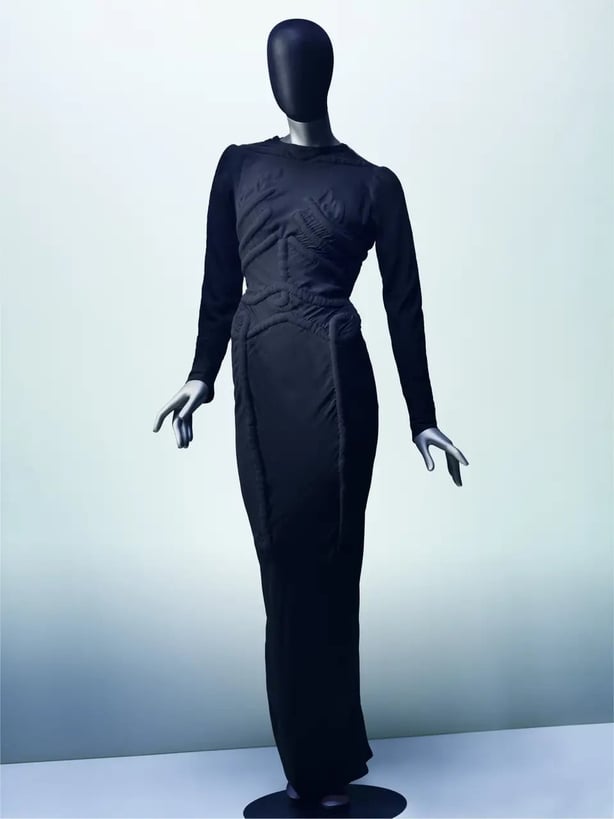
The ‘Skeleton Dress’, designed by Elsa Schiaparelli and Salvador Dalí, 1938 (Emil Larsson/V&A/PA)
The V&A’s senior curator of fashion, Sonnet Stanfill, says that the moment Schiaparelli’s work moved beyond fashion into art can be traced to the mid-Thirties.
“I think that from 1935, we know she started working very closely with the surrealist artist Salvador Dalí,” Stanfill says. “That starts small with a group of powder compacts […] and then moves on to garments like the tears dress, the skeleton dress and others.”
Schiaparelli described the process as “exhilarating” in her autobiography, Shocking Life.
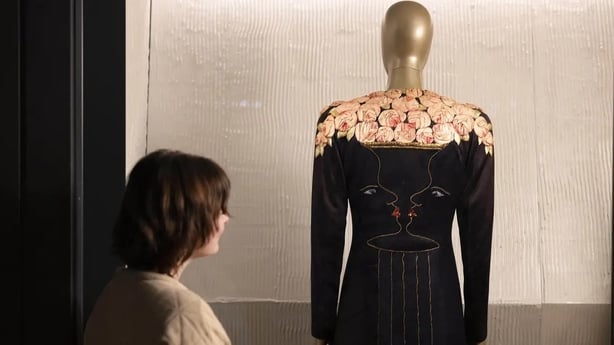
A silk evening coat made by Elsa Schiaparelli with embroidered drawings by Jean Cocteau from the designer’s 1937 collection (David Parry/PA)
Collaborations with artists
Schiaparelli’s relationship with artists went far beyond influence. While many designers socialised with artists, they rarely worked with them directly – yet she actively built collaboration into her collections.
When asked whether Schiaparelli was a designer influenced by artists or an artist in her own right, Stanfill says: “Both – she is someone who worked very closely with the leading artists of her time […] and she said, ‘dressmaking, for me, is not a profession, but an art.'”
Her work with figures including Jean Cocteau and Dalí helped define a new approach to couture – one that treated garments as creative works in their own right.
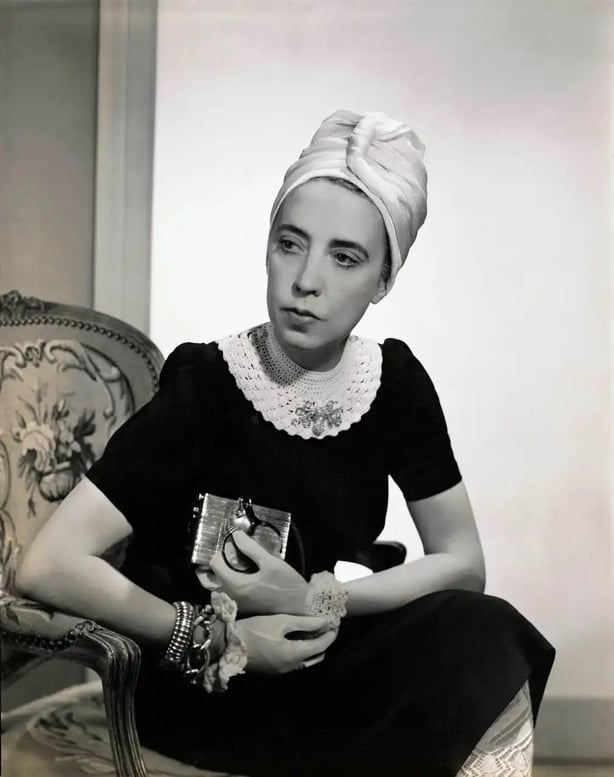
Designer Elsa Schiaparelli wearing a black silk dress with crocheted collar of her own design (Fredrich Baker/Condé Nast/PA)
Unlike contemporaries such as Coco Chanel, who moved in artistic circles, Schiaparelli actively collaborated with artists and made that exchange central to her identity.
“She even announced it in one press release,” Stanfill notes. “It was very integral to her concept of herself as a maker […] that she was collaborating with artists.”
Crucially, those relationships worked both ways.
“She was in a different league […] in terms of her actually working collaboratively and exchanging ideas, and also being the inspiration for the artists themselves.”
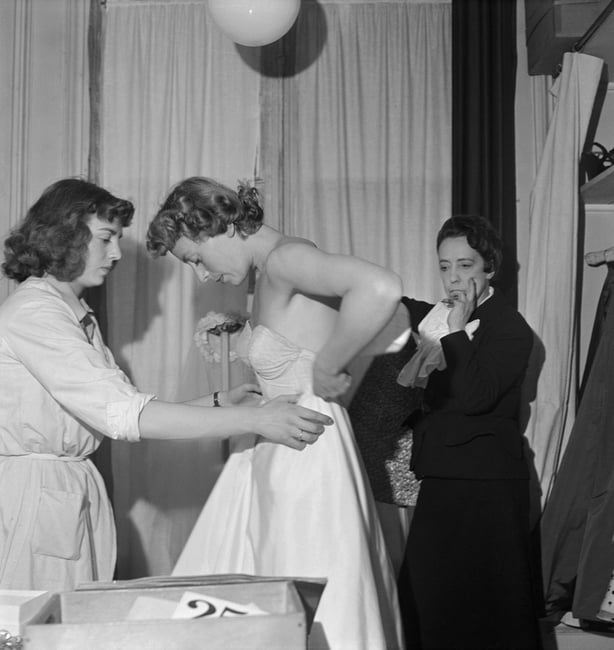
Elsa Schiaparelli is shown here with a model at 21 Place Vendome. Getty Images.
Schiaparelli’s London operation
If Paris provided the avant-garde backdrop for Schiaparelli’s rise, London offered a different kind of stage.
She opened a London branch of her business in 1933 in Mayfair, then the centre of luxury shopping in the capital.
Describing it as “the most masculine city in the world”, and its inhabitants as “mad, mad, mad”, Schiaparelli did not initially appear an obvious fit for British society.
Yet her London clientele proved anything but conservative.
“One might assume […] that maybe the British clients weren’t as daring as the people that shopped in Paris,” Stanfill says.
“But actually, when you look at the clothes, you see there’s vibrant colour […] unusual textile prints […] and some of her more outrageous designs were bought and worn by British clients.”
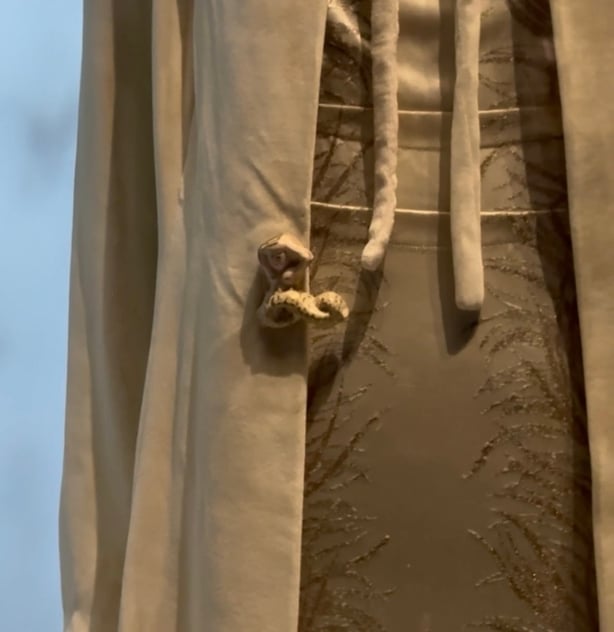
The bare-breasted mermaid button of Lady Jane Clark’s Coronation coat (Lara Owen/PA)
The London operation, which ran until 1939, allowed clients to buy directly without import duties and attend presentations locally.
Among them were a wide range of high-profile women, from actress Marlene Dietrich to aviator Amy Johnson and art collector Maud Russell.
“I think she called her clients those ‘glittering personalities,’” says Stanfill.
That spirit is perhaps best illustrated by Lady Jane Clark, who wore Schiaparelli to the 1937 Coronation – complete with a coat fastened by a button shaped like a bare-breasted mermaid.
“The fact that that was worn to the coronation […] I find that kind of sums up a lot of the Schiaparelli client spirit,” Stanfill laughs.
Use of colour, materials and detail
While Schiaparelli’s silhouettes often followed the prevailing styles of the Thirties, it was in the details that her work stood apart.
Rather than radically altering shape, she focused on colour, embellishment and materials.
“Her silhouettes didn’t veer dramatically away from what was fashionable,” Stanfill says, “but if you think about the colours […] she was quite a strong colourist.”
She describes combinations such as “a beetroot red with a salmon pink” or “a dusty brown evening dress with a bright green feathered capelet”.
Schiaparelli also pushed material innovation, working with unusual textiles including cellophane, rotophane and even woven glass.
“She really pushed […] to ensure that her house was associated with the most innovative and unusual materials,” says Stanfill.
Her collaborations with embroidery house Lesage resulted in richly embellished garments that she describes as “a kind of fantasy of couture technique and embellishment”.
Then and now
Although Schiaparelli closed her couture house in 1954, the brand remained dormant for decades before being revived and returning to the Paris couture calendar in 2014.
Today, under creative director Daniel Roseberry, the house has found a new audience through social media and red carpet fashion.
“I think that Daniel Roseberry is incredibly adept at capturing the attention economy,” Stanfill says.
“He’s not beholden to the history of the house […] he takes it as a departure point and translates it into something for a contemporary audience.”
Appointed in 2019, Roseberry has helped reintroduce Schiaparelli to a global audience, with sculptural couture regularly appearing on major red carpets.
For many, those high-profile celebrity moments like Kendall Jenner on the runway or Demi Moore on the red carpet, provide a first encounter with the house’s distinctive aesthetic.
Among celebrity highlights in the exhibition are the striking red and sculptural pink couture dresses worn by Ariana Grande to the 2025 Oscars – examples of how the house continues to capture global attention nearly a century after it was founded.
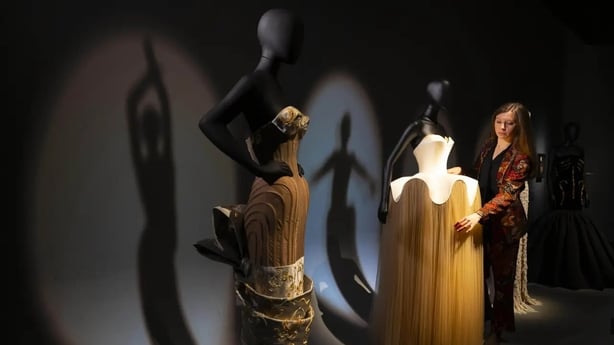
Exhibition overview
Spanning from the Twenties to the present day, the exhibition brings together around 200 objects, including some of Schiaparelli’s most radical designs alongside contemporary couture.
Running from March 28 to November 8, the V&A exhibition is the first major UK exhibition dedicated to her work.
For Stanfill, the aim is to highlight the breadth of Schiaparelli’s creative output.
“It’s truly a V&A show in the sense that it celebrates creativity in many forms,” she says.
“There are works of fashion, works of art […] and the story of her work with stage and screen.
“I hope people are inspired by the creativity that they see on display,” she concludes.