
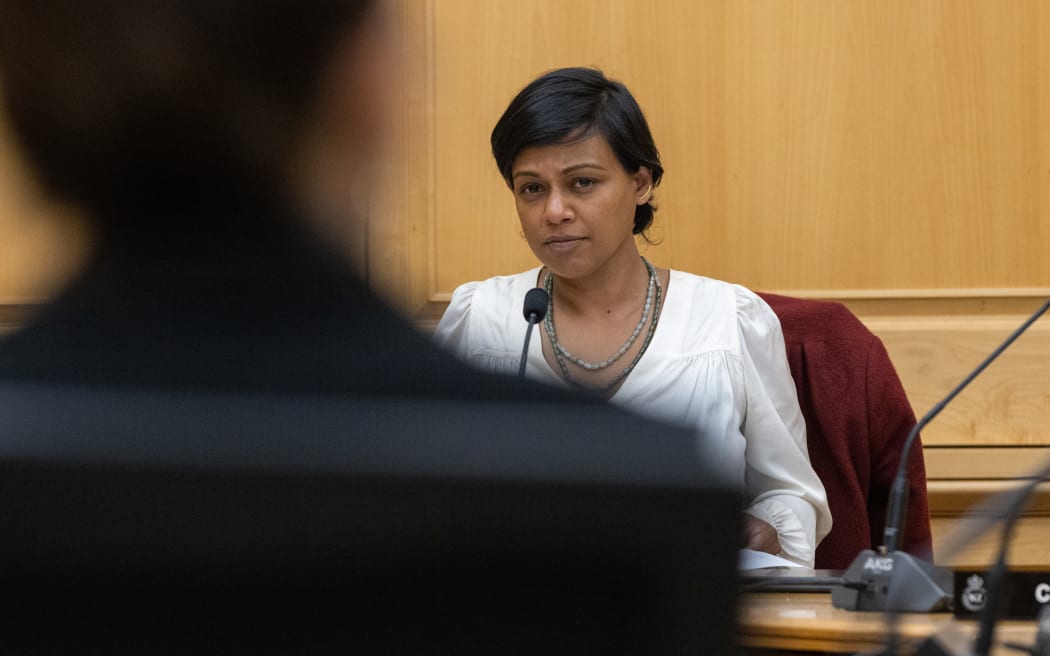
Labour Party MP Vanushi Walters chairs Parliament’s Justice Select Committee during a hearing on Youth Justice.
Photo: VNP / Phil Smith
Parliament’s first debate this week was over New Zealand having signed an international statement condemning Iran for attacks in the strait of Hormuz, and offering a “readiness to contribute” to ensuring safe passage for shipping.
When a major event occurs, Parliament sometimes puts aside its planned business and has an Urgent Debate on the topic. This hour of speeches is requested by an opposition MP. An alternative is a Ministerial Statement, in which the government initiates the debate. It has the potential downside of including questions.
Labour’s Foreign Affairs spokesperson Vanushi Walters requested this debate. Walters noted that Labour supported condemnation of attacks on shipping in the Strait of Hormuz, but had a number of objections.
The opposition case against
“The government has made a clear promise in this statement that puts New Zealand at risk; in expressing New Zealand’s readiness to assist in opening the Strait of Hormuz. This promise is one that feeds expectation on the global stage, in the context of the most serious of events: a war.”
The Statement includes the line: “We express our readiness to contribute to appropriate efforts to ensure safe passage through the Strait of Hormuz. We welcome the commitment of nations who are engaging in preparatory planning.”
Walters also objected to a lack of prior discussion or briefings.
“The Prime Minister himself said yesterday that this was a decision made without discussion nor debate. It was also made without briefings to the opposition, and it appears to have been made without advice about international law nor overreaching security and cost considerations.”
This, she argued, was a further expression of “the unprincipled, irresponsible, and unclear foreign policy we’ve seen expressed by the government in recent months”.
She argued the “war began with the US and Israel breaching the UN Charter”, and that New Zealand’s involvement in protecting Hormuz would make us “complicit in continuing a breach of the UN Charter”.
She noted that American statements about “how the Strait could be secured includes potential breaches of international humanitarian law, with the bombing of civilian infrastructure-we risk being seen as complicit on that front”.
Under those circumstances she believes “the risks to our Defence Force if placed within the region are very real”.
Finally, Walters was concerned that New Zealand was making itself a target for “asymmetric warfare. Europol and others have warned of an increased terror threat since the attacks”.
Labour’s Phil Twyford later outlined the threat of New Zealand involvement.
“If this government sends New Zealanders there, you will inevitably be seen as belligerents in the war, and New Zealanders, both there in the Gulf and anywhere else around the world, will become targets, and the inevitable legacy of this United States-Israel war against Iran (which will be generations of extremism and anti-Western terrorism), will be directed at New Zealanders. That’s what is at stake here.”
Given potential threats, Walters could see no evidence that the government had made a “comprehensive assessment about the risks of joining this statement, and of following through with the commitment made to our national security and the security of New Zealanders across the world.”
Later Twyford argued the government’s motivation was driven by not saying “anything that might attract a late night tweet from the White House. New Zealand’s once proud, independent foreign policy has, under this government …been reduced to abject servility to the Trump White House.”
Speaking for the Greens, Marama Davidson focused on the government’s relative silence about Iran’s combatants.
“This statement …is heinous in what it has left out. How can we pretend to normalise not just the illegal attack by the US and Israel on Iran but the fact that we are going to normalise and tolerate powerful men playing war games and then not call that out and then try and normalise it as if it’s okay?”
For Te Pāti Māori, Rawiri Waititi concurred with the Green approach in condemning the initial attacks.
“This particular letter reminds me of a rugby game. You get punched in the face, and then you retaliate. …Who gets the red card? The guy who retaliated. That’s the situation we’re in at the moment with this conflict. If you go and illegally invade a country, they then retaliate, then we condemn them. We condemn them for retaliating.”
Governing party responses
The initial right of reply was from the Minister of Foreign Affairs and New Zealand First leader Winston Peters. He both defended the government’s position and attacked the opposition.
“They lament that the New Zealand government does not currently place an emphasis on mindless moral posturing and vacuous virtue signalling. …We will never do that. Our focus is on dealing with the world as it is, not as we would wish it to be, and on getting the best possible outcomes for New Zealanders.”
“We also have outright scaremongering from our critics, who said the government is rushing to contribute military forces to this conflict. …What absolute crap. What absolute nonsense. New Zealand is not a party to this conflict, and we have absolutely no intention of joining it.”
The Opposition might have been pleased to hear that definitive rejection of involvement. Later however, after mocking the Opposition’s concerns Peters didn’t rule out New Zealand joining the conflict.
“If we receive a request, or if an international coalition was established in the future to safeguard commercial shipping, any possible contribution will be a matter for-guess who!-the Cabinet, first of all, to determine, based on careful consideration of New Zealand’s interests. That’s what we intend to do.”
For ACT, David Seymour appealed for what he called “moral clarity”. He argued that the opposition was “so blinded by their hatred of Israel, and perhaps the type of people that live there, and their hatred of America that they can’t see the moral dimension of this conflict.”
He believed the Iranian regime was “the most evil around in the world today”.
While he didn’t expressly state it, he appeared to argue that preemptive attacks are acceptable if one considers a country sufficiently evil.
“What is [the opposition’s] answer? To leave them alone, to wait until they have nuclear weapons, to wait until they’ve oppressed more of their own people, and to wait until they achieve their stated aim of a second Holocaust in Israel. Is that their answer, as they stand in Geneva and New York, and talk so nicely about international law and the protections that apparently it offers even to the most evil dictators on the planet.”
National’s primary contribution was from Minister of Defence Judith Collins.
“Well, hopefully there will be, at some stage, some leaders of Iran who will be committed to human rights, but I’m not feeling that vibe at the moment.”
Regarding calls to adhere to international law she said: “I give you, then, international law on the law of the sea and the rights for this country and other countries to be able to have commercial shipping, and we call on Iran to comply with the United Nations Security Council Resolution 2817. …New Zealand must be able to get the benefit of the oil coming through those straits.”
Regarding the commitment of members of military personnel, Collins said: “Frankly, I’m not putting them forward if we don’t have to do something, because it’s their lives while people on the other side are talking from their very, very excited position of holier than thou-how dare they say our people are going there.”
Later though, she segued abruptly from mocking fears New Zealand might commit troops (by proposing sending non-existent troops), to suggesting actual troops New Zealand could commit.
“Would you like me to find some stealth bombers? I don’t have any of those. How about an aircraft carrier? We don’t have any of those. We don’t have any of those sorts of things, but we do have some very well-qualified people involved in demining. That might be at the right time, at the right place, and at the right request-who knows. It also depends: is it in New Zealand’s best interest? These are always decisions for Cabinet.”
It likely did little to assuage the opposition’s initial fears for New Zealand’s military involvement, that in defending its joining the declaration, two separate government ministers had abruptly shifted from ‘absolutely not’, to ‘maybe’.
*RNZ’s The House, with insights into Parliament, legislation and issues, is made with funding from Parliament’s Office of the Clerk. Find our articles or podcast at RNZ.