
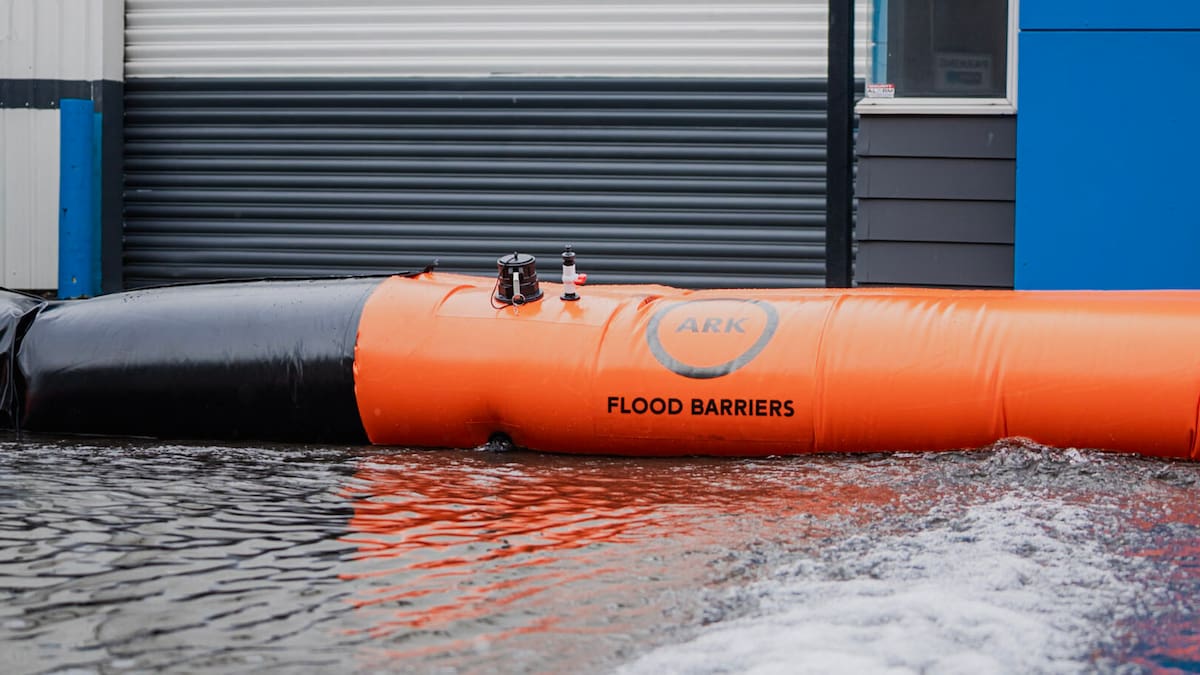
“It just gives people a little bit of security,” he said. Plus, it was far easier than filling and lugging hundreds of sandbags around town.
One of the new Ark flood barriers which was set up as a precaution in Wairoa. Photo / Annaleise Shortland
“The cost of the damage from flooding afterwards far outweighs the cost of having those,” said Little.
The 14.5m long PVC tubes join together to create a continuous barrier, equivalent to 160 sandbags.
Once they’re filled with water – via a fire hydrant or water truck, in about 10 minutes – they’re half a metre high, heavy and strong.
After a flood, they can be emptied, rolled up and stored.
The barriers are easy to deploy and can be stored after use. Photo / LinkedIn, Tarpaulin Makers
Klint Brittain-Freemantle from Tarpaulin Makers is the brains behind the gear.
Well before he joined the Tauranga-based company he had seen similar products overseas. Unable to find anything homegrown, he took up the challenge himself.
Living in Napier, he had witnessed homes under stormwater, and then Cyclone Cook hit in 2017.
“I drove in from home and deployed it out the front of my workshop across our big front roller doors and office.
“The water came right up to the doors, and it basically stopped it getting flooded, the places next door to us got flooded, all through the workshop floors, but we weren’t.”
What’s now known as the Ark flood barrier, sold by Tarpaulin Makers, was born.
Brittain-Freemantle urged local authorities to consider them.
“It’s almost soul-destroying at this point because we’ve got this product that’s so good and we know it works so well, and seeing people getting flooded around the country, like the recent ones in Wairoa [after Cyclone Gabrielle] … something like 400 houses got flooded.
“Even if we would have saved a fraction of that, that’s huge for those people.”
Tarpaulin Makers owner and general manager Beni Hafoka said many communities had big plans for flood resilience infrastructure.
“They might take 10 years to put in place, and in the meantime, communities need some short-term solutions,” he said.
“That’s what Ark is.”
While the product would not prevent major flooding, it could be used strategically, he said.
The 14.5m tubes can be connected to make a continuous barrier. Photo / LinkedIn, Tarpaulin Makers
“In [Cyclone] Gabrielle, there was a particular power station that only just flooded up a couple of hundred mil.
“So if we had Ark wrapped around that power station, we save that power station.”
Tairāwhiti civil defence made the first purchase.
For controller Ben Green, it added an element of speed to flood response.
“You don’t have time, you’re dealing with something that’s situational, and the ability to rapidly deploy … that type of equipment … can be quite a game-changer,” he said.
Green said they bought 10 at about $4000 each, but the cost would come down for larger orders.
– RNZ