
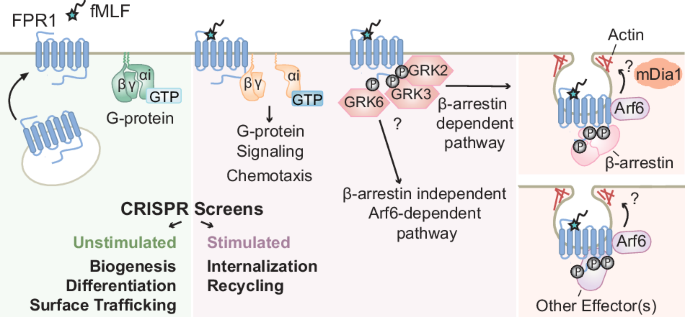
Peiseler, M. & Kubes, P. More friend than foe: the emerging role of neutrophils in tissue repair. J. Clin. Invest. 129, 2629–2639 (2019).
Herrero-Cervera, A., Soehnlein, O. & Kenne, E. Neutrophils in chronic inflammatory diseases. Cell. Mol. Immunol. 19, 177–191 (2022).
Metzemaekers, M., Gouwy, M. & Proost, P. Neutrophil chemoattractant receptors in health and disease: double-edged swords. Cell. Mol. Immunol. 17, 433–450 (2020).
Dahlgren, C. et al. Neutrophil signaling that challenges dogmata of G protein-coupled receptor regulated functions. ACS Pharmacol. Transl. Sci. 3, 203–220 (2020).
Dahlgren, C. et al. G protein coupled pattern receptors expressed in neutrophils: recognition, activation/modulation, signaling and receptor regulated functions. Immunol. Rev. 314, 69–92 (2023).
Dorward, D. A. et al. The role of formylated peptides and formyl peptide receptor 1 in governing neutrophil function during acute inflammation. Am. J. Pathol. 185, 1172–1184 (2015).
He, H.-Q. & Ye, R. D. The formyl peptide receptors: diversity of ligands and mechanism for recognition. Mol. J. Synth. Chem. Nat. Prod. Chem. 22, 455 (2017).
Honda, M. et al. Intravital imaging of neutrophil recruitment reveals the efficacy of FPR1 blockade in hepatic ischemia-reperfusion injury. J. Immunol. 198, 1718–1728 (2017).
Lind, S., Dahlgren, C., Holmdahl, R., Olofsson, P. & Forsman, H. Functional selective FPR1 signaling in favor of an activation of the neutrophil superoxide generating NOX2 complex. J. Leukoc. Biol. 109, 1105–1120 (2021).
Li, Y. et al. Targeting formyl peptide receptor 1 reduces brain inflammation and neurodegeneration. Science 390, eadq1177 (2025).
Wang, J., Chen, M., Li, S. & Ye, R. D. Targeted delivery of a ligand–drug conjugate via formyl peptide receptor 1 through cholesterol-dependent endocytosis. Mol. Pharm. 16, 2636–2647 (2019).
Pierce, K. L., Premont, R. T. & Lefkowitz, R. J. Seven-transmembrane receptors. Nat. Rev. Mol. Cell Biol. 3, 639–650 (2002).
Maaty, W. S. et al. Identification of C-terminal phosphorylation sites of N-formyl peptide receptor-1 (FPR1) in human blood neutrophils. J. Biol. Chem. 288, 27042–27058 (2013).
Prossnitz, E. R., Kim, C. M., Benovic, J. L. & Ye, R. D. Phosphorylation of the N-formyl peptide receptor carboxyl terminus by the G protein-coupled receptor kinase, GRK2. J. Biol. Chem. 270, 1130–1137 (1995).
Liu, X. et al. Bidirectional regulation of neutrophil migration by mitogen-activated protein kinases. Nat. Immunol. 13, 457–464 (2012).
Subramanian, B. C., Moissoglu, K. & Parent, C. A. The LTB4–BLT1 axis regulates the polarized trafficking of chemoattractant GPCRs during neutrophil chemotaxis. J. Cell Sci. 131, jcs217422 (2018).
Potter, R. M., Maestas, D. C., Cimino, D. F. & Prossnitz, E. R. Regulation of N-formyl peptide receptor signaling and trafficking by individual carboxyl-terminal serine and threonine residues. J. Immunol. 176, 5418–5425 (2006).
Gilbert, T. L., Bennett, T. A., Maestas, D. C., Cimino, D. F. & Prossnitz, E. R. Internalization of the human N -formyl peptide and C5a chemoattractant receptors occurs via clathrin-independent mechanisms. Biochemistry 40, 3467–3475 (2001).
Nakai, A. et al. The COMMD3/8 complex determines GRK6 specificity for chemoattractant receptors. J. Exp. Med. 216, 1630–1647 (2019).
Vines, C. M. et al. N-formyl peptide receptors internalize but do not recycle in the absence of arrestins. J. Biol. Chem. 278, 41581–41584 (2003).
Wang, J. & Ye, R. D. Agonist concentration–dependent changes in FPR1 conformation lead to biased signaling for selective activation of phagocyte functions. Proc. Natl. Acad. Sci. 119, e2201249119 (2022).
Winther, M., Dahlgren, C. & Forsman, H. Formyl peptide receptors in mice and men: similarities and differences in recognition of conventional ligands and modulating lipopeptides. Basic Clin. Pharmacol. Toxicol. 122, 191–198 (2018).
Mayer, D. et al. Distinct G protein-coupled receptor phosphorylation motifs modulate arrestin affinity and activation and global conformation. Nat. Commun. 10, 1261 (2019).
Rincón, E., Rocha-Gregg, B. L. & Collins, S. R. A map of gene expression in neutrophil-like cell lines. BMC Genomics 19, 573 (2018).
Sengeløv, H., Boulay, F., Kjeldsen, L. & Borregaard, N. Subcellular localization and translocation of the receptor for N -formylmethionyl-leucyl-phenylalanine in human neutrophils. Biochem. J. 299, 473–479 (1994).
Bock, C. et al. High-content CRISPR screening. Nat. Rev. Methods Prim. 2, 8 (2022).
Evers, B. et al. CRISPR knockout screening outperforms shRNA and CRISPRi in identifying essential genes. Nat. Biotechnol. 34, 631–633 (2016).
Morgens, D. W. et al. Genome-scale measurement of off-target activity using Cas9 toxicity in high-throughput screens. Nat. Commun. 8, 15178 (2017).
Novy, B. et al. An engineered trafficking biosensor reveals a role for DNAJC13 in DOR downregulation. BMC Genomics 19, 573 (2024).
Haney, M. S. et al. Identification of phagocytosis regulators using magnetic genome-wide CRISPR screens. Nat. Genet. 50, 1716–1727 (2018).
Belliveau, N. M. et al. Whole-genome screens reveal regulators of differentiation state and context-dependent migration in human neutrophils. Nat. Commun. 14, 5770 (2023).
Tiedemann, R. E. et al. Kinome-wide RNAi studies in human multiple myeloma identify vulnerable kinase targets, including a lymphoid-restricted kinase, GRK6. Blood 115, 1594–1604 (2010).
Willets, J. M., Challiss, R. A. J. & Nahorski, S. R. Non-visual GRKs: are we seeing the whole picture? Trends Pharmacol. Sci. 24, 626–633 (2003).
Okawa, T. et al. Design, synthesis, and evaluation of the highly selective and potent G-protein-coupled receptor kinase 2 (GRK2) inhibitor for the potential treatment of heart failure. J. Med. Chem. 60, 6942–6990 (2017).
Dahlgren, C., Gabl, M., Holdfeldt, A., Winther, M. & Forsman, H. Basic characteristics of the neutrophil receptors that recognize formylated peptides, a danger-associated molecular pattern generated by bacteria and mitochondria. Biochem. Pharmacol. 114, 22–39 (2016).
Bennett, T. A., Maestas, D. C. & Prossnitz, E. R. Arrestin binding to the g protein-coupled N-formyl peptide receptor is regulated by the conserved “DRY” sequence. J. Biol. Chem. 275, 24590–24594 (2000).
Morgens, D. W., Deans, R. M., Li, A. & Bassik, M. C. Systematic comparison of CRISPR/Cas9 and RNAi screens for essential genes. Nat. Biotechnol. 34, 634–636 (2016).
Guna, A., Volkmar, N., Christianson, J. C. & Hegde, R. S. The ER membrane protein complex is a transmembrane domain insertase. Science 359, 470–473 (2018).
Shurtleff, M. J. et al. The ER membrane protein complex interacts cotranslationally to enable biogenesis of multipass membrane proteins. eLife 7, e37018 (2018).
Subramanian, A. et al. Gene set enrichment analysis: a knowledge-based approach for interpreting genome-wide expression profiles. Proc. Natl. Acad. Sci. 102, 15545–15550 (2005).
Aliyu, M. et al. Interleukin-6 cytokine: an overview of the immune regulation, immune dysregulation, and therapeutic approach. Int. Immunopharmacol. 111, 109130 (2022).
Park, S.-J. et al. IL-6 regulates in vivo dendritic cell differentiation through STAT3 activation. J. Immunol. 173, 3844–3854 (2004).
Yang, J. et al. Sequential genome-wide CRISPR-Cas9 screens identify genes regulating cell-surface expression of tetraspanins. Cell Rep. 42, 112065 (2023).
Lachance, V. et al. Ubiquitination and activation of a Rab GTPase promoted by a β2-adrenergic receptor/HACE1 complex. J. Cell Sci. 126, 5669–5682 (2013).
Bai, S. et al. Exocyst controls exosome biogenesis via Rab11a. Mol. Ther. Nucleic Acids 27, 535–546 (2022).
Shirakawa, R. & Horiuchi, H. Ral GTPases: crucial mediators of exocytosis and tumourigenesis. J. Biochem. 157, 285–299 (2015).
Kawato, M. et al. Regulation of platelet dense granule secretion by the Ral GTPase-exocyst pathway. J. Biol. Chem. 283, 166–174 (2008).
Laulumaa, S. & Varjosalo, M. Commander complex—a multifaceted operator in intracellular signaling and cargo. Cells 10, 3447 (2021).
Gershlick, D. C. & Lucas, M. Endosomal trafficking: retromer and retriever are relatives in recycling. Curr. Biol. 27, R1233–R1236 (2017).
Liu, D., Tsarouhas, V. & Samakovlis, C. WASH activation controls endosomal recycling and EGFR and Hippo signaling during tumor-suppressive cell competition. Nat. Commun. 13, 6243 (2022).
Xu, J. et al. Divergent signals and cytoskeletal assemblies regulate self-organizing polarity in neutrophils. Cell 114, 201–214 (2003).
Hind, L. E., Vincent, W. J. B. & Huttenlocher, A. Leading from the back: the role of the uropod in neutrophil polarization and migration. Dev. Cell 38, 161–169 (2016).
Kumar, A., Kremer, K. N., Dominguez, D., Tadi, M. & Hedin, K. E. Gα13 and Rho mediate endosomal trafficking of CXCR4 into Rab11+ vesicles upon stromal cell-derived factor-1 stimulation. J. Immunol. 186, 951–958 (2011).
Abouelezz, A. & Almeida-Souza, L. The mammalian endocytic cytoskeleton. Eur. J. Cell Biol. 101, 151222 (2022).
Chakrabarti, R., Lee, M. & Higgs, H. N. Multiple roles for actin in secretory and endocytic pathways. Curr. Biol. 31, R603–R618 (2021).
Soykan, T. et al. Synaptic vesicle endocytosis occurs on multiple timescales and is mediated by formin-dependent actin assembly. Neuron 93, 854–866.e4 (2017).
Nishimura, Y. et al. The formin inhibitor SMIFH2 inhibits members of the myosin superfamily. J. Cell Sci. 134, jcs253708 (2021).
Chen, P.-W., Gasilina, A., Yadav, M. P. & Randazzo, P. A. Control of cell signaling by Arf GTPases and their regulators: focus on links to cancer and other GTPase families. Biochim. Biophys. Acta – Mol. Cell Res. 1869, 119171 (2022).
Donaldson, J. G. & Jackson, C. L. ARF family G proteins and their regulators: roles in membrane transport, development and disease. Nat. Rev. Mol. Cell Biol. 12, 362–375 (2011).
Dong, C. et al. ADP-ribosylation factors modulate the cell surface transport of G protein-coupled receptors. J. Pharmacol. Exp. Ther. 333, 174–183 (2010).
Cavenagh, M. M. et al. Intracellular distribution of arf proteins in mammalian cells. J. Biol. Chem. 271, 21767–21774 (1996).
Paleotti, O. et al. The small G-protein ARF6GTP recruits the AP-2 adaptor complex to membranes. J. Biol. Chem. 280, 21661–21666 (2005).
Poupart, M.-E., Fessart, D., Cotton, M., Laporte, S. A. & Claing, A. ARF6 regulates angiotensin II type 1 receptor endocytosis by controlling the recruitment of AP-2 and clathrin. Cell. Signal. 19, 2370–2378 (2007).
Delaney, K. A., Murph, M. M., Brown, L. M. & Radhakrishna, H. Transfer of M2 muscarinic acetylcholine receptors to clathrin-derived early endosomes following clathrin-independent endocytosis. J. Biol. Chem. 277, 33439–33446 (2002).
Claing, A. et al. β-arrestin-mediated ADP-ribosylation factor 6 activation and β2-adrenergic receptor endocytosis. J. Biol. Chem. 276, 42509–42513 (2001).
Rosenberg, E. M. et al. The small molecule inhibitor NAV-2729 has a complex target profile including multiple ADP-ribosylation factor regulatory proteins. J. Biol. Chem. 299, 102992 (2023).
Montagnac, G. et al. Decoupling of activation and effector binding underlies ARF6 priming of fast endocytic recycling. Curr. Biol. 21, 574–579 (2011).
Dana, R. R., Eigsti, C., Holmes, K. L. & Leto, T. L. A regulatory role for ADP-ribosylation factor 6 (ARF6) in activation of the phagocyte NADPH oxidase. J. Biol. Chem. 275, 32566–32571 (2000).
Matthees, E. S. F., Haider, R. S., Hoffmann, C. & Drube, J. Differential regulation of GPCRs—are GRK expression levels the key? Front. Cell Dev. Biol. 9, 687489 (2021).
Nobles, K. N. et al. Distinct phosphorylation sites on the β2 -adrenergic receptor establish a barcode that encodes differential functions of β-arrestin. Sci. Signal. 4, ra51 (2011).
Liggett, S. B. Phosphorylation barcoding as a mechanism of directing GPCR signaling. Sci. Signal. 4, re3 (2011).
Kee, T. R. et al. The multifaceted functions of β-arrestins and their therapeutic potential in neurodegenerative diseases. Exp. Mol. Med. 56, 129–141 (2024).
Xiao, K. et al. Functional specialization of beta-arrestin interactions revealed by proteomic analysis. Proc. Natl. Acad. Sci. USA 104, 12011–12016 (2007).
Takahashi, Y. et al. VPS37A directs ESCRT recruitment for phagophore closure. J. Cell Biol. 218, 3336–3354 (2019).
Ramírez-García, P. D. et al. A pH-responsive nanoparticle targets the neurokinin 1 receptor in endosomes to prevent chronic pain. Nat. Nanotechnol. 14, 1150–1159 (2019).
Chew, H. Y. et al. Endocytosis inhibition in humans to improve responses to ADCC-mediating antibodies. Cell 180, 895–914.e27 (2020).
Lundgren, S. M. et al. Signaling dynamics distinguish high- and low-priority neutrophil chemoattractant receptors. Sci. Signal. 16, eadd1845 (2023).
Gera, N., Swanson, K. D. & Jin, T. β-Arrestin 1-dependent regulation of Rap2 is required for fMLP-stimulated chemotaxis in neutrophil-like HL-60 cells. J. Leukoc. Biol. 101, 239–251 (2017).
Li, W. et al. MAGeCK enables robust identification of essential genes from genome-scale CRISPR/Cas9 knockout screens. Genome Biol. 15, 554 (2014).
Bailey, T. L. & Gribskov, M. Combining evidence using p-values: application to sequence homology searches. Bioinformatics 14, 48–54 (1998).
Storey, J. D. A direct approach to false discovery rates. J. R. Stat. Soc. Ser. B Stat. Methodol. 64, 479–498 (2002).
Reimand, J. et al. Pathway enrichment analysis and visualization of omics data using g:Profiler, GSEA, Cytoscape and EnrichmentMap. Nat. Protoc. 14, 482–517 (2019).
Conway, J. R., Lex, A. & Gehlenborg, N. UpSetR: an R package for the visualization of intersecting sets and their properties. Bioinformatics 33, 2938–2940 (2017).