
Composting keeps organic waste out of landfills, where it can produce methane, a very potent greenhouse gas. But a new study from Costa Rica’s Guanacaste province finds that when not disposed of properly, organic waste can also trigger a cascade of events resulting in fewer sea turtles.
“Normally in Costa Rica we are very used to throwing the peels of the vegetables or fruits in the backyard,” Keilor Cordero, lead author of the study and a Ph.D. student at Menéndez Pelayo International University in Spain, told Mongabay. “I used to do it, I remember possums every night coming to eat the organic trash, and for us it was fun and we didn’t think about the impacts.”
But he found impacts in Las Baulas Marine National Park, which was established in 1991 to protect one of the most important nesting areas for threatened leatherback sea turtles (Dermochelys coriacea) along the Eastern Pacific. Costa Rica invested in infrastructure in and around the park to enable ecotourists to enjoy the beaches and observe nesting sea turtles.
Ecotourism makes up a big part of Costa Rica’s economy, and all was well In Las Baulas until around 2012, when researchers began seeing a big increase in animals preying on turtle eggs.
Cordero suspected rapid urbanization had something to do with it. So, he looked at satellite images of urban growth from 1990, just before the park was established, to 2024.
“Despite being a national park, the urbanization grew exponentially through the years,” Cordero said.
He also set up camera traps to document wildlife interactions with trash produced from that urbanization, and found that although many areas had some sort of receptacle for organic waste, most were inadequate.
Finally, using data from another local research project, he examined what animals were commonly raiding turtle nests. He found that racoons accounted for 84% of trash feeders and 91% of nest predators.
“We sell the country as a green country with sustainability. It’s like our brand, right? It brings a lot of money that we can use in conservation,” Cordero said. “But on the other hand, it’s bringing a lot of people and infrastructure to host those people. So, it’s a paradox”
It’s a paradox not limited to sea turtles at the beach, Cordero said.
“What is happening in Las Baulas is just a reflection of the whole country,” as informal composting is extremely common.
Marine biologist Christine Figgener, not involved with the research, said the study, “reinforces the idea that conservation success depends on how we manage the interface between people and ecosystems.”
Cordero said turtle conservation in Las Baulas can be successful with more formal composting, improved racoon-proof bins, and education. Costa Ricans have a strong ethos of conservation, he said, and when that translates to collective action, the results can be remarkable.
“When communities get together in Costa Rica, it’s magical.”
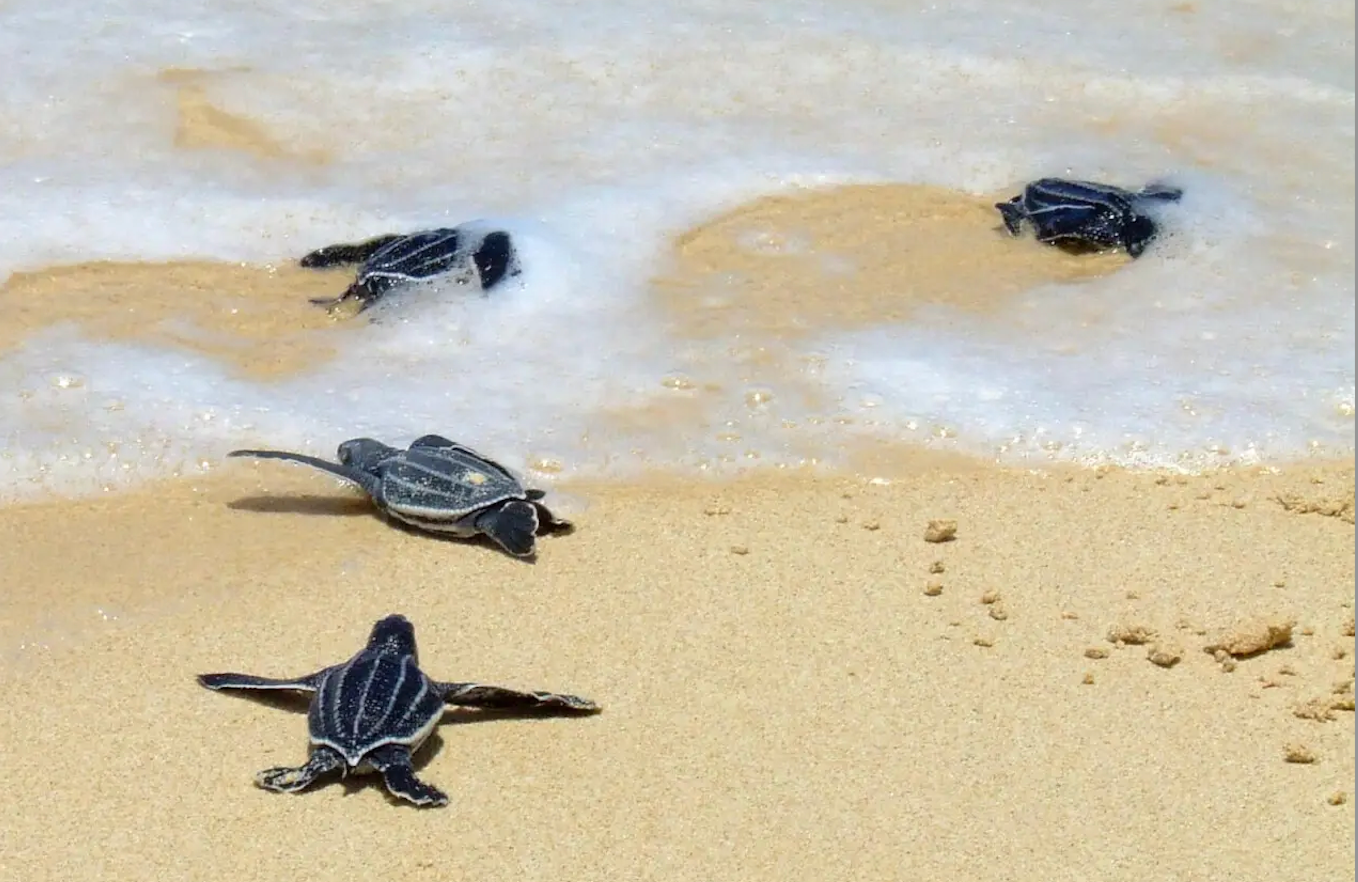
Banner image: Leatherback sea turtle hatchlings head to sea. Image by US Fish and Wildlife Service via Wikimedia Commons/ Animalia. (CC SA 3.0)
