
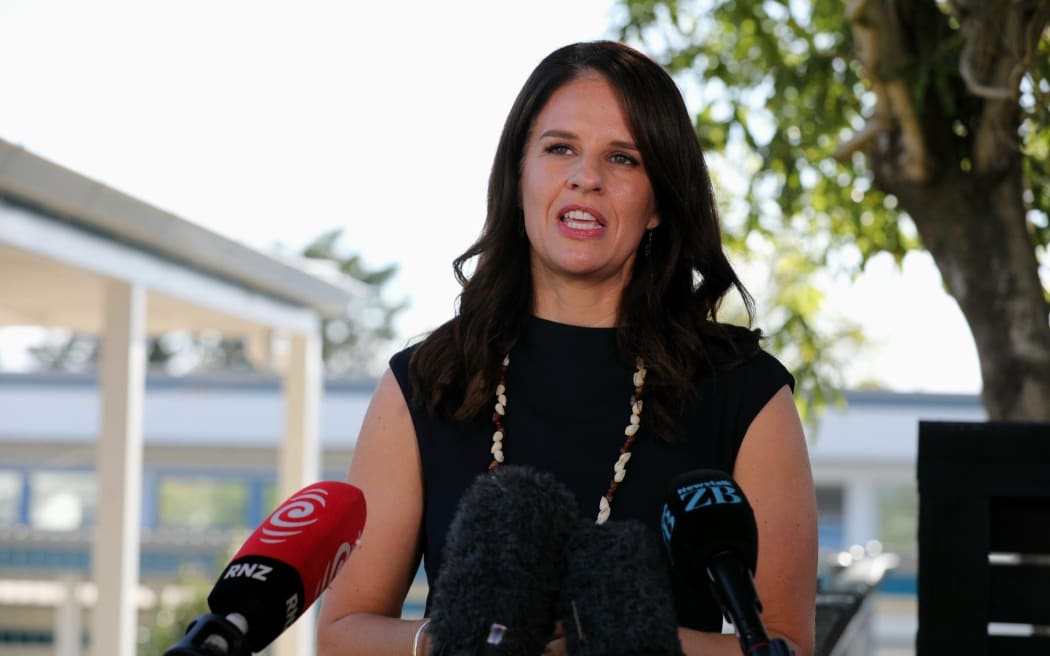
Photo: RNZ / Nick Monro
The government is considering making science a compulsory subject for Year 11 students when it replaces the NCEA.
Education Minister Erica Stanford on Thursday confirmed the government would go ahead with the plan announced last year to replace NCEA with a new two-level qualification.
It would abolish NCEA level 1 in 2028 with the new qualification introduced for Year 12 students in 2029 and Year 13 students in 2030.
Stanford said Year 11 students would sit a foundation qualification based on the current reading, writing and maths tests that students must pass to get an NCEA certificate.
She said English and maths would be compulsory at Year 11.
“From 2028, all Year 11 students will study English and maths, ensuring that every young person has the opportunity to experience deep learning in these core subjects,” she said.
“We are also considering whether science should also be compulsory at this level. It was something that was raised during the consultation and I have asked for further advice on.”
Stanford said without NCEA level 1, Year 11s would not be eligible for exam leave at the end of the school year.
“What this means in practice is there will be no exam leave at the beginning of Term 4 for Year 11 students. They will receive a full year of deep, rich learning right to the end of the year to fully prepare them for Year 12,” she said.
Stanford said the government’s decision followed consultation involving more than 10,000 people.
“The next phase, which we’ve been working on for some time, I’ll make decisions on shortly, will focus on the technical design, including achievement requirements, grading, the balance between internal and external assessment, exam weighting, moderation and comparability,” she said.
“These are complex, interlinked decisions and are being worked through very carefully by a technical advisory group who will be working alongside my professional advisory group”.
NCEA harder to fail than pass
Stanford said NCEA’s shortcomings were well-known and one student had told her the qualification was harder to fail than it was to pass.
“It’s become increasingly fragmented, difficult to understand, too easy to game, and too often students have been able to accumulate credits without building deep knowledge within subject areas and giving them the skills and knowledge they need to succeed beyond school,” she said.
Education Ministry figures indicated most Year 11 students studied English last year.
There were 69,108 Year 11 students in 2025 and 61,687 were enrolled in English, 57,275 in maths and 1699 in remedial maths.
There were 45,500 Year 11 students enrolled in science last year, 3426 in physics, 2404 in chemistry and 3507 in biology.
Union criticises lack of detail
Post Primary Teachers Association president Chris Abercrombie said the lack of new details in the minister’s announcement was deeply concerning.

Post Primary Teachers Association president Chris Abercrombie
Photo: Supplied
He said the government should have made more progress.
“We were expecting an analysis of the consultation process on the changes, and what the new system would look like. Instead, we got a repetition of an announcement that was made seven months ago,” he said.
“Seven months is an extremely long time when you’re planning to introduce once-in-a-generation changes to secondary school qualifications and assessment the year after next.”
Abercrombie said the timeline for the changes was wildly optimistic.
“None of the material that the new system is supposed to be based on has even been written, let alone consulted on, absorbed and developed by teachers into classroom programmes,” he said.
More needed than just literacy, numeracy
The chairperson of the PPTA’s Secondary Principals’ Council, Steve McCracken, said a foundation qualification for Year 11 should include more than just literacy and numeracy.
“We need the option of a broader qualification that takes into account as many of each student’s strengths as possible, to give potential employers a good idea of what the young person can offer,” he said.
“We remain concerned that this narrow focus on numeracy and literacy will simply condemn many students to failure rather than enabling them to show their learning in ways that draw on their strengths. No parent wants their child to have doors close on them at age 15.”
McCracken said principals were also worried about the lack of clarity around the development of vocational subjects in the new system.
“Today’s ‘announcement’ did nothing to allay these concerns. The new Industry Skills Boards have been charged with putting in place a fully developed vocational assessment system by August, but they have only just come into existence. Also, it’s not clear that they have any staff who can write assessment material and there are no new curricula yet to develop the assessments from.”
Sign up for Ngā Pitopito Kōrero, a daily newsletter curated by our editors and delivered straight to your inbox every weekday.