
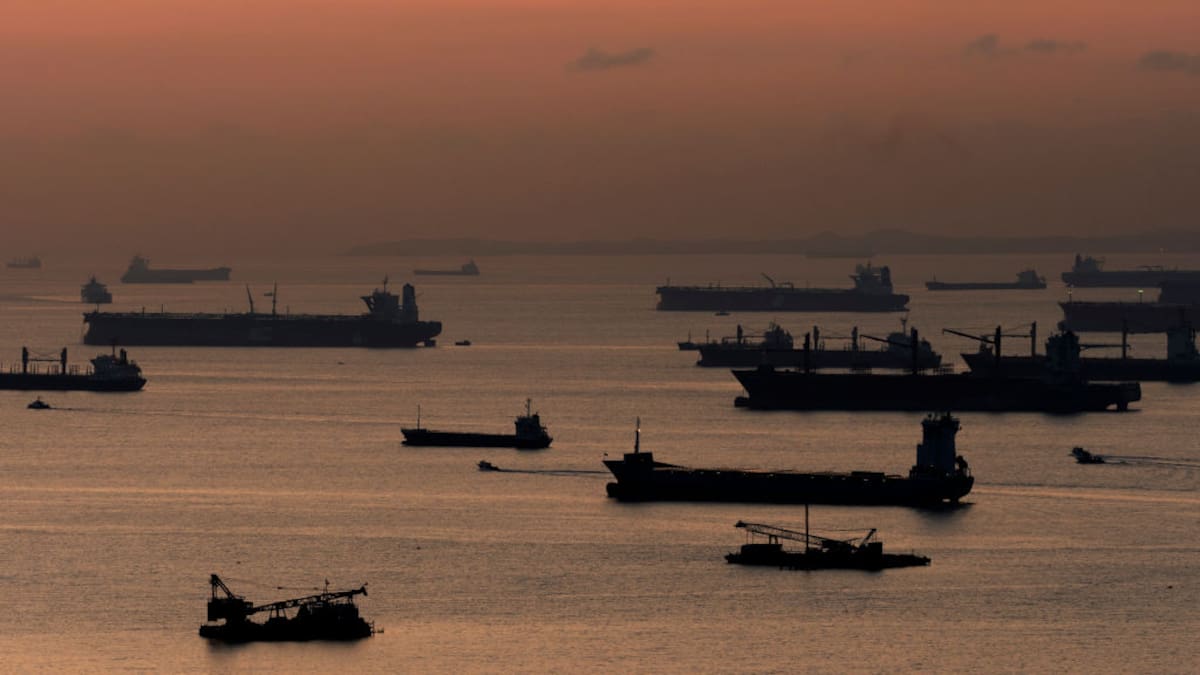
While transmitting data does not break down the type of fuel carried – petrol, avgas or diesel – this volume suggests enough to cover New Zealand’s typical fuel use for 15 days.
The tankers all recently departed Singapore and South Korea – New Zealand’s primary sources of refined fuels – and are making their way through the Pacific.
The energy supply update from the Ministry of Business, Innovation and Employment (MBIE) on Wednesday originally indicated only two fuel tankers were scheduled to land within two weeks from last Sunday, March 22.
On Thursday MBIE issued an urgent update, clarifying that some vessels listed as “on water” and more than a fortnight away were in fact discharging fuel or arriving within the next few days. The clarification boosted the stocks of diesel that were in New Zealand or on the way for the period up to April 12 to 46.4 days’ worth.
Tracking from Starboard Maritime Intelligence shows six fuel tankers heading to New Zealand remain on schedule.
Starboard analyst Mark Douglas said the ongoing conflict had caused traffic through the Strait of Hormuz – a key chokepoint for oil exports out of the Gulf – to diminish significantly.
A handful of vessels were still transiting daily, typically keeping to the coastal waters of Iran, but Douglas said significant commercial traffic had dropped from 60 passages a day on average before the conflict to just five.
Douglas said second-order effects, chiefly on refineries that process crude oil from the region into useable fuels, had begun to be felt in our part of the world.
“Singapore is readjusting its supplies and looking at other sources, Africa and further afield, and seem to be using more smaller tankers to keep their flow of fuel up. And Japan and Korea are certainly also scrambling to get their fuel levels up too,” he said.
Gulf producers had also activated pipelines to shift oil to ports beyond the Strait of Hormuz, but Douglas said this could not “quite make up for the entire infrastructure of the Gulf”.
Douglas said New Zealand’s incoming tanker traffic had showed a shift in behaviour.
“We are seeing vessels that are saying that they’re headed into New Zealand, and they’re taking interesting, possibly longer routes, which indicates that maybe the owners haven’t quite decided where the fuel is going to go yet. The vessels, where they’re saying they’re going is just an indication, and they’re still open for buying on the world market,” he said.
Douglas said he and Starboard would continue monitoring incoming tanker traffic, but the real risk for New Zealand would come from a prolonged closure of the strait.
“It’s seeing a tightening of all the supply chains, because it’s not just the fuel that the tankers are carrying – it’s also the fuel that supplies the ships that come here. It’s the routing of vessels to be able to pick up fuel, where they can get it, and come to the countries where they need to go,” he said.
Douglas said the movement of containers – both empty and full – was also a risk that spilled over into exporting generally.
“The easy answer to the medium-term outlook is all about risk: the longer this goes on, the more acute the risk is,” he said.
Matt Nippert is an Auckland-based investigations reporter and ICIJ member covering white-collar and transnational crimes and the intersection of politics and business. He has won more than a dozen awards for his journalism – including twice being named Reporter of the Year – and joined the Herald in 2014 after having spent the decade prior reporting for business newspapers and national magazines.
Stay ahead with the latest market moves, corporate updates, and economic insights by subscribing to our Business newsletter – your essential weekly round-up of all the business news you need.