
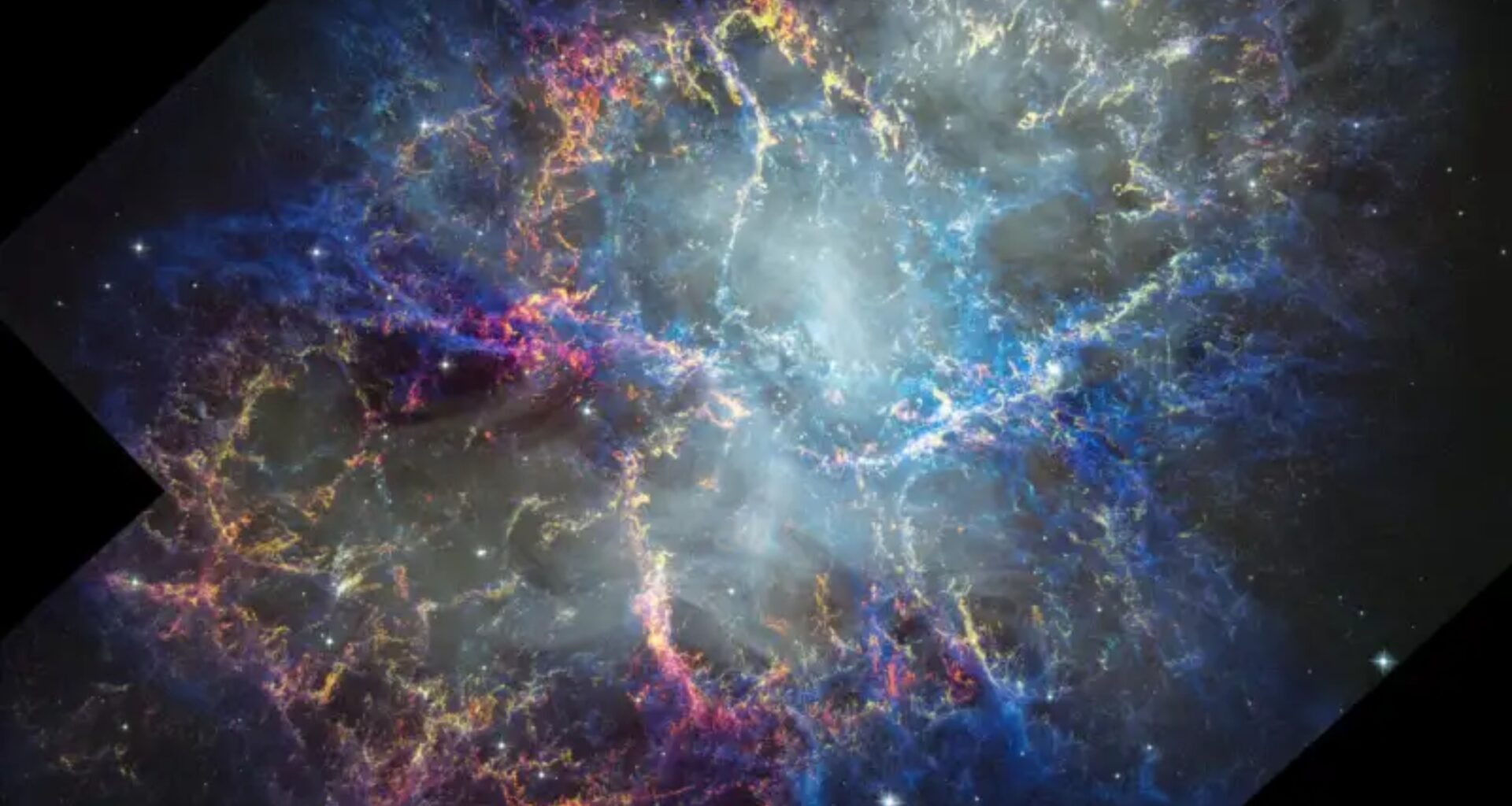
The Crab Nebula has been expanding ever since a star exploded nearly 1,000 years ago – but until now, that motion has mostly lived in static images.
Instead of a frozen cloud of debris, the nebula reveals itself as a system that is still actively reshaping.

Its filaments drift outward in a surprisingly organized way, challenging what scientists thought they knew about supernova remnants.
Motion seen across decades
In paired Hubble images taken decades apart, the nebula’s filamentary structure appears shifted outward while retaining nearly identical shapes.
By aligning those observations, William Blair at Johns Hopkins University showed that the same strands of debris could be tracked as they advanced across space.
Across the nebula, outer filaments moved farther than those near the center, yet none showed signs of stretching or distortion.
Such uniform outward motion indicates that a sustained force from within continues to shape the expansion rather than leaving it to dissipate over time.
Tracing nearly 1,000 years
Because Chinese astronomers recorded the supernova in 1054 – visible even in daytime – Hubble’s repeat portrait stretches a documented story across nearly 1,000 years.
Hubble first mapped the nebula, about 6,500 light-years away, in 1999 and 2000, then returned in 2024 with a sharper camera.
By reprocessing the older mosaic, the team turned two familiar images into a clearer record of change.
“However, with the longevity of the Hubble Space Telescope, even an object like the Crab Nebula is revealed to be in motion, still expanding from the explosion nearly a millennium ago,” said Blair.
The engine inside the nebula
At the center sits a pulsar, a crushed stellar core spinning and blasting radiation, and its energy keeps pushing the nebula from inside.
Charged particles stream away from that core, and their turns through magnetic fields create synchrotron radiation, the nebula’s bright inner glow.
Unlike remnants driven mainly by old shock waves, the Crab receives a continuing energy supply that keeps its expansion organized.
That steady push helps explain why the overall pattern held together instead of breaking into fast-changing knots.
Shadows reveal hidden structure
Some of Hubble’s most useful clues come from dark patches scattered across the nebula.
These are dusty filaments blocking light from behind them. If a strand casts a shadow, it must sit on the near side, in front of the glowing background.
Interestingly, some bright filaments cast no shadow at all, suggesting they lie on the far side instead.
Together, these light-and-shadow patterns turn what looks like a flat image into a rough three-dimensional map – something that will become even clearer with future observations.
Colors tell a deeper story
Color changes across the new mosaic are not just decoration – they trace real differences in gas temperature, density, and chemistry.
One filter isolated hydrogen, while others emphasized oxygen and sulfur, letting the team compare thin haze with denser knots.
In many places, the diffuse oxygen glow spreads beyond compact cores, showing where lower-density gas stays more exposed.
That pattern matters because it separates structure from composition, even when both influence the same patch of light.
Infrared reveals hidden dust
Before Hubble returned, Webb had already shown the Crab in infrared light, but the older optical mosaic had grown outdated.
That closer match in timing made sharper side-by-side comparisons of warm dust and infrared emission possible.
Webb observations revealed dust grains packed into the innermost dense filaments, where infrared light catches material that optical light misses. Used together, the two telescopes begin to separate dust, gas, and particle glow into a fuller story.
Crab nebula’s glow shifts
Beyond the bright filaments, the nebula’s smooth interior glow also changed between 2000 and 2024.
Patchy differences in the optical light suggest that the flow of energetic particles has shifted on large scales over time.
When the team compared optical light with Webb’s longer wavelengths, the outer edges appeared relatively brighter in infrared.
That likely reflects cooling, because particles lose energy as they travel, so shorter-wavelength light fades first.
Strange structures in the nebula
Buried in the wider mosaic, two compact filament groups stand out on opposite sides of the pulsar.
Neither cluster changed much in shape across the 25-year gap, which makes their origin harder to pin down.
Velocity measurements broke the symmetry, with the northwestern feature moving mostly across our view and the southeastern one moving toward us.
Iron emission makes both regions conspicuous, raising the possibility of shocks, although the team cannot yet rule out other causes.
Motion with surprising stability
For all that motion, many bright knots in the Crab Nebula barely changed in shape or brightness between observations.
That stands in contrast to other young remnants, where shock waves slam into clumps and trigger dramatic flickers.
Here, the filaments sit in a steadier bath of radiation from the pulsar rather than waiting for single violent hits. That unusual mix of movement and stability makes the Crab an especially clean place to watch how a supernova’s aftermath evolves over time.
And that evolution is still underway. Nearly 1,000 years after the explosion, the Crab remains an active system shaped by dust, radiation, and motion – not a frozen relic.
Future side-by-side observations from Hubble, Webb, and other telescopes should reveal how this shifting structure continues to reorganize itself.
The study is published in The Astrophysical Journal.
Image Credit: NASA, ESA, STScI, W. Blair (JHU)
—–
Like what you read? Subscribe to our newsletter for engaging articles, exclusive content, and the latest updates.
Check us out on EarthSnap, a free app brought to you by Eric Ralls and Earth.com.
—–