
Stay up to speed with stories written by drivers, for drivers.
Get automotive news, DIY tips, market trends, in-depth car profiles, and more right in your email inbox.
Going into orbit has always been expensive. A typical NASA Space Shuttle mission, for example, pulled a whopping $2.24 billion (adjusted for inflation) from federal coffers, which put a lot of pressure on the program’s engineers and managers to make sure that every component escaping the surly bonds of Earth had been thoroughly vetted on the ground beforehand.
That might be simple enough to do for things like integrated circuits and pod bay door hinges, but not every part of the Space Shuttle could be thrown onto a test bench in a lab and given the OK. This was particularly true of aspects of the vessel that were crucial during its landing phase, whose conditions couldn’t be easily replicated outside of actually dropping the glider from above and hoping for the best.
Tires, in particular, posed a major challenge. The Space Shuttle was an enormously heavy piece of gear, weighing nearly a quarter of a million pounds, and when it hit the runway it was traveling at speeds approaching 220 miles per hour. To make that even close to feasible, the front tires were filled with 300 pounds per square inch of nitrogen, with the main tires pumped up to 315 pounds per square inch.
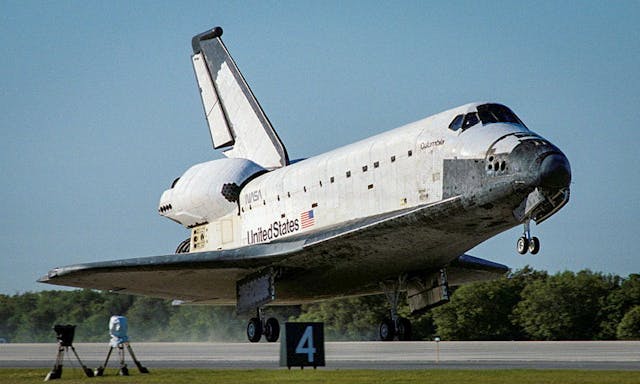 Columbia touching down at the Kennedy Space Center, 18 March 1994.NASA
If that sounds like a dangerous amount of pressure to be playing with—particularly when operating with such enormous weights and neck-snapping speeds—you’d be right. The lifespan of these tires was measured in single missions for the main landing gear, with the front tires lasting two under ideal conditions.
NASA had to get creative to ensure the safety of the Shuttle and its occupants at landing time. In a weird twist, the eventual solution to keeping the Administration’s tire testing as safe as possible tagged in one of the most popular model car companies in the world, vindicating millions of hobbyists and proving that to think big, sometimes you first have to get small.
Too Big To Fail (Safely)
Much of NASA’s Space Shuttle tire testing involved what could be considered more traditional processes. In addition to using tire dynamometers, a 57-ton test rack was built in Langley, Virginia, to accelerate tires to 250 miles per hour in just two seconds, moving them down a nearly 3000-foot track before slamming them into the ground to simulate wear.
 NASA
NASA
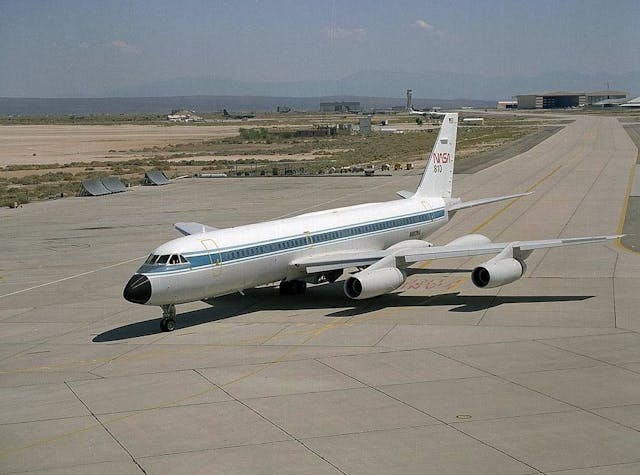
On the more exotic side, program engineers converted a Convair 990 four-engine jet airliner into a mobile test bed that could simulate a vast range of Shuttle landing profiles, all computer-controlled. It was a successful platform that helped NASA understand how to better get the Shuttle on the ground in serious crosswinds, and it had the bonus of being able to travel to each of the three main landing strips used by the Shuttle so that varying surfaces could be taken into account.
 NASA
NASA
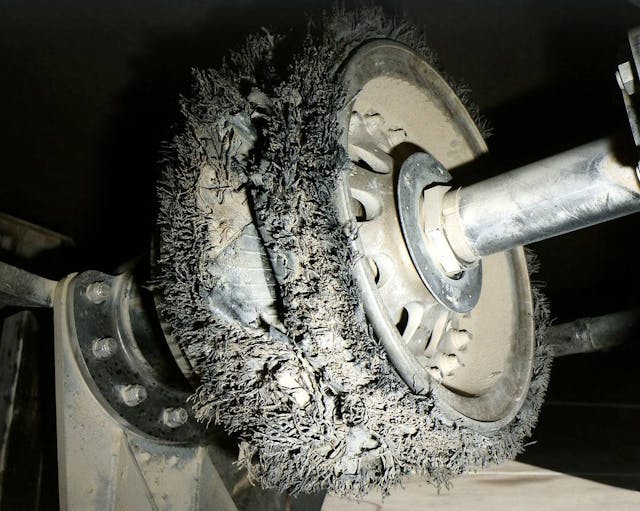
Sometimes the results were dramatic, such as a mid-’90s test where the Convair actually shredded a Shuttle test tire after rolling it on the rim, grinding it down to within four inches of the axle and causing a fire in the process. These kinds of ‘push it until it breaks’ tests were necessary to find out how the Space Shuttle would react in extreme landing conditions, but safety concerns meant that these flight tests often invited danger even after the Convair had taxied to a halt.
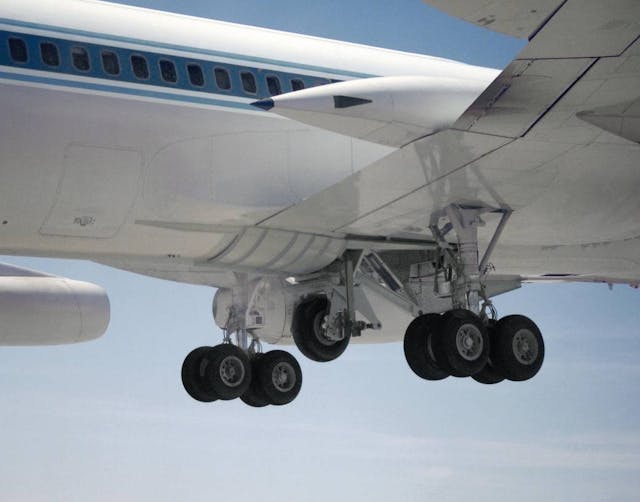
One of the greatest risks centered on the consequences of a blowout on landing. Each of the Shuttle’s tires weighed upwards of 230 pounds and had a diameter of 44 inches. There were six in total, each mounted at a vulnerable spot underneath the vessel’s fuselage.
Poor performance from the Shuttle’s braking system on early missions drove home how much was riding on this rubber, and how much danger it was in during the landing process: of the first 17 landings, 14 resulted in cracked brake rotors. It was easy to see how a wayward bit of brake could cut a sidewall and result in a dangerous situation. In fact, a blowout had already occurred when the Shuttle was forced to land during heavy crosswinds that put a huge amount of stress–40 million pound-feet (yes, you read that right, check out the above link for more details)—on the right side of the craft.
NASA classified Shuttle tires on a three-color explosion safety scale: green for no danger, yellow for a ‘risk’ of detonation, and red for rubber that’s on the verge of popping. The ratings were developed based on the tire’s pressure, its wear, and the heat of the moment. Both the Shuttle and the Convair test plane were capable of pushing these tires to the brink, and if an explosion didn’t happen on the runway, under some circumstances the surviving rubber became a ticking time bomb. Yellow-grade tires were thought to be dangerous for up to an hour after landing, but it wasn’t an exact science, and there was no way of knowing when they would detonate or what would set them off.
In the early 1990s, NASA was in the middle of upgrading the Shuttle’s landing gear, and found themselves in a bit of a safety pickle as hard landing after hard landing punished the Convair’s tire test rig. It’s here that an unlikely NASA partner—Tamiya—stepped into the breech to save the day.
Not Your Average Blow-out
 NASA
NASA
To put the power of a 230-pound tire pressurized to more than 300 psi in perspective, it holds enough energy to cause serious injury at distances as far as 100 feet should it be released all at once. It’s roughly the same effect as lighting 2.5 sticks of dynamite and tossing it under the fuselage of a very expensive airplane surrounded by a very fragile ground crew.
NASA had already run through the gamut of how it could defuse a post-testing “red” or “yellow” Space Shuttle tire from a distance without putting its people at risk. Predictably, the first efforts involved bomb disposal robots, but they were found to be too clunky to control with the precision required to properly pop a tire mounted under the Convair. Remember, these relatively simple bots are designed to grab a bomb and lug it somewhere safe to be blown up, rather than provide a stable platform for the fine-tuned drilling required to pierce the Shuttle’s sidewall and instigate a safer blow-out.
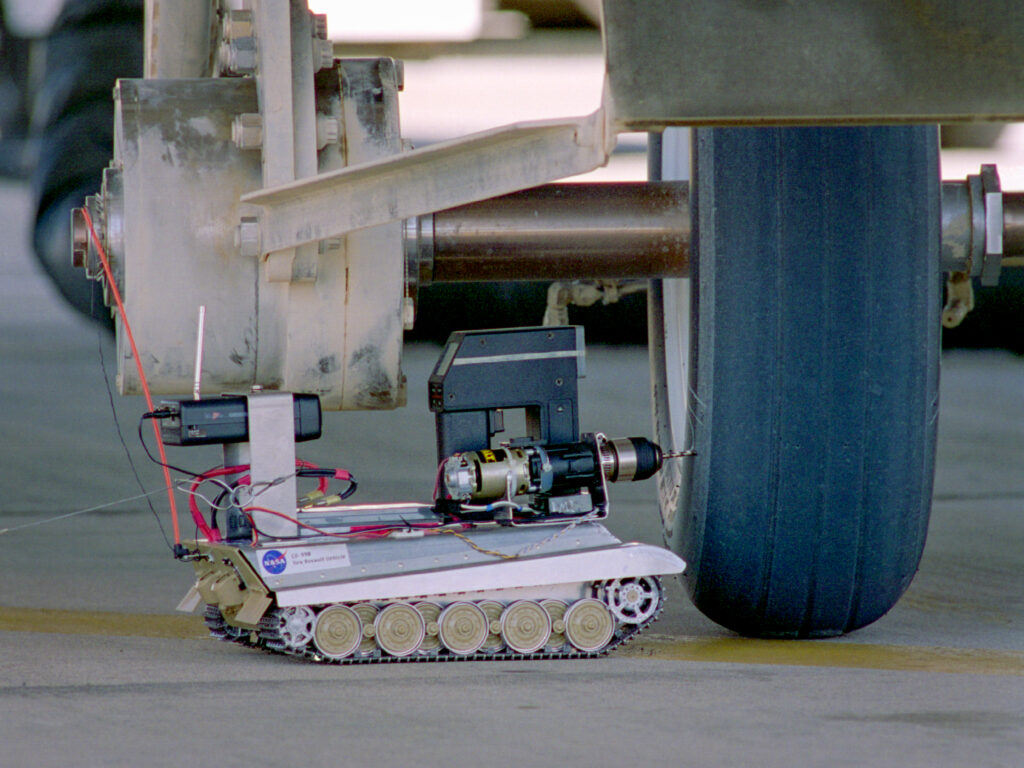
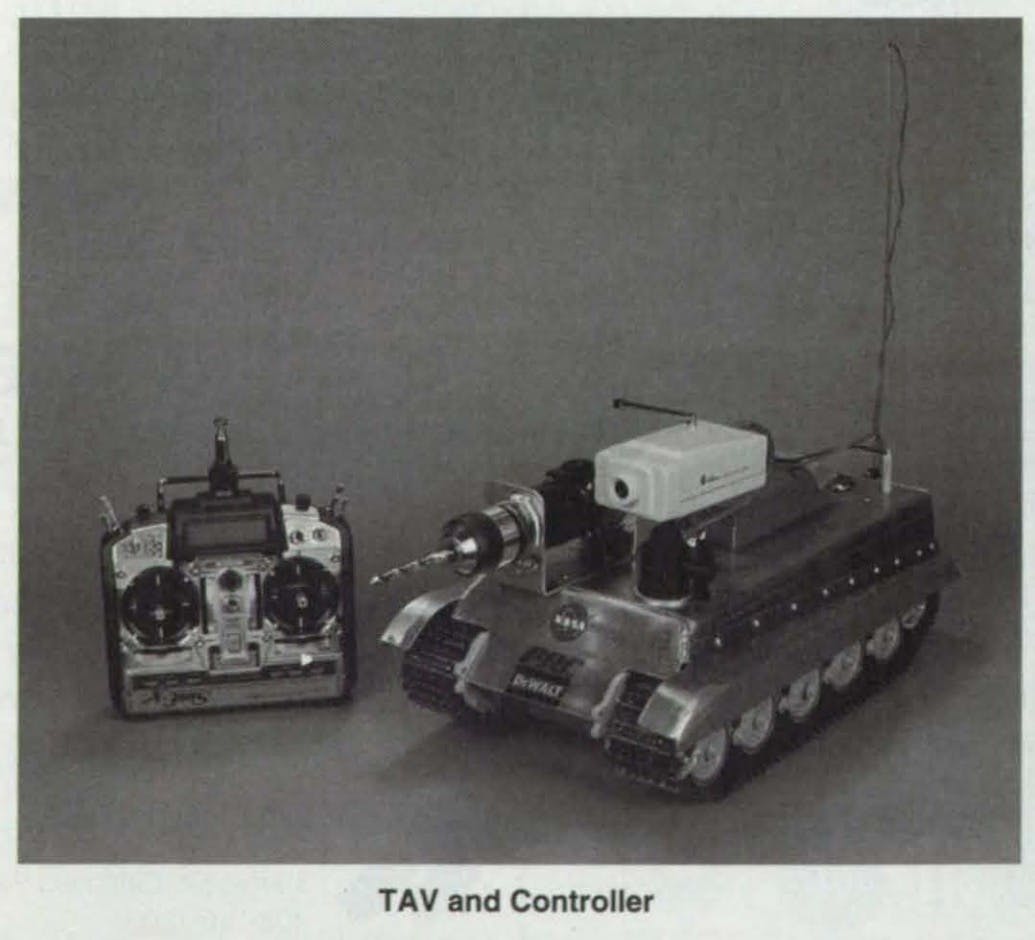
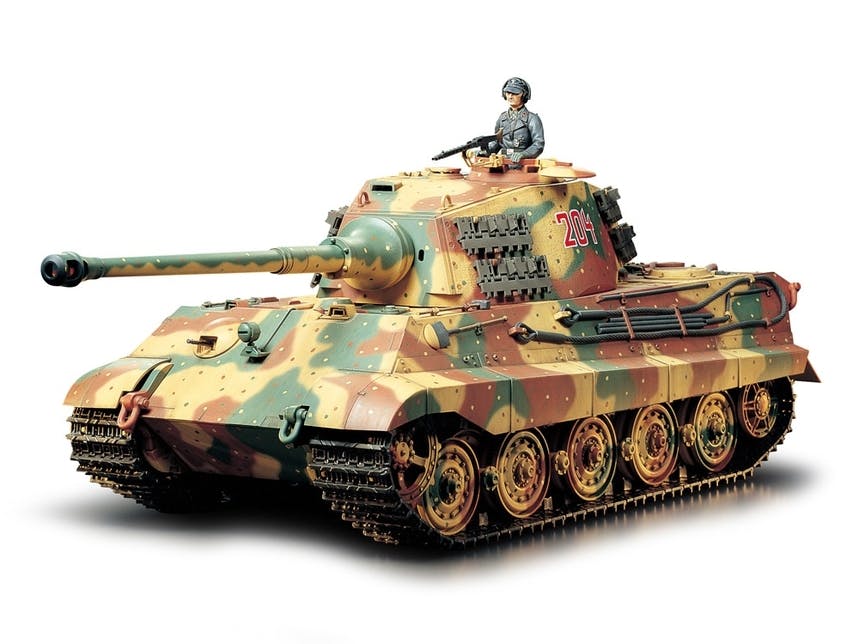
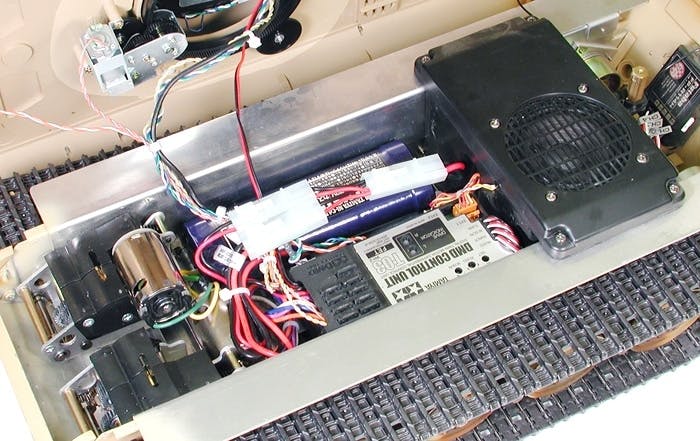
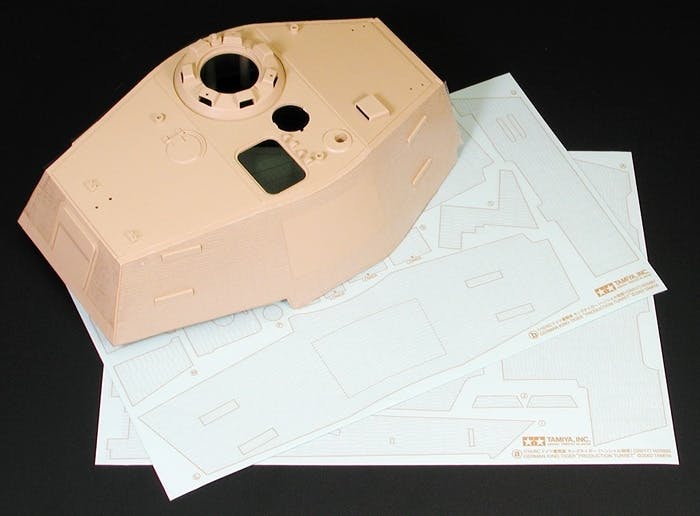
This is where NASA—or, more specifically, where one of the Administration’s contractors, David Carrott—got creative. Rather than design and develop a bespoke tire-testing robot at considerable expense, Carrott simply grabbed an off-the-shelf remote control tank and got to work. Basing his design on Tamiya’s 1/16 –scale Tiger II (which, in perhaps the least-known NASA connection to Operation Paperclip, was a German Wehrmacht design from World War II), he stripped the top half and kept the tracked base to use as the mobility component of his drill-equipped machine.
 NASA
NASA
Featuring DeWalt motors and a Black and Decker battery, the Tire Assault Vehicle (creatively named by Carrott) could be navigated via a live video feed, making it perfect for approaching the sweet spot of the Shuttle tire’s sidewall. There, using its camera and its infrared temperature probe, it could find the right spot on the tire to begin drilling using a three-eighths bit, with the goal of releasing pressure as slowly as possible.
Not only was it 97 percent cheaper than the $75,000 to $125,000 bomb-bots NASA had first tried to use, but it was also eight times lighter and more than five times quicker to set up and get into action on the runway. It was also remarkably resilient, surviving nine tire explosions out of the 32 drill-down missions it attempted. The original Tire Assault Vehicle is still viewable at the Armstrong Flight Research Center at Edwards Air Force Base in California, where it proudly wears its interstellar battle scars.
Build Your Own TAV
 Tamiya USA
 Tamiya USA
 Tamiya USA
 Tamiya USA
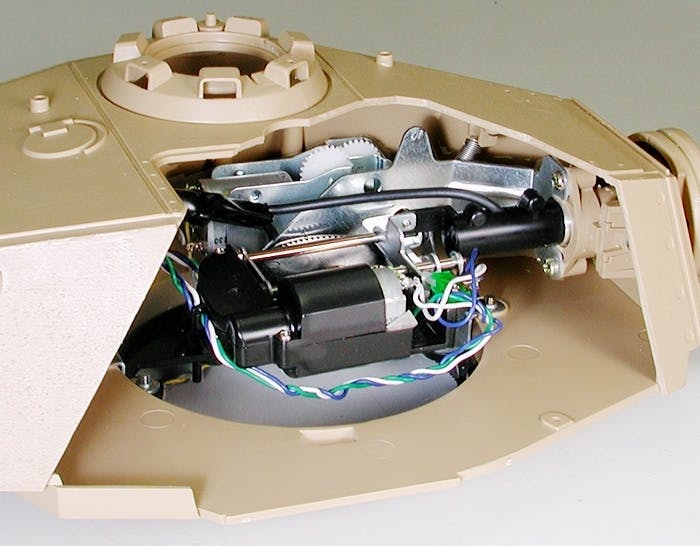
Want to build a Tire Assault Vehicle of your own? While you could always just slap a TAV sticker on an R/C muscle car and call it a day, those seeking true NASA-level authenticity will be pleased to know that the Tamiya kit used by Carrott is still available. Sold as the King Tiger Heavy Tank, it costs about $1300, plus whatever you spend on batteries, drill bits, and GoPro cameras so you can address stressed tires of your own without fear of bodily damage.
We’ve all heard the jokes about NASA spending a million bucks designing a pen that could write in zero gravity, while the Soviet Union just used pencils. While that tale might be apocryphal (with a few elements of truth thrown in to help it pass muster), wasteful government spending is far from an urban legend. The Tire Assault Vehicle managed to save lives while whimsically justifying the obsessive efforts of remote control vehicle fiends, making it perhaps the most fun example of stretching a dollar to emerge from the space program.