
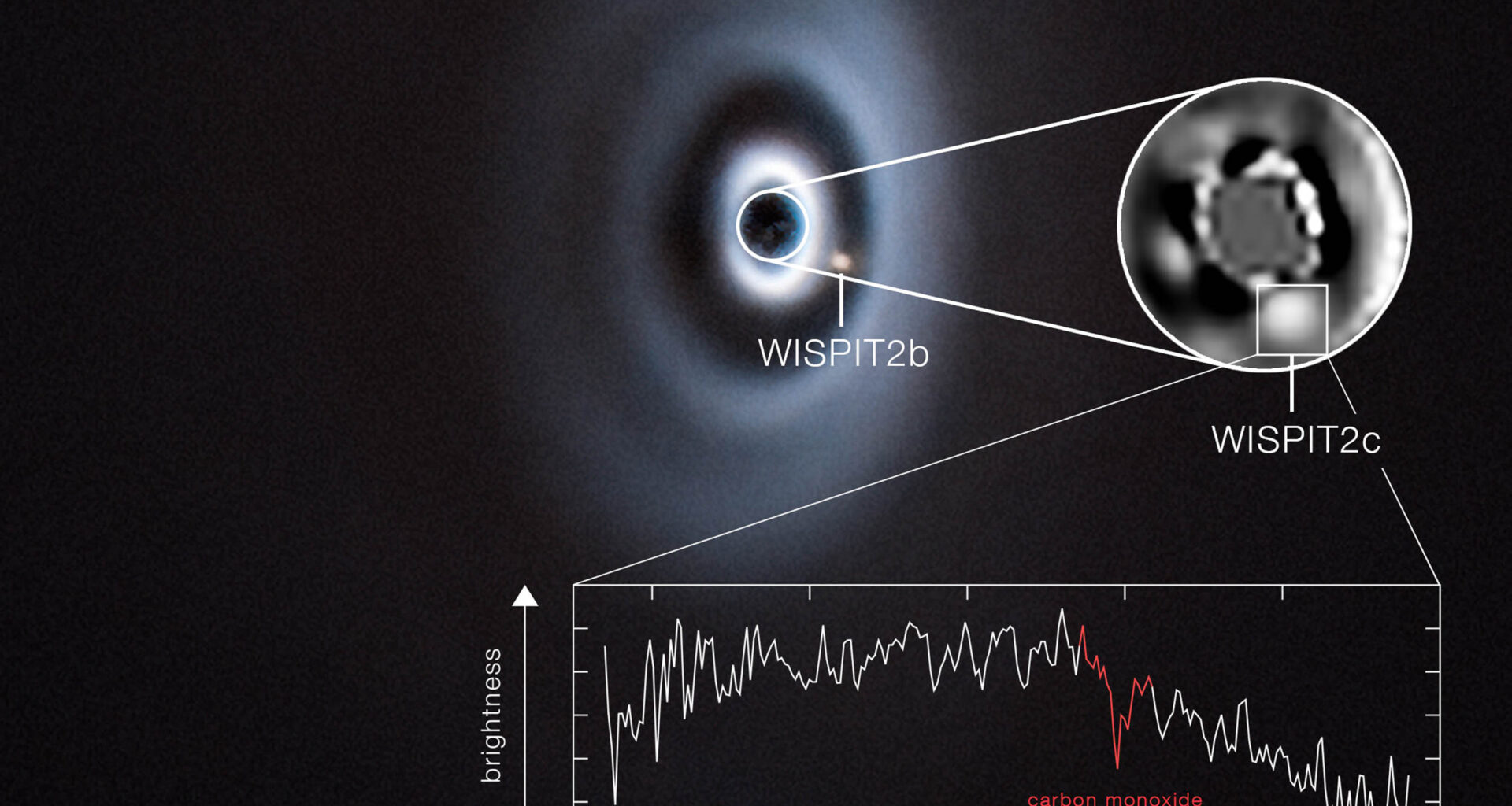
Space is messy when a planet is being born. Dust swirls, gas stretches into rings, and gravity pulls matter into clumps that may one day become planets.
In one distant system, that process is happening right now, and astronomers have just spotted something rare inside it.

A second giant planet is forming around a young star known as WISPIT 2. The system sits in the constellation Aquila, visible in the northern sky between July and November.
This fresh find places WISPIT 2 among only a handful of known systems where multiple planets are still taking shape.
The WISPIT 2 star system
WISPIT 2 is about five million years old, which makes it a cosmic newborn. Around it spins a wide disk of gas and dust, marked by rings that hint at hidden activity.
Inside that disk are now two confirmed planets: WISPIT 2b and the newly identified WISPIT 2c.
WISPIT 2c stands out. It is likely about ten times the mass of Jupiter and sits much closer to its star than its sibling.
It orbits four times nearer than WISPIT 2b, which makes it extremely hard to spot because the star’s brightness overwhelms it.
Scientists behind discovery
The research was led by Ph.D. student Chloe Lawlor from the University of Galway, working with Richelle van Capelleveen of Leiden Observatory and Guillaume Bourdarot from the Max Planck Institute for Extraterrestrial Physics.
Their work builds on last year’s discovery of WISPIT 2b, which had already hinted that something more might be hiding in the system.
Lawlor, Ph.D. describes the moment the team confirmed the discovery.
“Carbon monoxide is one of the key signatures we are looking for in young giant planets. When we saw it clearly in the data, that was when we knew we had something significant. There was definitely an element of disbelief,” said Lawlor.
“WISPIT 2 will become an important laboratory to study planet formation,” she said.
Finding WISPIT 2’s planet
Finding a forming planet is not easy. The star it orbits can outshine it by thousands of times, making direct observation nearly impossible with standard methods.
The team relied on the European Southern Observatory’s Very Large Telescope Interferometer in Chile’s Atacama Desert.
This system links multiple telescopes to act like one giant instrument. With the upgraded GRAVITY+ system, the team combined light from four 26-foot (8-meter) telescopes to peer close to the star.
“This allowed us to take what we call a spectrum, which is essentially a chemical fingerprint, revealing the elements and molecules in an object’s atmosphere,” said Lawlor.
That level of precision allowed them to detect carbon monoxide gas, a clear sign of a young gas giant’s atmosphere.
That chemical signal made all the difference. It confirmed that what looked like a faint feature in the data was not dust, but a planet still in the process of forming.
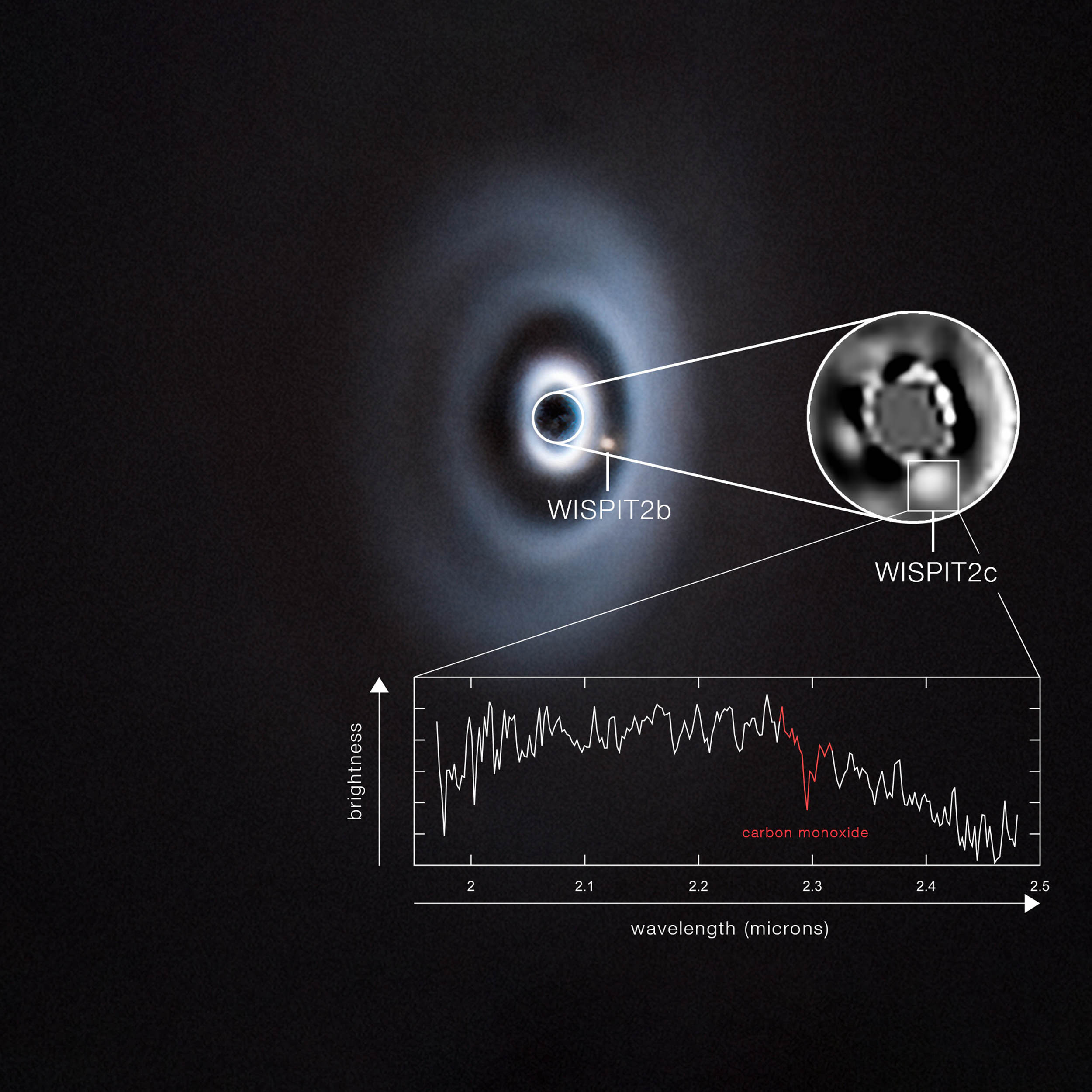 This image shows two planets forming around the young star WISPIT 2. The images at the top were obtained with ESO’s Very Large Telescope (VLT) using the SPHERE instrument. Credit: ESO. Click image to enlarge.Why WISPIT 2 matters
Only one other system like this has been confirmed so far, where multiple planets are still forming within a disk. That makes WISPIT 2 a rare window into how planetary systems begin.
Scientists believe our own solar system went through a similar phase billions of years ago. Gas giants like Jupiter likely formed early and shaped the rest of the system by influencing how material moved and clumped together.
Watching WISPIT 2 now offers a chance to see that process in action rather than reconstructing it from clues.
“Finding these young planets in formation is the culmination of a lot of work by scientists and engineers alike,” said Dr. Christian Ginski, co-author of the study and supervisor of the research.
“When I started out in my career, we had only a few hundred exoplanets discovered (as opposed to the many thousands that we know now) and being able to take a direct image of any planet was considered an incredible challenge. It still boggles my mind that now we are at the level where we can take a peek at the planets as they are forming,” he concluded.
Future of planet hunting
This discovery shows how far astronomy has come. Not long ago, scientists could only infer the existence of planets by watching how stars wobble.
Now they can detect the chemical makeup of a planet’s atmosphere while it is still forming.
“The discovery of the planet WISPIT 2c is a remarkable achievement and highlights the world-class astrophysics research taking place at University of Galway,” said Professor Frances Fahy, Director of the Ryan Institute at the University of Galway.
“Discoveries like this capture the imagination and can inspire a whole new generation of astronomers,” said Fahy.
WISPIT 2 is not just another distant system. It is a working example of how planets come together, collide, and settle into place. Every new detail adds to a clearer picture of how worlds like ours begin.
The full study was published in the journal The Astrophysical Journal Letters.
—–
Like what you read? Subscribe to our newsletter for engaging articles, exclusive content, and the latest updates.
Check us out on EarthSnap, a free app brought to you by Eric Ralls and Earth.com.
—–