
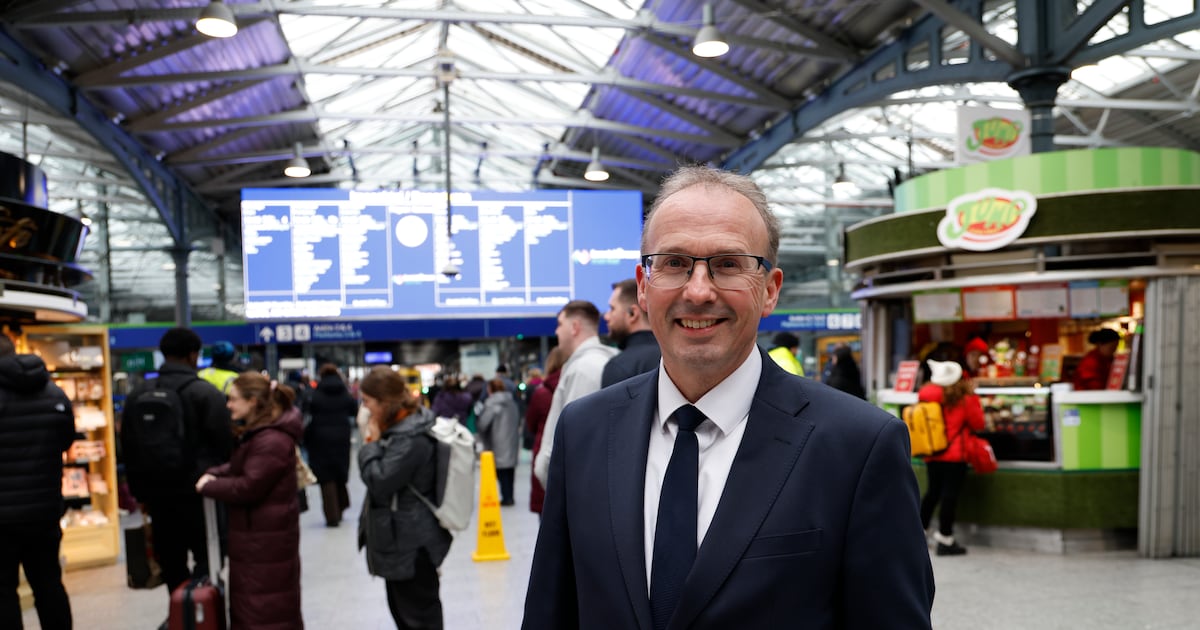
Stephen Kent opens a nondescript door and leads the way down a winding staircase to a part of Dublin’s Heuston Station that the vast bulk of the 27,000 people who travel through it daily probably do not know exists.
Beneath the main concourse, below the shops, restaurants and the feet of the eight million or so passengers who use the station each year, is a warren of white-walled passageways.
Kent points to the open shelving along the walls containing bound volumes – the records of train companies going back to the Great Southern & Western Railway that have operated from the Heuston site which itself dates back to the famine era.
The Irish Times spotted one bound volume inscribed with the date 1865. Kent says some are older.
But there are not only written records. Behind one regular door there stands what used to be a cell for holding prisoners being taken by train to court or prisons around the country.
Kent is the new chief executive of CIÉ, the State-owned transport group that includes Dublin Bus, Bus Éireann and Irish Rail.
He has been in the role for nearly three months, having previously spent seven years running Bus Éireann, which operates the Expressway routes across the State as well as city services outside Dublin and school transport.
Enthusiastic about the history of the organisation, he says work is under way to digitise, archive and securely store the historical records in the basement rooms below the station.
Kent describes the archiving initiative as “a critical project” for the organisation. He says CIÉ is seeking to find a proper building to house the records and is liaising with the Office of Public Works.
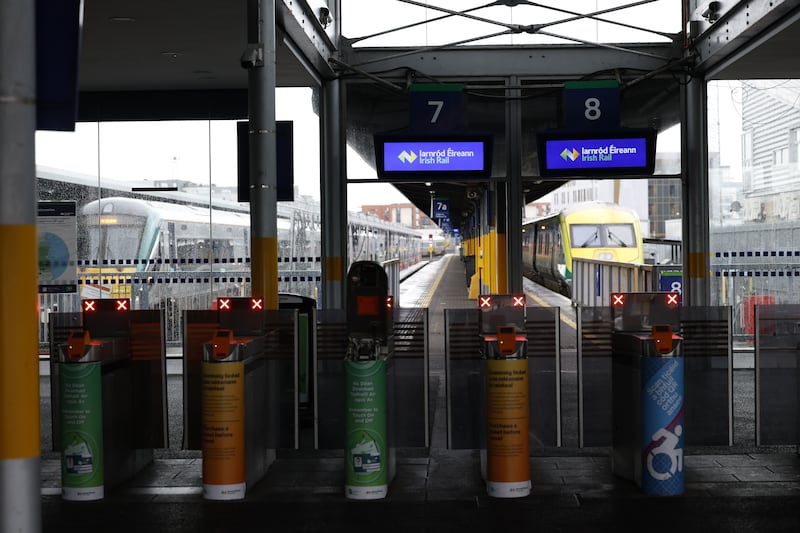 Heuston Station: A key project announced some years ago was the Heuston Masterplan involving redevelopment of the area around the station and the bus depot at Conyngham Road. Photograph: Nick Bradshaw
While he is “thrilled” to have the store rooms beneath the concourse at Heuston Station, they are “not perfect”. The river Liffey is very close by and the floors show signs of water damage from some point in the past.
The bound volumes in the Heuston basement are not the only records in the group’s possession. “We have these right across parts of Ireland. We should be trying to preserve [them]. I keep saying we have to be proud of the past, but we have also to look to the future.”
CIÉ itself is now more than 80 years old, having come into being in January 1945 under legislation that brought together the Great Southern Railways, which operated bus, rail and lorry services, and the Dublin United Tramway Company.
Further reforms in 1987 saw the establishment of three operating companies as subsidiaries of CIÉ – Dublin Bus, Irish Rail and Bus Éireann. An overall CIÉ Holding Company remained as part of the structure.
But with the private sector now operating in the bus market and various other regulatory and funding bodies such as the National Transport Authority, Transport Infrastructure Ireland and the Department of Transport all in place, what does the CIÉ holding company actually do?
“We are the shareholder for those [subsidiary] companies”, Kent says. “So we have our responsibilities on governance, on codes of practice, on financial sustainability, on banking, investment.”
In December 2024, NewEra, which advises the Government on its shareholding in some State companies, drew up a report which Kent says was less about command and control by the group and more about the companies collaborating. He says the notion of things being better together came out as the overarching desire in the company.
The group provides an extensive range of shared services for the subsidiary companies, Kent says, while it also operates CIÉ Tours – which he says facilitated 35,000 visitors to Ireland last year – and manages a large property portfolio.
“We’ve a whole bundle of shared services and we run them and recover costs through the operating companies. Those services include property management, claims management [and] insurance, where we have to deploy it. We have a group IT and telecoms structure – including cybersecurity as well as treasury.”
He says the group has also been looking at artificial intelligence and its potential.
Pensions
However, the key issue at present for the group is the future of its two superannuation schemes, which have faced enormous potential deficits in recent years. That has resulted in more than 6,000 retired personnel not receiving any pension increases for the past 18 years.
A deal was reached last May between the company and its unions which would see a sliding scale of increases of up to 5 per cent under a formula calculated on the basis of an individual’s date of retirement.
[ CIÉ group pensioners to get increase after 17 yearsOpens in new window ]
More than nine months later and despite the public support of the Government, frustration is growing among the retired staff that there has been no sign of the promised pension rises.
The Irish Times reported last month that former CIÉ workers were planning a protest march to the office of the Taoiseach in Cork to highlight the delay, arguing that at a time of increasing costs of living, some were struggling to get by on pensions as low as €10,000.
Kent says everyone wants to see the pension increases happen. However, he says the issue is complex and the deal requires the appropriate building blocks to be put in place to underpin it. These include the establishment of a new defined contribution scheme before the Minister for Transport and the Minister for Public Expenditure can provide formal consent. He says new statutory instruments are in the process of being developed.
The company had been carrying arguably the largest pension deficit in the State, he says. At one point, that was estimated to be more than €900 million before later actuarial evaluations set it at about €361 million at the end of 2024.
The more the company continues to expand, the more you continue to expose yourself to potential risks
— Stephen Kent
He suggests the planned reforms will need to look both at investment strategy and the structural arrangements required to put the new defined contribution scheme in place.
While many semi-State organisations had assets invested in bonds, “CIÉ at the moment has probably more proportionate in terms of equities”, he says. “And it needs to arrive in a place where we’ve got more in bonds, where it’s safe.”
Kent says where CIÉ is “offside at the moment” is that it is a growing company where new personnel are being enrolled into defined benefit pension schemes which already have significant deficits.
“We have a scheme open to defined benefits and that is completely at odd to what’s happening in the rest of the semi-State sector. Secondly, at the moment here, the group has just over 13,000 employees. If you take the last year alone, across the group – largely because of all of the expansion – nearly 700 people have joined. But the more the company continues to expand, the more you continue to expose yourself to potential risks.”
Kent maintains that if the pension arrangements had continued unchanged, estimated liabilities could have reached €4 billion in the next 10 years.
“Now that is clearly unaffordable. That is an existential threat.”
Establishing the new defined contribution scheme, creates a better investment framework long term, he says. “Certainly, it will stabilise where we are. It brings the business back to a solvent position.”
Kent says that when the pension issue is resolved, “the business then needs to develop greater commercial resilience so that we can continue to provide services that are not entirely reliant on the State”.
Since Covid, the three operating companies have seen a boom in passenger numbers. However, many of their services receive State subsidies through the National Transport Authority (NTA) which, in turn, receives fare revenue generated from passengers.
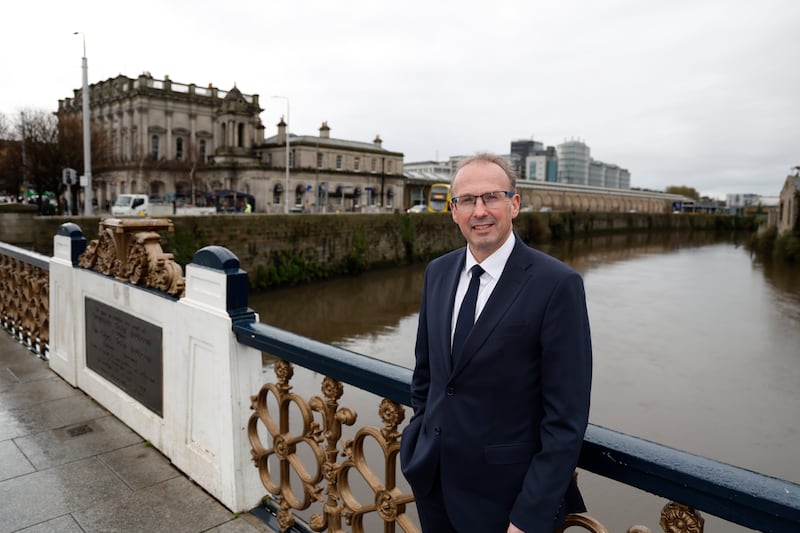 Stephen Kent: ‘It was always marketing,’ he says of his career path, ‘either developing or innovation, trying to look through the consumer lens as much as I could.’ Photograph: Nick Bradshaw
Even some of the money received from bus advertisements goes back to the NTA because it was part of public service obligation revenue at one point, as does some income generated from the group’s properties.
Some activities are purely commercial, such as the Expressway network run by Bus Éireann. But Kent says, even there, revenue has to be used, in part, to buy vehicles.
“So you can see, if you were looking at the profit and loss [accounts] of each of the individual companies, the company isn’t cash rich and a lot of what we’ve been trying to do at the moment is sustain ourselves by delivering a lot of public service obligation operations.
“And while we might have cash in the bank, our free cash flow, really, when you take out all of the working capital and what gets paid back [to the NTA] is not at a level yet that I believe the company should be at. And this is where I believe there might be much greater focus.”
He says this should be for no other reason than for investment in facilities which are not underwritten by the State.
Looking around the1848 Heuston building, he says, “we do have legacy properties, we do have commercial vehicles and we have strands of our technology that relate to commercial investments and not the public service obligations. And there are a number of other initiatives that go on across the group, like people initiatives that are not directly funded”.
While the group has at as its foremost objective the delivery of Government policy and its transport operations, “we also have to be able to find out if there is more commercial opportunity in the business. And, I believe, there is.”
Kent has a family background steeped in business. He is from Tramore in Waterford and says his family goes back “six generations selling deckchairs on the promenade”.
His father was a printer, while he went to the University of Limerick to study marketing. He worked with Tony Ryan at GPA for a period and later for the Dwans drinks company before moving to Waterford Foods and working for Premier Dairies.
“I‘ll tell you, you get the understanding of margins when you move into the milk business. And out of that, I got interested in the value added part of it and got transferred, working in innovation at Yoplait in Dungarvan and Kilmeaden cheese.
“I got picked up out of Waterfood Foods and moved into Waterford Crystal at an exciting time when [it was] developing the John Rocha [brands] and you had the millennium flutes and Times Square [crystal] ball.”
In 2001, he moved “up the road to Clonmel and Bulmers and that brought me into launching Magners (the cider brand) in 26 countries”.
“And then I found myself for a period on planes three times per week, which wasn’t great living in Tramore. I wanted to work on a national brand and to stay on the island for a while. ”
He says he was brought into Bus Éireann to do some work on its Expressway brand. This was at a time of deregulation, when the commercial and public service obligation elements of the business had to be segregated.
He eventually got the top job in the bus company, being in charge when Covid hit and lockdowns were introduced. He remembers well revenues just going off a cliff and he pays tribute to drivers who went to work, taking passengers – some in hazmat suits – to essential workplaces or to hospitals.
“So it was always marketing,” he says of his career path, “either developing or innovation, trying to look through the consumer lens as much as I could. I see it more so in this job. It is always looking to the future, never standing still and always being ready to collaborate.”
Outside of work, music is a strong theme running through his family. His wife teaches music while he has one daughter in Kerry, who works full time as a musician. Another daughter is based in Kilkenny, where she is a primary teacher.
Kent says living with three musicians meant he also had to play. He plays traditional Irish music. “I can play a bit of banjo, bodhrán and some guitar.
“Just before Christmas, my wife bought me, as a retirement present from Bus Éireann, some piano lessons. I am through my first eight lessons and looking to the next 10 years. That is a 10-year project”, he says.
As Kent moves into his new role at CIÉ, another significant issue will be how to unlock the significant landbanks owned by the transport companies to facilitate the delivery of houses and apartments, which is a crucial Government policy.
Kent says the group has already been involved in some projects, including the delivery of about 300 homes near the main train station in Cork.
He says “broader policy initiatives” on climate, housing and social issues, such as diversity and inclusion, has led to interactions with the NTA, Transport Infrastructure Ireland and the Land Development Agency.”
One key project announced some years ago was the Heuston Masterplan involving redevelopment of the area around the station and the bus depot at Conyngham Road to facilitate the construction of new walkways, bridges over the Liffey and about 1,000 housing units.
He says in addition to redevelopment around Heuston Station, there are plans to bring “concepts” to the Minister for Transport about transforming the area around Connolly Station in the city centre.
He says the new Grand Central Station in Belfast represents a “magnificent entrance to Northern Ireland. I think we can do better coming out of Connolly. I think the vista that could be created, both in the public realm and with the integration of buses with the trains could be dramatically improved.
“We are working with developers to try to work through it and say what is possible. Of course, none of this will be possible without dialogue with Dublin City Council. But at the moment, we are trying to look at the potential.”
CV
Name: Stephen Kent.
Age: 57.
Position: Chief executive of CIÉ group.
Family: Married with two daughters.
Outside interests: Music. He plays the banjo and bodhrán
Something that might surprise: He lives in Tramore, Co Waterford, and commutes to Heuston Station in Dublin a number of days each week.