
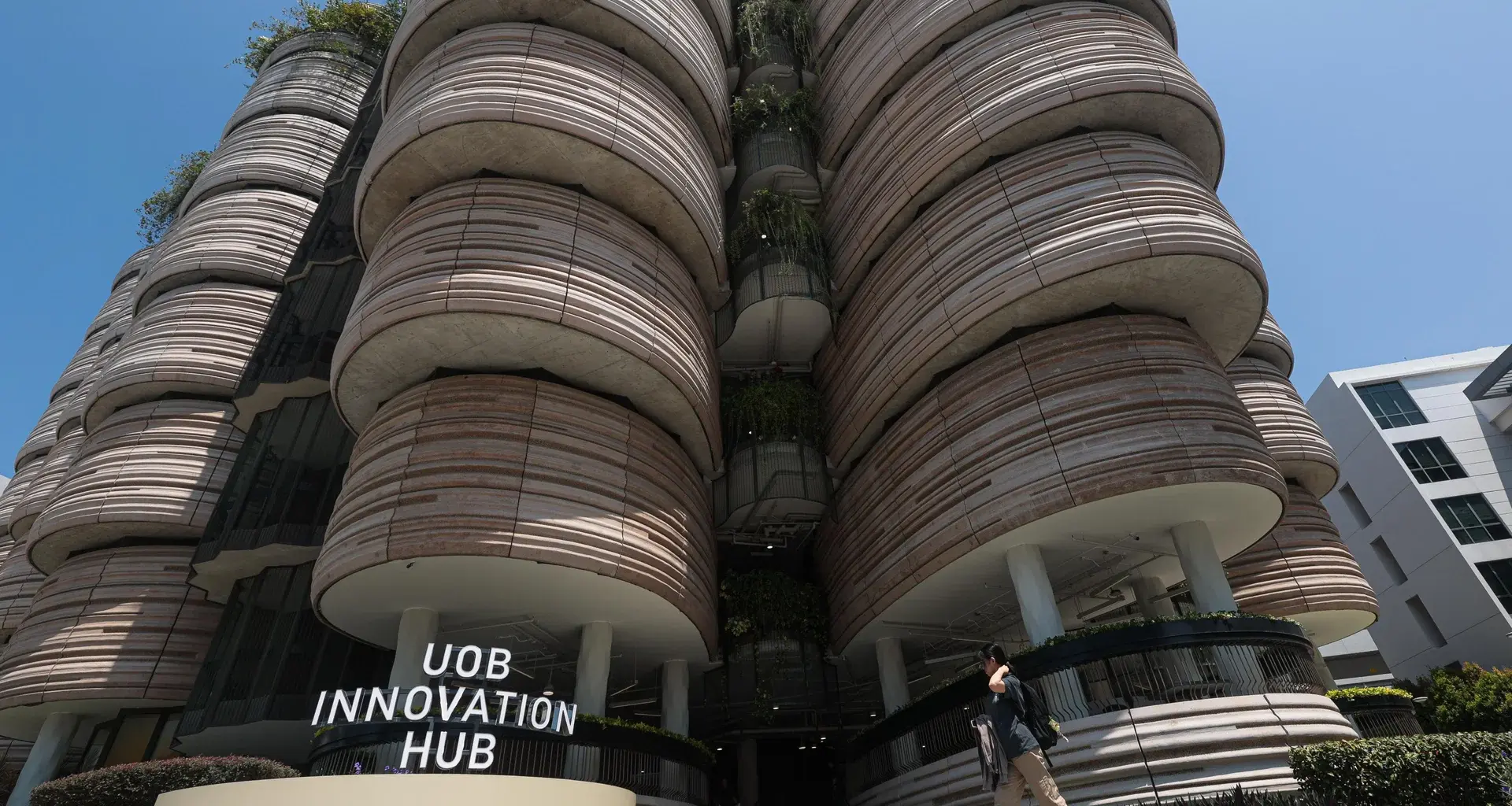
Hub is supported by S$110 million from UOB and Wee Foundation as well as government contributions
[SINGAPORE] The Nanyang Technological University (NTU) on Wednesday (Mar 25) unveiled a new UOB Innovation Hub.
The move is to grow deep-tech startups and ventures, with plans to incubate more than 90 venture teams and startups over the next five years.
The hub is supported by the S$110 million invested by UOB and the Wee Foundation in April last year, bringing the total investment – including government contributions – to S$275 million for the university’s strategic priorities.
It will house a two-and-a-half storey entrepreneurship space, including incubation rooms and collaborative workspaces, for venture teams and deep-tech startups in areas such as artificial intelligence (AI), sustainability and advanced technologies.
These facilities will allow founders to develop their ventures without incurring high costs and strengthen the country’s deep-tech entrepreneur pipeline, noted NTU.
Wee Ee Cheong, UOB’s deputy chairman and CEO, said that the total investment will “help level the playing field for less-advantaged students, support community uplift programmes and catalyse innovation through programmes such as NTU Venture Creation”.
Navigate Asia in
a new global order
Get the insights delivered to your inbox.
The NTU Venture Creation Programme, launched under the hub, will provide students with a platform to develop innovative and high-impact solutions with real commercial potential.
Wee added that the student projects will apply advanced technologies “from AI in healthcare to data‐driven environmental solutions to address real‐world challenges”.
The programme aims to support up to 50 teams annually, offering seed funding of up to S$5,000 for prototype development. The most promising ventures can receive scale-up grants of up to S$100,000 for real-world testing.
SEE ALSO

Students will also receive structured mentorship from industry partners, including UOB, as well as hands-on training and opportunities to pitch their ideas to investors and accelerators.
Participants will also gain support to scale their innovations and build commercial viability through networking opportunities and partnerships.
Speaking at the launch event, Professor Louis Phee, NTU’s vice-president for innovation and entrepreneurship, said the hub will expand beyond incubation offices to include additional co-working spaces, teaching studios, as well as event and exhibition areas.
There are also plans to introduce co-location spaces for industry collaborators to work closely with startups for real-world collaboration.
The hub will feature specialised spaces for building and storytelling. These include makerspaces for prototyping and 3D printing, interdisciplinary collaboration zones where engineers, designers and entrepreneurs can work side by side, and a media studio for live recordings and digital content creation.
Pilot projects
The NTU Venture Creation Programme was piloted last year, with 13 students forming six venture teams to tackle challenges ranging from data security to sustainability.
Among the projects is MiniClue, an AI tool aimed at reducing data breaches. It enables users to read and interact with documents directly on their own devices without uploading sensitive information.
Another project is Peat Guard, a data-driven environmental restoration platform that uses satellite imagery and ground sensors to guide communities in restoring degraded peatlands.
Prof Phee noted that “while not every student will eventually start a company, these early experiences are crucial in building the mindsets, skills and confidence needed for future entrepreneurship or intrapreneurship”.
Push for innovation and entrepreneurship
Over the past decade, NTU has launched over 430 startups and raised more than S$600 million in investment funds.
In a speech at the launch event, National Research Foundation chairman Heng Swee Keat highlighted the importance of stronger interaction between universities and companies to connect research insights to industry needs and entrepreneurship.
Against this backdrop, he pointed to the government’s Research, Innovation and Enterprise 2030 plan that will see S$37 billion invested over the next five years.
“As NTU’s research standing rises, it is also pursuing innovation and entrepreneurship more vigorously and seeking to translate its insights into practical solutions that support Singapore’s economic growth and improve societal well-being,” he said.
Separately at the event, UOB’s Wee announced the establishment of the UOB Foundation, a dedicated philanthropic platform to drive focused, purposeful impact across education, children and the arts.
It supports initiatives such as scholarships, digital learning and financial literacy programmes. Wee said that the foundation will help equip “the next generation with future-ready skills”.
Additional reporting by Lindsay Wong
Decoding Asia newsletter: your guide to navigating Asia in a new global order. Sign up here to get Decoding Asia newsletter. Delivered to your inbox. Free.