
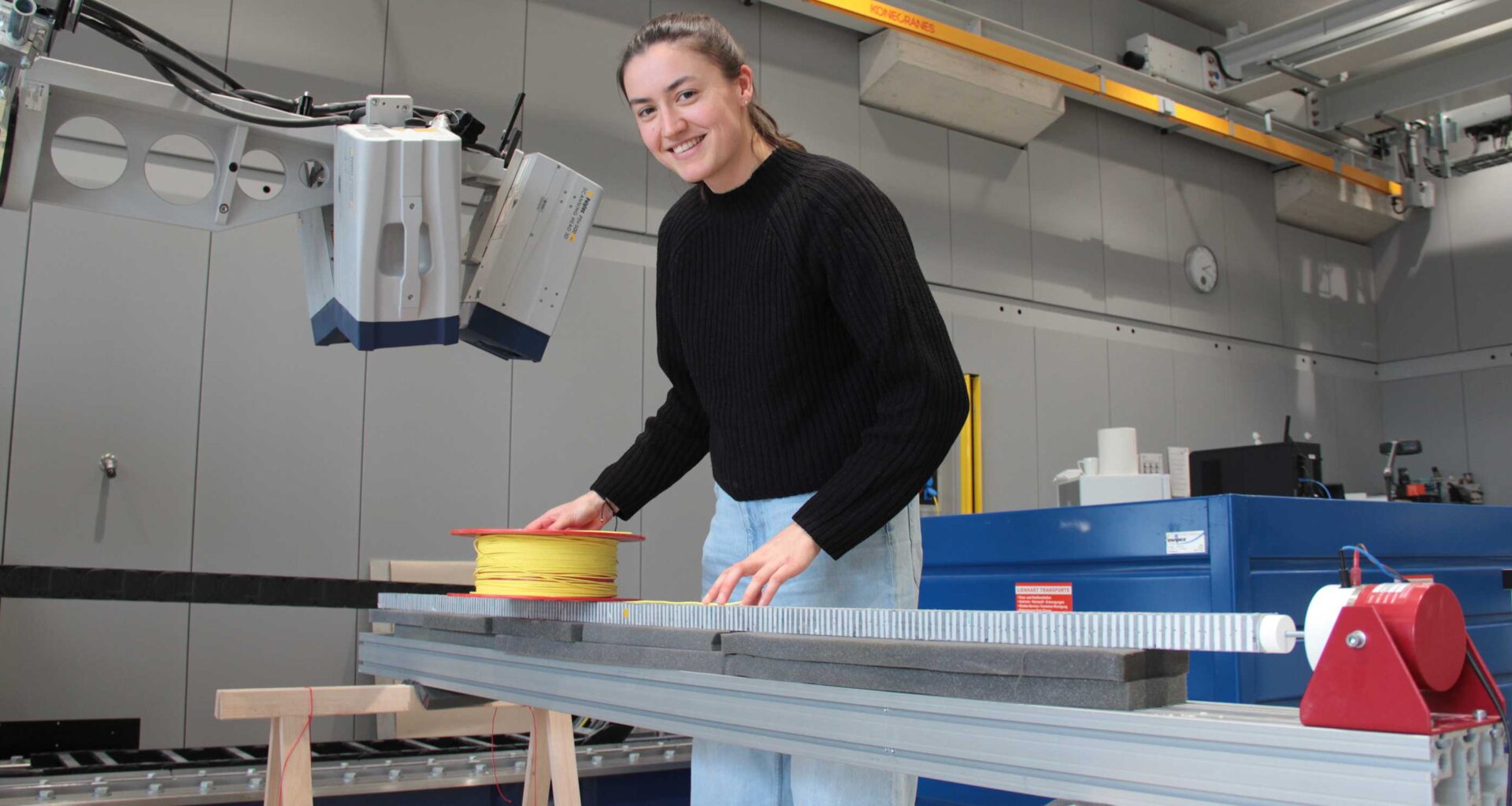
A new approach to exploring the Moon’s hidden interior could transform future lunar missions. Researchers at ETH Zurich are investigating whether lightweight fibre-optic cables—similar to those used for internet communication on Earth—can be deployed across the Moon’s surface to detect seismic activity and reveal subsurface structures.
The idea builds on a long-standing gap in lunar data. The last seismic instruments placed on the Moon were deployed in 1972 during the Apollo missions, continuing to operate until 1977. While they recorded thousands of moonquakes, the dataset offers only limited insight into the Moon’s interior, and scientists still rely on it today.
To expand this understanding, a team led by Johan Robertsson, Professor of Applied Geophysics at ETH Zurich, along with international partners including Los Alamos National Laboratory, is testing a new method. Instead of placing heavy seismometers individually, a rover could deploy kilometres of fibre-optic cable across the lunar surface. These cables would function as dense arrays of sensors, capable of detecting vibrations from moonquakes, meteorite impacts, and lunar landings.
The method relies on Distributed Acoustic Sensing (DAS), a laser-based technology that turns fibre-optic cables into continuous seismic sensors. Laser pulses are sent through the cable, and tiny imperfections in the fibre scatter light back to a measuring device. By analysing the returning signals, researchers can detect vibrations and pinpoint where along the cable they occur. A single fibre, roughly the width of a human hair, can act as thousands of evenly spaced sensors, offering higher spatial resolution than traditional seismic networks.
On Earth, DAS is already used to monitor earthquakes, landslides, and even whale movements via ocean telecom cables. On the Moon, the technology could serve additional purposes. Vibrations generated by spacecraft landings and take-offs could act as controlled seismic sources, allowing scientists to image subsurface structures in a way comparable to medical ultrasound. The cables could also measure how much lunar dust is disturbed during landings, providing data to help mitigate risks for future missions.


Initial experiments suggest the Moon may be especially suitable for this technology. Tests conducted at Los Alamos using crushed basalt—similar to lunar soil—showed that fibre-optic cables can effectively record seismic signals even when laid on the surface rather than buried. Unlike Earth, where wind can weaken signals, the Moon’s lack of atmosphere may allow cables to function efficiently without being underground.
Researchers are also using computer simulations to study how the cables interact with the lunar surface and how this interaction is influenced by lunar gravity. Understanding these factors is considered essential for assessing the system’s performance under real conditions.
According to the research team, fibre-optic sensing could significantly expand knowledge of the Moon’s interior, including features such as lava tubes, landing sites, and potential water resources. Long cables could also detect tidal stresses caused by Earth’s gravity, offering further insight into how seismic waves travel through the Moon.
If successful, this approach could lead to extensive fibre-optic networks spread across the lunar surface, effectively turning the Moon into one of the most densely instrumented seismic laboratories beyond Earth.