
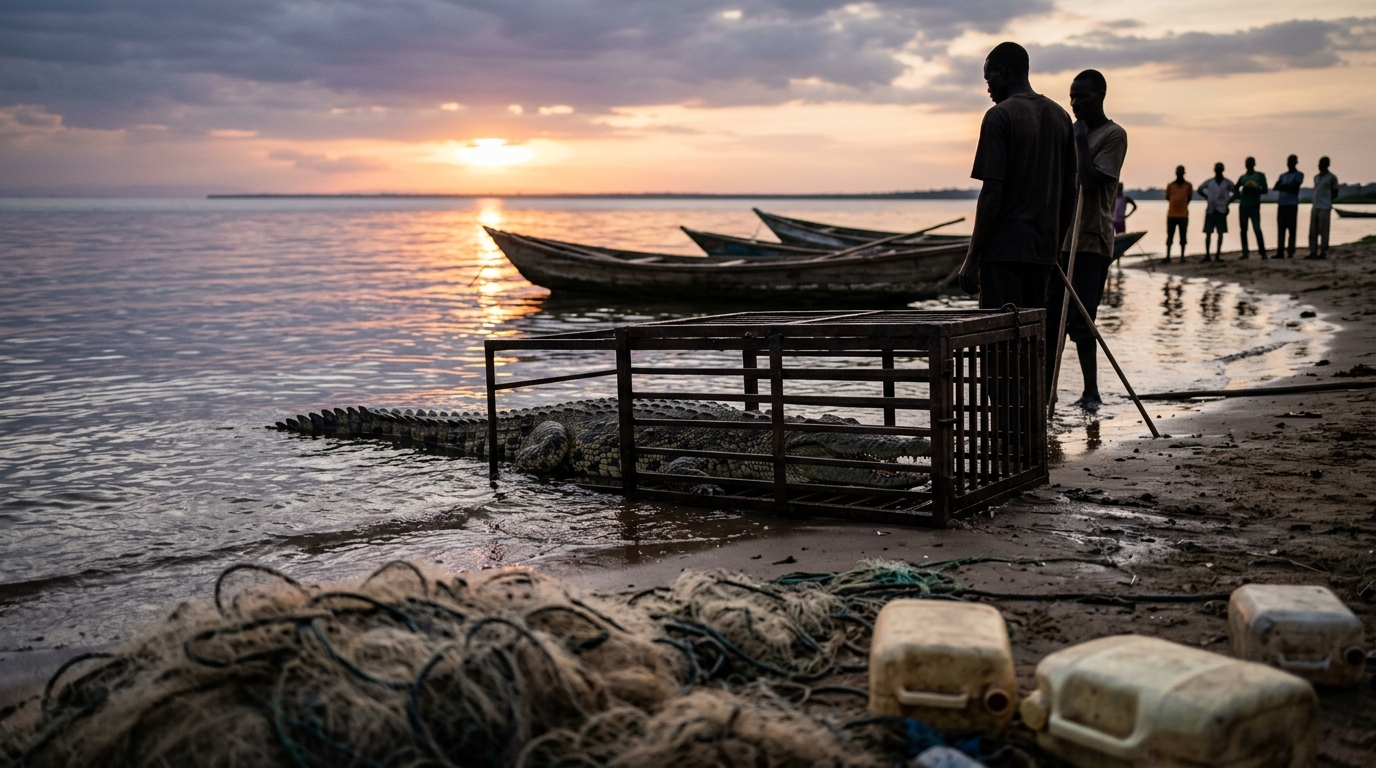
The silence at Kopiata Beach in Rarieda sub-county, Siaya County, has long been punctuated by the dread of unseen hunters beneath the surface of Lake Victoria. On Wednesday, the community finally witnessed a rare victory against the terror that has gripped their lives. Kenya Wildlife Service (KWS) officers successfully trapped a massive crocodile, an apex predator believed to be responsible for years of attacks that have claimed the lives of at least three local residents since 2025.
This development, while offering a moment of reprieve for the fishing community, lays bare a much deeper, systemic emergency. The capture comes as human-wildlife conflict along the shores of Lake Victoria reaches a breaking point, driven by volatile ecological shifts and an acute lack of basic water infrastructure. For the families living along these banks, every trip to the water is a gamble with a lethal adversary, and the recent tragedy in neighboring Bondo sub-county—where a 35-year-old woman lost her life just a day prior—underscores the urgent, often fatal, stakes of this coexistence.
A Community Living in Constant Fear
The successful operation at Kopiata Beach was confirmed by the Kenya Wildlife Service Warden for Siaya County, Sheila Ochieng. Speaking to the media, Ochieng noted that the trapped reptile had been a source of recurring terror for the local population. The community, led by Chief of East Uyoma location Peter Odongo, had been working in close coordination with KWS, National Government Administration Officers, and local Beach Management Units to identify and mitigate the threats posed by these predators.
The human cost of this conflict is staggering. Residents describe a reality where essential daily chores—fetching water, washing clothes, or even accessing fishing spots—are fraught with peril. The psychological toll is profound. For many, the lake is their only source of livelihood and basic survival, creating a tragic paradox where they must enter the very territory that has proven to be a graveyard for their neighbors.
Timeline of Recent Conflict: Since 2025, KWS has recorded three human fatalities at Kopiata Beach alone.
Cumulative Impact: Across Siaya County, authorities have successfully trapped two rogue crocodiles within the last two years.
Regional Trend: Similar spikes in attacks have been documented in neighboring Bondo and across the wider Lake Victoria basin, where rising water levels have significantly altered animal habitats.
The Ecological Drivers of the Crisis
Conservation experts point to environmental instability as the primary catalyst for these encounters. The Nile crocodile, a territorial apex predator, is increasingly encroaching on human settlements as climate-driven fluctuations in Lake Victoria’s water levels blur the boundaries of its hunting grounds. When water levels rise, the crocodiles are displaced from their natural deep-water territories and pushed into the shallows near human habitations, where they find both easy prey and a lack of natural barriers.
This displacement is exacerbated by the absence of piped water infrastructure in many rural areas of Siaya. When the government fails to provide borehole water or safe distribution systems, villagers are forced to rely on the lake. This creates a predictable and tragic cycle: women and children, who typically bear the burden of water collection, become the primary targets of these predators.
The Regulatory and Economic Tightrope
KWS faces an immense challenge in balancing wildlife conservation with the immediate safety of human populations. While the authority has established programs for sensitization and the establishment of Community Wildlife Conservation and Compensation Committees, the implementation remains slow and bureaucratic. The Wildlife Conservation and Management Act 2013 mandates compensation for deaths and injuries, yet many families find themselves mired in legal battles for years, struggling to secure the justice they are entitled to under the law.
The financial impact on these communities is compounded by the loss of livestock—a primary asset for rural households. When a crocodile attacks, it destroys not just a life but a family’s economic foundation. While KWS has engaged in strategic trapping to remove “problem” animals, critics argue that this reactive approach is insufficient. True security requires a holistic investment in water infrastructure, perimeter protections at identified “hotspots,” and a more rapid, decentralized response mechanism for compensation and conflict mitigation.
As the community at Kopiata Beach celebrates the removal of this predator, the underlying environmental and infrastructure gaps remain. The question for the national government is no longer whether they can trap every individual crocodile, but whether they can build the necessary infrastructure to prevent the need for such fatal confrontations in the first place. Until that happens, the people of Siaya will continue to watch the water with a mix of dependency and dread, waiting to see who will be next.