
Mars has yielded one of the oldest known traces of flowing surface water, preserved beneath the floor of Jezero Crater, a large impact basin on Mars that was once filled with a lake.
That buried record reaches back to a far earlier chapter in the planet’s history, widening the window when Mars may have held environments able to sustain life.
Buried layers speak of Mars’ water

Beneath a battered strip of crater floor, radar images expose layers dropped where a river once met a lake.
Reading those layers, planetary scientist Emily Cardarelli at the University of California, Los Angeles (UCLA), identified a deposit older than Jezero’s western delta.
Her estimate places the hidden structure at about 3.7 to 4.2 billion years old, near the start of Mars’s history.
It does not prove that life existed there, but it shows that water reached this basin earlier than the surface view sugges.
Radar sees below
Instead of digging, Perseverance used ground-penetrating radar – a tool that maps buried layers using radio waves – while driving along.
Its radar instrument sent pulses downward and recorded echoes, letting scientists rebuild buried rock in three dimensions.
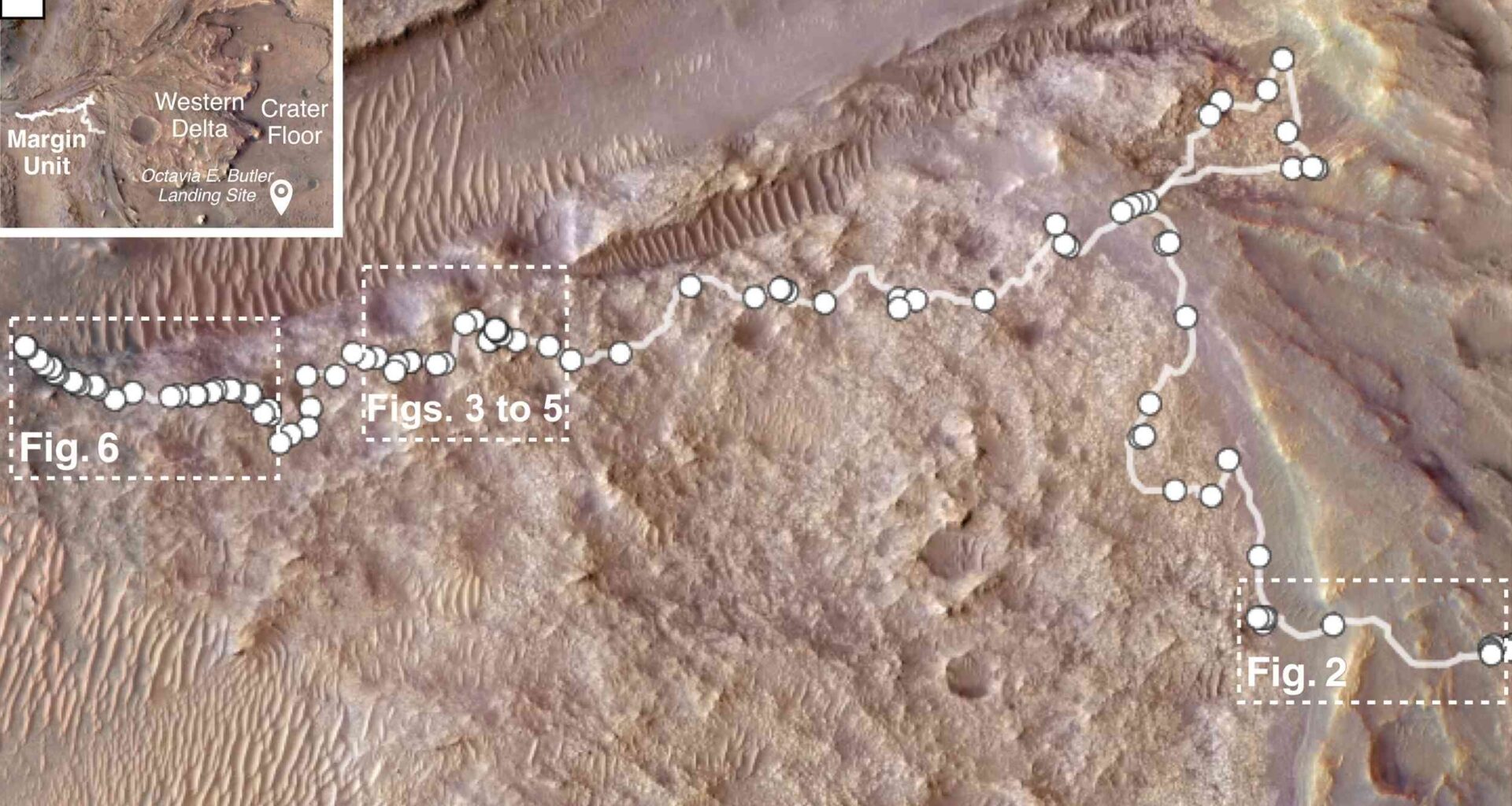
Across 3.8 miles (6.1 kilometers), the rover traced features more than 115 feet (35 meters) down during 250 Martian days of measurements.
That reach let the team compare deep layers with surface landforms instead of relying on orbital hints.
Two deltas appear below Jezero
Jezero looks like it holds one obvious delta – a fan-shaped deposit of sediment – but the subsurface shows at least two separate episodes.
Earlier radar work showed quiet lake sediments beneath the western delta, and the new scans push the story back further.
Before that visible fan formed, an older, river-built deposit spread into the basin and was later eroded.
Mars seems to have kept water moving, settling, and cutting rock over a longer stretch than one landform suggested.
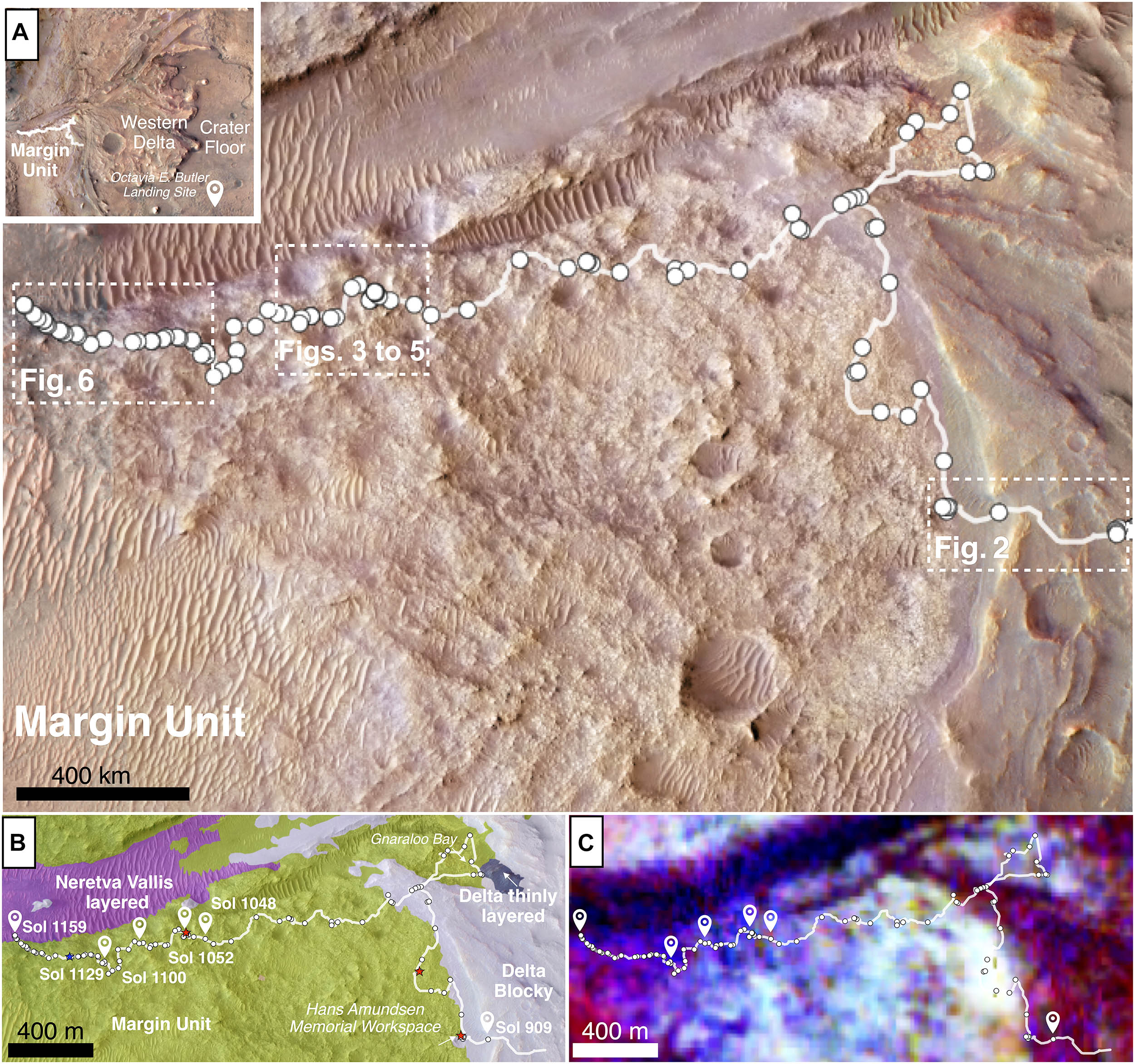 Orbital context maps of the Jezero marginal region and its inferred spectral composition. Credit: Science Advances. Click image to enlarge.Why deltas matter
On Earth, rivers can build a delta where they enter still water. Mud and clues can be trapped in this slowing flow.
That is why Mars scientists care, because fine sediments can bury fragile traces before wind and radiation erase them.
Researchers call those possible traces a biosignature – a chemical or physical clue to past life – even when chemistry can imitate it.
Seen this way, the buried delta matters because it points to conditions that could have stored delicate evidence.
Jezero was chosen
Since landing in 2021, Perseverance has crossed Jezero because scientists suspected the crater once held a lake and delta.
Channels cut through the rim and fed that basin, leaving a setting that could collect mud, salts, and carbon-rich matter.
Radar now shows that water reached this basin before the time of the landscape that rover can see, with an older system below it.
That deeper start broadens the slice of Martian time when this crater may have preserved fragile records.
Erosion changed everything
Deep below those layered rocks, the scans also caught rough surfaces where older deposits had been worn away.
That pattern means water did not arrive only once, because sediment piled up, eroded, and younger material covered what remained.
Ancient Mars seems to have swung through repeated wet and dry stretches instead of one flood followed by silence.
Such a tangled history matters because any signs of life would have formed, moved, or vanished inside changing conditions.
Limits still matter
No sample has come from the buried deposit itself, so the case rests on shape, layering, and rock clues.
Radar can show where boundaries, slopes, and scoured surfaces lie but it cannot, by itself, name every mineral.
Nonliving chemistry can create similar features, so Mars researchers separate a place that could host evidence of life from actual proof.
The new result sharpens the target rather than settling the argument, and that distinction keeps the science honest.
Samples may decide
Perseverance cannot dig down 115 feet (35 meters), but it can store samples that connect buried layers to the outcrops it touches.
Those samples matter because laboratories on Earth can test chemistry at a precision that no rover can carry.
Knowing the hidden water history also helps planners judge where preserved organics, useful minerals, and stable ground are most likely.
What looks like ancient geology, from orbit, becomes practical when a rover shows which layers deserve the next close look.
Mars keeps yielding
Elsewhere on Mars, orbiters and rovers have found channels, lake beds, and water-altered minerals.
“Over time, we’ve seen more and more evidence for liquid water on the Martian surface at various rover landing sites,” said Cardarelli.
That longer list matters because the buried delta joins several other clues pointing to a Mars that had repeated surface water.
“Mars is diverse, and each rover mission reveals another piece of its puzzling past and the early development of our rocky neighbor,” Cardarelli said.
What comes next
A crater chosen for an obvious surface delta now holds a deeper record that starts earlier and runs for longer.
As Perseverance keeps driving, the strongest discoveries may come not from what Mars shows openly but from what it hides.
The study is published in Science Advances.
—–
Like what you read? Subscribe to our newsletter for engaging articles, exclusive content, and the latest updates.
Check us out on EarthSnap, a free app brought to you by Eric Ralls and Earth.com.
—–