
Who would’ve thought it: As we try to navigate and survive in a world of digital distraction, constant chaos in the news, and worries about the encroachment of artificial intelligence, we can find solace and even some darn good advice in the words of a man who lived two centuries ago and is perhaps best known for holing up in a cabin in the woods.
Henry David Thoreau, author of Walden and other famous works, responded to the technological upheavals and social strife of the mid-1800s by choosing to temporarily step away from the everyday turbulence of that time to live more simply, thoughtfully, and purposefully, in a remote natural setting. Could we do likewise—at least a little bit—in today’s world? And should we?
Those are questions one can’t help pondering while watching the two-part PBS documentary film, Henry David Thoreau, airing March 30 and 31 on public television stations across the country. The film was co-produced by legendary documentarian Ken Burns and the famed Eagles singer/songwriter (and lifelong Thoreau aficionado) Don Henley, and co-directed by the brothers Erik and Chris Ewers.
It’s a heartfelt, poetic, and beautifully shot tribute to Thoreau. But it’s also something more: a reminder to all of us that it’s not too late to take back our attention and our lives—to slow down and make room for actual thinking, wondering, and reconnecting with nature.
A newfound interest in Henry Thoreau
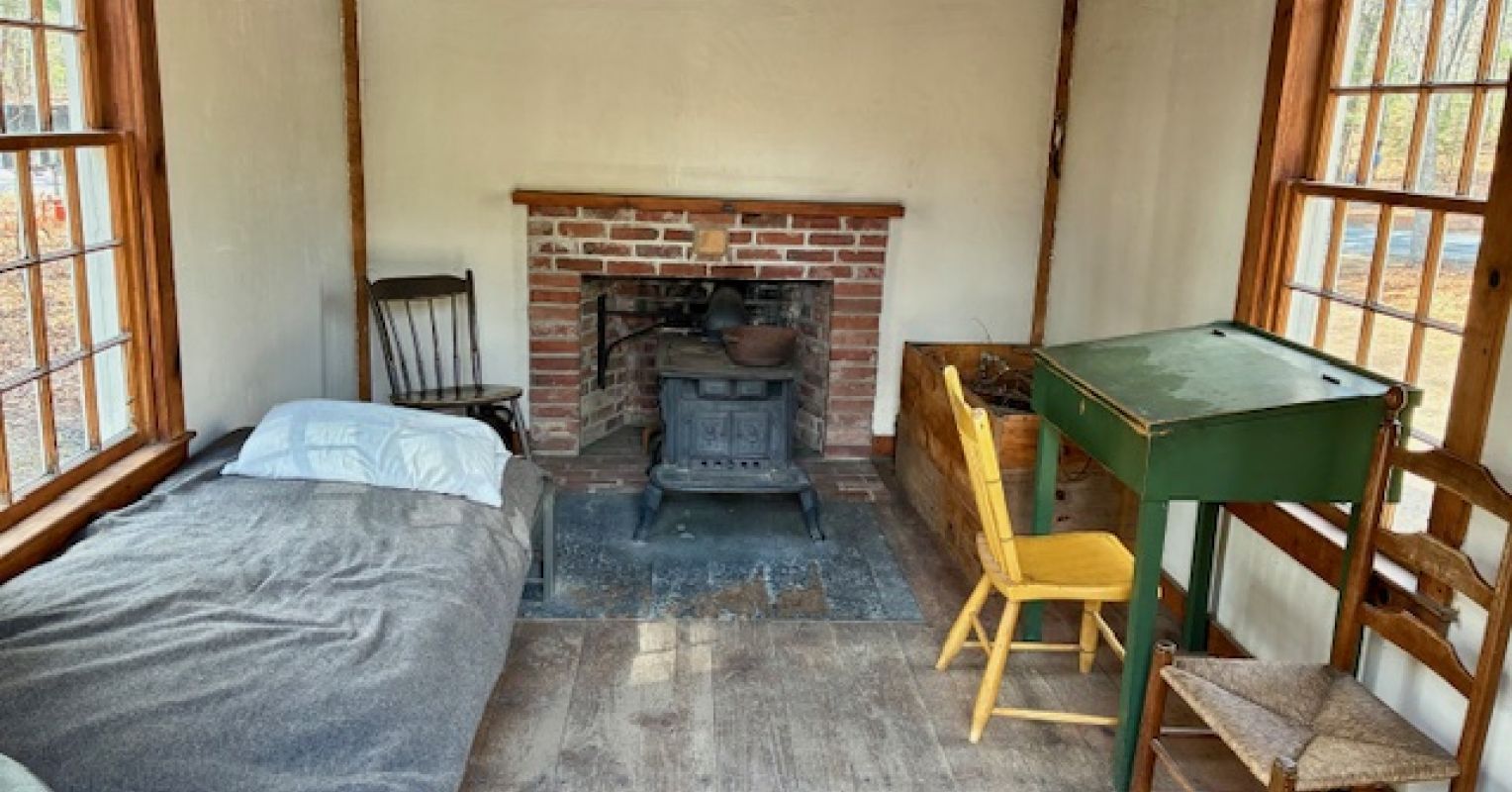
I’ve been thinking a lot about these same themes because of a book I’m writing about how creativity can be inspired by the places where we walk and the spaces where we work. Thoreau was, of course, inspired by Walden Pond and its surrounding woods, where he walked for hours each day. And he used his tiny cabin there (which he built himself) as the place where he turned his pondside thoughts into literature.
Because I’d developed this newfound interest in Thoreau, I recently traveled to his hometown of Concord, Mass. to attend an advance screening of the film. I also planned to walk in Thoreau’s footsteps, circling the pond, the following day.
The screening included a panel discussion featuring Henley and the Ewers brothers, along with the Thoreau scholar Kristen Case and the historian Douglas Brinkley. It was beautifully moderated by Lois Brown, Director of the Center for the Study of Race and Democracy at Arizona State University.
At the panel, Erik and Chris Ewers shared insights on how the film—eight years in the making—took shape and evolved as they came to better understand Thoreau’s life, his intense relationship with nature, and his deep commitment to social causes of the day (Thoreau was an early abolitionist and an anti-war activist who was briefly jailed for his stance). As Erik put it: “Thoreau retreated into nature not to escape the world, but to better understand it.”
Don Henley’s Walden Woods project
Henley, meanwhile, discussed the origins of his own involvement with Thoreau—which began before his rock stardom, when he was a 21-year-old who left college and returned to his Texas home to help care for his ailing father. He started reading Thoreau at that difficult period in his life and was inspired by the writing and by Thoreau’s commitment to nature and nonviolent social activism.
Years later, when Henley, by this time famous and living in Los Angeles, heard on a TV news broadcast of plans to construct an office park on property near Walden Pond, he immediately traveled cross-country to intervene. He raised funds to acquire and protect the land, under the auspices of a group he started (and still oversees) called the Walden Woods Project.
Environment Essential Reads
Some of the panel discussion touched on the parallels between Thoreau’s time and our own. America, back then, was deeply divided over slavery in the period leading up to the Civil War. At the same time, the Industrial Revolution was wreaking havoc on the natural world and the everyday lives of workers. As Henley put it during the panel discussion: “Thoreau saw the machinery of the mills replacing human hands; today we have technology that’s going to replace the human mind.”
“We built the world that Thoreau feared”
At one point near the end of the film, the environmentalist Bill McKibben says, “We built the world that Thoreau feared. A world that’s so noisy and crowded that we don’t have any time to think for ourselves anymore.”
But of course, that’s not really true: We do have time to think for ourselves, and to appreciate nature, if we make time for that. It’s a matter of resetting priorities and making choices, as Henry did. And no, we don’t have to live alone in a cabin for two years. We can start with a walk in the woods for an hour or two.
This is what I did the day after the screening, figuring I’d “saunter” (Thoreau’s preferred term, meaning to walk at a leisurely pace) for about two hours around the pond.
I ended up walking for four hours, not just circling the pond but roaming all around the expansive grounds.
My walk in the woods
I’d asked Henley, at the end of the panel discussion, for a recommendation on where to walk and he said, without hesitation “Brister’s Hill.” It’s a beautiful spot, named after a freed slave who lived there in the early 1800s. As you walk through wooded trails, you encounter occasional stone slabs on the ground bearing quotes from Thoreau, placed there by the Walden Woods Project. So if you didn’t happen to come to these woods with thoughts on your mind, these quotes will surely get you thinking—about nature, about justice, about how to live meaningfully.
I also wandered through a gorgeous meadow near the pond, which filmmaker Chris Ewers recommended to me. He told me that during filming this had been his favorite spot to shoot. And of course, I circled the pond, which takes an hour—or a lot longer if you veer off onto various trails along the way.
This was my second time coming to Walden Pond in the past year. It’s a magical place, and I will surely return, even though it’s a three-hour drive from my home. And while I recommend everyone visit it, you don’t necessarily have to be at Walden Pond in order to follow Henry’s great example.
Somewhere not too far from wherever you might live, there is a pond, or a lake, or a park, or a garden, or a mountain. Take the time to go there and saunter. Bring a notepad with you, as Henry used to do. Keep your phone securely stashed away in the backpack. And leave your headphones off—so you can hear yourself think.