
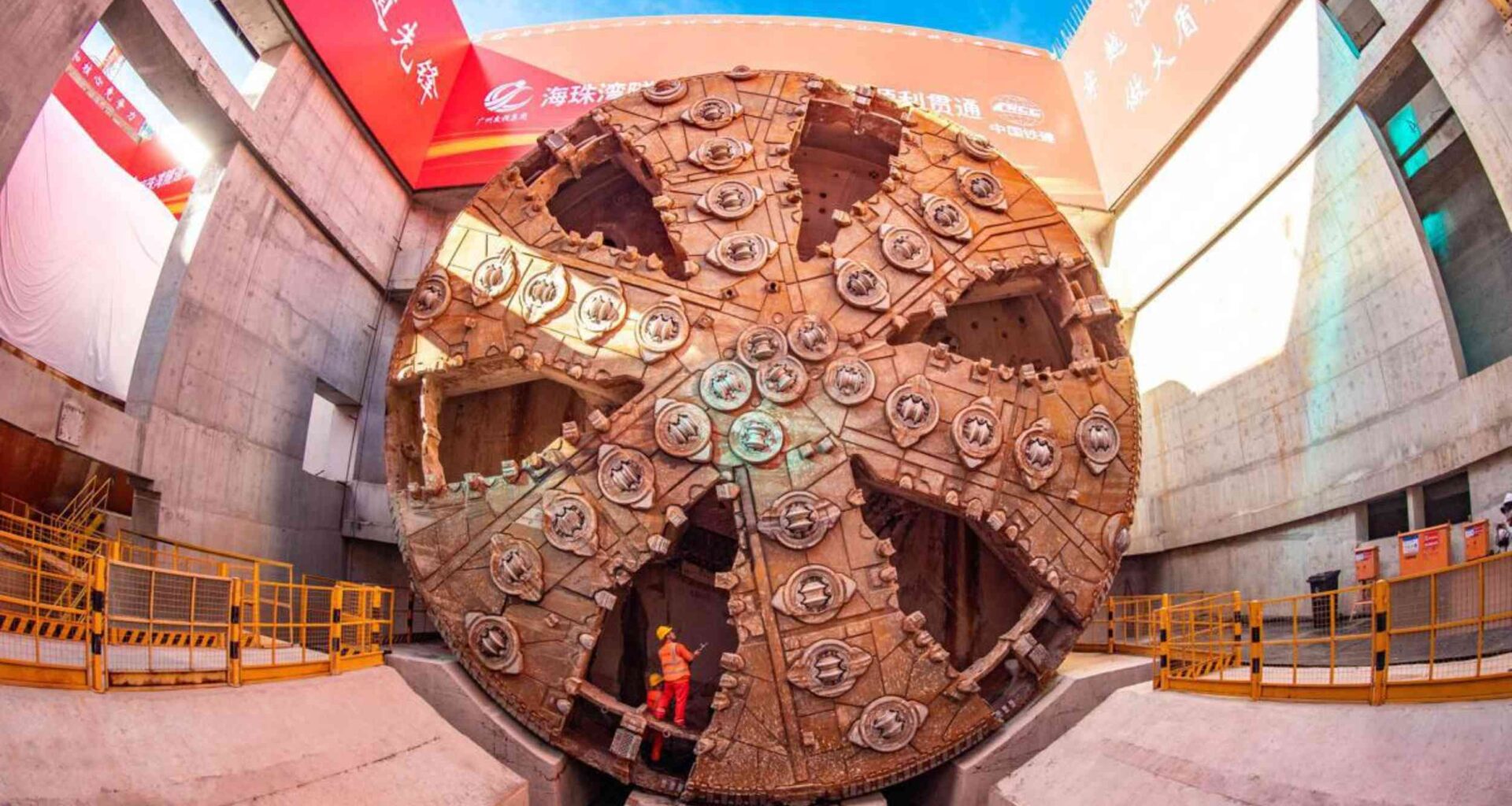
A 49-foot tunnel boring machine, a massive underground drilling system that cuts through rock to create tunnels, has proved capable of trapping its own broken rock when fast rotation drives the muddy mix into a circling wall.
That finding reframes why these machines stall, pointing to internal flow and debris transport, not cutting power, as the core constraint on progress.
Inside the chamber

Inside the pressurized chamber of a slurry shield, the blockage took shape as fresh debris dropped quickly and spread across the floor.
Tracking that buildup, doctoral researcher Hongwan Xiao at Central South University (CSU) showed the mass sliding toward the outlet instead of lifting free.
Only a small share escaped upward through the cutterhead openings, leaving most of the rock to thicken into a stubborn bed below.
That pattern centers the analysis on how rotation speed and pump-driven flow control whether debris clears the chamber or accumulates.
When speed backfires
Faster spinning at the cutterhead, the rotating front face that bites rock, made the flow look orderly but actually removed debris less well.
Once speed topped 1.2 revolutions per minute, circumferential flow, liquid circling the chamber wall, started to dominate.
That sideways motion kept fragments moving around the chamber instead of toward the opening that should carry them out.
Operators could not solve the jam by simply spinning harder, a common instinct when progress starts to drag.
Pumps pulling apart
Pump settings mattered because the chamber did not behave like a single bucket of moving mud.
More flow through Pump 0.1 helped sweep broken rock toward the discharge side, where suction could finally grab it.
Sending extra flow through Pump 0.2 did the opposite, pushing material into patterns that kept it circulating and settling.
Small changes in where liquid entered the machine therefore changed whether debris moved out or simply moved around.
One jet matters
A separate recirculation jet, liquid sent back through the chamber, turned out to be one of the easiest fixes. Tilting that jet 30 degrees downward aimed force at the low debris bed instead of above it.
At about 5,300 gallons per minute, the adjusted stream raised debris discharge by 5.8 percent without redesigning the whole machine.
That result mattered because crews often have room to retune jets and pumps long before they can rebuild hardware.
Costs below ground
Rock-heavy slurry can wear down pipes, cutters, and chamber walls when trapped fragments keep scraping the same surfaces.
A field case in China found that elbows and bends wore faster than straight sections during rock-heavy slurry tunneling.
Repeated cleanup stops also eat work time because crews must clear packed chambers before the machine can advance safely again.
The jam is costly not just because progress slows, but because every delay can create more wear to repair later.
Why size matters
Bigger machines face a basic arithmetic problem: a wider cut produces more broken rock every time the face turns.
At the Haizhu Bay Tunnel in Guangzhou, southern China, the shield section ran about 1.3 miles with machines about 49 feet across.
It was Guangzhou’s first ultra-large shield section, a scale large enough to magnify every internal traffic problem.
As shield diameters grow for river and sea crossings, transport inside the machine becomes as important as cutting power.
Whole system view
Earlier models tracked the cutterhead or rear chamber alone, leaving the links between them partly hidden.
A paper from the same CSU research circle found heavy soil clustering near the cutterhead center and edge.
That local picture helped explain where clogging starts, but it still missed how pump choices redirect material later.
The new study mattered because it followed the same debris across the entire path to the discharge pipeline.
Earlier fixes helped
Another suction port study improved discharge in the chamber behind the cutting face by moving the opening forward.
That change increased discharge by 75.19 percent and cut chamber buildup by 84.70 percent in clay conditions.
Even so, a local fix could not explain why debris still stalled elsewhere once the entire pipeline network came into play.
The new work built on that CSU lesson by treating the machine like one linked transport system, not separate trouble spots.
From model onward
Because the CSU team tested a full-scale virtual copy, their recommendations were close enough to field conditions to try on site.
Crews successfully applied the optimized scheme on site, easing the retention problem without waiting for a new machine design.
Results still depend on local geology, because muddy sandstone and other ground types create different particle sizes, stickiness, and wear patterns.
Even with that limit, the study gives builders a cheaper first move: change flow, angle, and speed before ordering new hardware.
What it means
These results point to an awkward truth: giant boring machines fail less from hard rock than from bad traffic inside moving mud.
For builders planning ever-larger tunnels, the next gains may come from smarter internal flow control rather than bigger motors alone.
The study is published in Tunnelling and Underground Space Technology.
—–
Like what you read? Subscribe to our newsletter for engaging articles, exclusive content, and the latest updates.
Check us out on EarthSnap, a free app brought to you by Eric Ralls and Earth.com.
—–