
However, he has kept up to date with the region by chatting with locals.
For his research, Moffatt scoured Hawke’s Bay Knowledge Bank website, a digital record of the region’s history.
There Moffatt learned of John Finlinson, a brass musician in Waipawa’s Harding’s Band, who died in a fire in 1888.
Finlinson’s death brought his band and their local brass rivals together.
They led his funeral procession, which resolved the issues between the groups. They became, as the Waipawa Mail put it, “one united band” over Finlinson’s grave.
The cover of the Ashley Clinton Sheep’s Choir LP.
To the west of Waipawa, lies the rural community of Ashley Clinton, where in the late 1950s, an ovine singing group needed regular grooming.
Shepherd, teacher and choir conductor Donald J Squire recorded the baas of solo sheep at different pitches.
He spliced notes together and produced the sheep “singing” hits such as Pōkarekare Ana, Pō Atarau, and Baa Baa Black Sheep, well before music editing software was in vogue.
Moffatt listened to the album when writing the piece.
“It’s not something you’d listen to more than once,” he said.
Northeast of Ashley Clinton is Te Aute College, the alma mater of many politicians and rugby players.
It also helped produce notable Kiwi musicians such as “Māori Cowboy” Johnny Cooper, Sir Howard Morrison, Rim D. Paul, composer Hirini Melbourne, Troy Kingi and Corella member Pipi Campbell.
Moffatt’s piece also explores Bruno Lawrence and Blerta’s Snoring Waters commune in Waimārama, concerts at the Pukeora Sanatorium, and the role of the region’s community halls in the past and present.
It also takes in talent quests of the 1960s at Waipukurau’s Municipal Theatre and a Dannevirke home studio that helped launch bands’ careers in the 1950s, and more.
A map of the areas Glen Moffatt explored in his music map for AudioCulture.
Moffatt said the traditional sound of Central and Southern Hawke’s Bay bands changed in the 1960s, when they began borrowing from British Invasion bands such as The Shadows and The Beatles.
“The bands that didn’t shift broke up because they couldn’t or weren’t willing to change the music or style,” Moffatt said.
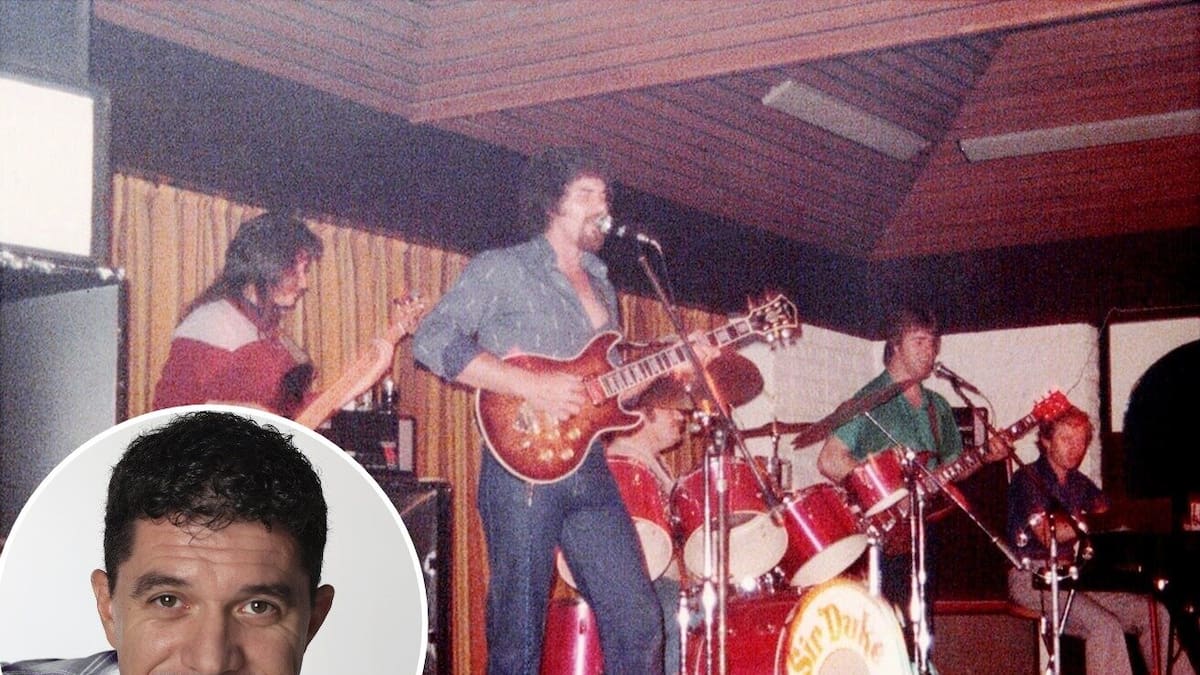
Moffatt said bands like Sir Duke, happy to remain as a covers or party band, had the best success at home without having to move to Wellington, Auckland or Australia.
Arguably Hawke’s Bay’s most popular band, Sir Duke started as Waipukurau party band Theme, or The Theme.
They were the resident band at the Leopard Hotel on Ruataniwha St in the early 1970s.
They moved their show to Napier where they played the Leopard Inn from Thursday to Sunday every week, until the pub was sold in 1987.
Moffatt said the band survived for 50 years.
He said with musicians dying in recent years, such as Sir Duke drummer Neil Sloan in 2025, it was important to have their stories written and shared so they would not be forgotten.
“People are just so willing to tell their stories and so it’s just great because once those people have gone, all the stories go with them.”
Sir Duke’s singer Pat Atkinson told Moffatt the band would play to couples at Leopard Hotel, then at their weddings years later, and then at their children’s 21st parties.
“That’s huge when you can be playing at the 21st of the people that you were playing to at the pub when they were 21,” he said.
Moffatt is an accomplished country musician, and is set to be inducted into the Hands of Fame alongside Kaylee Bell at this year’s Gold Guitar Awards in Gore on May 30.
Although he had been away for a long time, the region still holds a place in his heart.
“You get back there, it’s just like being back at home,” he said.
The Central and Southern Hawke’s Bay Music Map can be found on audioculture.co.nz.
Jack Riddell is a multimedia journalist with Hawke’s Bay Today and has worked in radio and media in the UK, Germany, and New Zealand.