
Jiang wanted to learn everything. He wanted to be better at everything. And this was a way to make sure that happened.
The teachings of German psychologist Hermann Ebbinghaus, who researched memory retention in the 1880s, helped. The Big Bang Theory, a sitcom about science (coincidence? Probably not), did too.
Three years of filling those dictionaries led to Jiang growing from someone who struggled to understand English and communicate with his classmates to being one of New Zealand’s top academic performers.
Now 32, he has studied at some of the world’s top universities and at the same time helped build Crimson Education, the New Zealand-founded global education company advising and tutoring students to help them gain admission to those same top-tier schools.
This week, he’s publishing Classroom CEO, a book sharing his story alongside tips for students and their parents wanting to follow a similar educational and entrepreneurial path. A book he wrote while finishing his MBA at Stanford University. (Yes: while, not after.)
“Basically, I blocked out every weekend. So Saturday, Sunday, I got up at 7 or 8am and then just kept writing till 10pm. And then I just did that across 12, 14 consecutive weekends,” he says, making it all sound quite simple.
Fangzhou Jiang (back, third from right) at the Prime Minister’s Scholarship Award ceremony. Photo / Supplied.
Jiang, known as FZ to his friends and colleagues, was 15 when he arrived in Auckland from his home in northwestern China, where he had tried – and failed – three times to get into the prestigious high school he thought would open doors for his future.
Here, he was alone and without much English, but possessing a desperate need to achieve.
In China, his parents were making their own sacrifices. The family had sold their family home to finance his last three years of high school in New Zealand. After that, Jiang was on his own. To go to university, he needed to get a scholarship.
Jiang says his path was difficult, sure, but it was clear: learn English, do well at school, get a scholarship, get a degree, then a job and start a new life here. Only then could he consider himself successful.
“When my parents made this huge sacrifice – against basically the advice of all of our family members – I need to prove they are right. That they’ve made the right decision. I don’t want to let them down, because if I did then they become the laughing stock of the family, extended family, of the community.
“And if I don’t get a scholarship, how do I finance my university education? So that’s also a practical constraint. It’s not about right or wrong anymore. It’s about, do I get to stay here or do I pack my bags and go home?”
All of this happened more than 15 years ago, but Jiang still talks of it in the present tense. The hustle, one of the first English words he internalised from Crimson co-founder Jaime Beaton, has always been present.
Fangzhou Jiang has studied at some of the world’s top universities. Photo / Supplied
Crimson Education was recently valued at $1 billion. The admissions consultancy supports students to study at the world’s top universities, has clients across 23 countries and has raised $170 million in venture capital from leading investors such as Tiger Global and Icehouse Ventures.
But Jiang’s first job was at a North Shore fish and chip shop.
Three times a week, he would finish school, walk an hour to work, do his job, then walk an hour home again. Rain, hail or shine. A bus fare cut into the money he was saving.
Between frying fish and wrapping chips, he practised his English. At school, he decided to finish his homework during his lunch break, rather than mucking around like many other teenage boys, to have more time in the evenings to work, or when he wasn’t, dedicate himself to his other extra-curricular (often educational) activities such as the Young Enterprise Scheme. It was all training for the life he wanted.
And it worked. Jiang was Dux of Rangitoto College, winner of the New Zealand Premier Scholarship for the country’s top students, and was awarded a full scholarship to study at Australia National University in Canberra. He was on his way to that picture of success.
He’s gone on to study at Beijing’s Tsinghua University, and earned the John F. Kennedy Fellowship to pursue joint degrees at the Harvard Kennedy School and Stanford Graduate School of Business. And he has no plans to stop learning.
“Some people say, ‘why do you want to get more degrees or get more education?’ … It’s because, intellectually speaking, those are what I’m genuinely interested in,” he says.
“Some might prefer to go to the gym or turn on Netflix, but I’d rather read a research paper.”
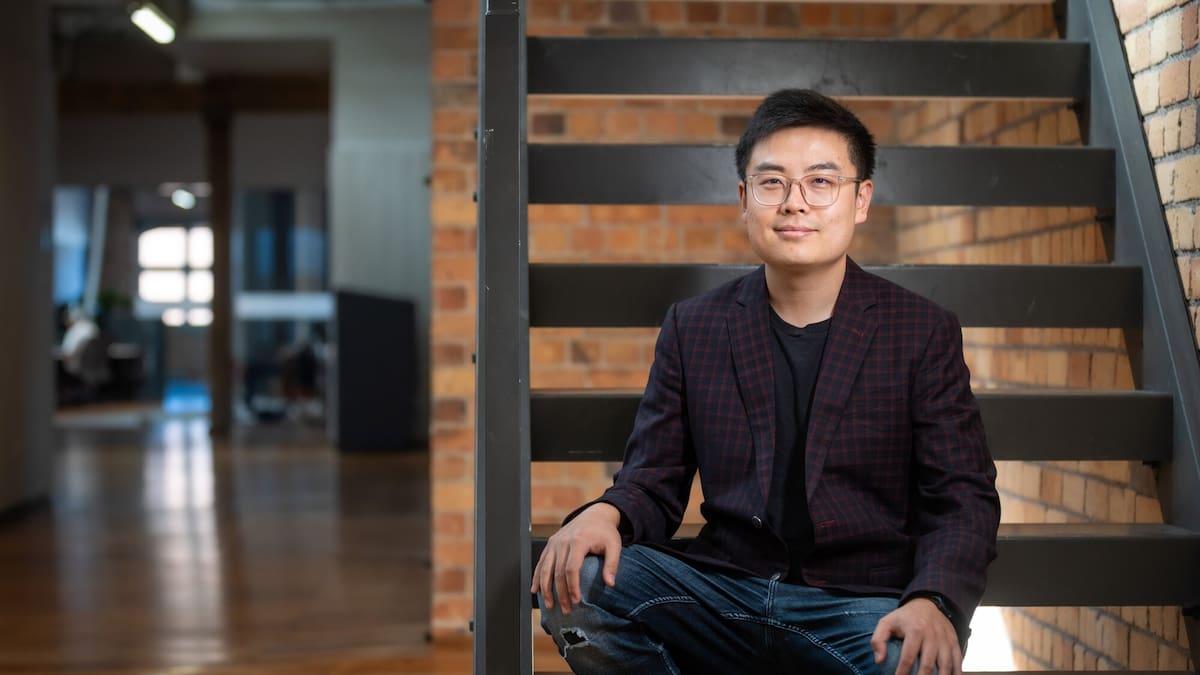
Fangzhou Jiang splits his time between New Zealand, Australia, the United States and China. Photo / Michael Craig
Jiang hadn’t been to his Auckland office before the day we met. The company only moved in a month ago. He flew in overnight from San Francisco, where he is primarily based, he went to the gym, found his way here and tomorrow he will be in Sydney.
He won’t take a flight that doesn’t have Wi-Fi if he can help it (“Being unplugged for so long is dangerous. It feels unsettling for me”) but uses his time to catch up on sleep. At home, he gets six hours a night, with a bonus nap during the day. He wishes he needed less sleep, “then I could do so much more stuff at night”. By stuff, he means work, reading, thinking, planning.
Jiang has his pilot’s licence, loves to scuba dive and ride rollercoasters. He reckons his average phone screentime is six hours a day, but insists it’s not doom scrolling on TikTok – he does almost all his work from his device.
He’s never tried meditation, never pulled an all-nighter for study or work, and never had a sick day. “Which, yeah, I think controversially makes me less sympathetic about sick days.”
He “hates” being bored, doesn’t think “chit chatting” is a good use of his time and his dream holiday would be somewhere like Santorini, beside a pool… with his laptop or an academic research paper to keep him occupied.
If this all makes him sound intense, in person Jiang appears generous with his time, a good storyteller and seems relatively calm. This is not your standard TechBro. He’s competitive, but the “self-improvement is what I deeply care about”.
“You don’t want to just sit there, lock yourself in a room and implode, right?”
Fangzhou Jiang has his pilot’s licence, loves to scuba dive and ride rollercoasters. Photo / Supplied.
It was his dad who made him run. Early one cold morning, when everything inside the tween screamed no (but nothing externally – he says he would never yell at his father), the pair hit the pavement.
While Jiang was happy spending late nights slumped over books and homework, his father wanted more. He told him study was only one part of a full life. If he didn’t sort out the physical side now, he’d regret it.
Jiang begrudgingly agreed. Every Saturday and Sunday morning, the pair would jog, side-by-side. And one day, it didn’t hurt as much. One day, the exhaustion that stalked the young boy through his school days faded away.
When he turned 18, he ran his first half marathon in Auckland. During his university studies, he started doing Ironman races. He calls his love of triathlons his “stabiliser”.
That idea of living a balanced life is part of the Classroom CEO framework. Throughout the book, Jiang cites clinical trials, academic studies and self-help books. One of his key pillars for success is “building powerful personal and professional networks”, though in his own experience, he says his “emotional bonds get saturated very, very quickly”.
Fangzhou Jiang has been competing in marathons and Ironman races since his university days. Photo / Supplied
The book aims to help young people understand the meaning of leadership. That and embracing an entrepreneurial mindset is what Jiang thinks sets good students apart from the really ambitious ones.
Using the term CEO on a bunch of 16-year-olds might sound too much, but Jiang disagrees.
“If you only think about CEO as being the leader of the largest company in the country or in the world, then maybe it’s going a bit too much… But if you see this as a notion where [you] lead something, do something meaningful, create something that has an impact, then I think it’s never too early to start.
“The meaning of leadership isn’t necessarily being like the head boy or the head girl or anything.
“It’s basically identifying problems, solving problems.”
It wasn’t hard to write the book. Jiang regularly shares his personal journey with Crimson’s teenage clients as a coach. He’s used to trying to find ways to connect with them where they are at. Yes, he thinks it’s important to work hard, but it’s also about being strategic – and helping them understand their own version of that.
“And teenagers, they have different levels of motivation and maturity. Some procrastinate a little bit, some are a bit lost… So you can’t just say, ‘oh, here’s a bunch of things, go do them’. You have to help them see there’s a meaning for it, right?”
It’s clear Jiang found his own meaning early, probably before he stepped off the plane and built a new life in Auckland. But that day, and that 15-year-old version of himself, feel far away from the life he’s living today.
“People tend to overestimate what they can achieve within a year, but drastically underestimate what they can achieve in 10 years, right?” he says.
“I think these two [versions of myself] are just in a completely different universe.”
Classroom CEO by Fangzhou Jiang is available from April 1.
Bridget Jones joined the New Zealand Herald in 2025. She has been a lifestyle and entertainment journalist and editor for more than 15 years.