
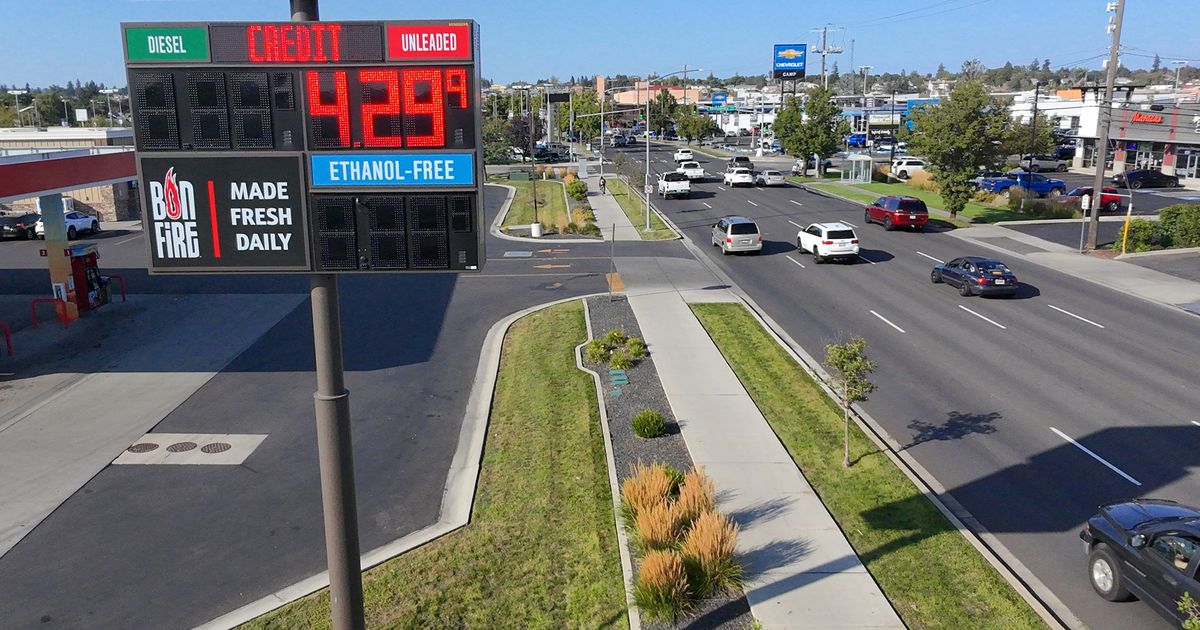
Oil and gas prices continue to rise rapidly across the globe, spurred by the Middle East war, which has cut off critical transportation routes.
In Washington, the average per-gallon price of regular gasoline reached $5.30 on Thursday, according to data published by AAA. That’s an increase of more than 21.5% compared with one month ago, just before the U.S. and Israel first launched strikes against Iran.
Meanwhile, the price of diesel in Washington hit a record-high $6.528 per gallon midweek, falling by a fraction of a cent on Thursday.
The recent price surge is a direct result of the conflict choking off the global supply of crude oil, economists say. Crude oil is a resource that is refined into petroleum products like gasoline and diesel.
The war’s happening and that’s why the gas price is going up,” said Nick Huntington-Klein, an associate professor of economics at Seattle University, referring to changes over the past month. “It’s pretty stark.”
However, for many drivers in Washington, war is an insufficient explanation for today’s prices.
Prior to the conflict, pump prices in Washington were already more expensive than in any other state except Hawaii and California, according to AAA data.
Even as drivers across the country grapple with rising gas prices, the national average is still lower than what Washingtonians paid before the start of the war. On Thursday, the U.S. average per-gallon price of regular gasoline was $3.981, around 35 cents cheaper than the state average at the end of February.
So while the war may be driving gas prices up across the world, some consumers and businesses in Washington feel it’s simply magnifying an expense they already struggle to afford.
Let’s break down what goes into the price of gas in Washington.
Why are Washington’s gas prices so high?
Gas prices are a reflection of the cost of crude oil itself, transportation and refining costs, state and federal taxes and Washington’s climate laws.
All these factors contribute to the final price that drivers pay at the pump.
The federal government charges an excise tax of 18.3 cents per gallon.
Washington charges a separate excise tax of 55.4 cents per gallon. The state also levies an oil spill response tax, an oil spill administration tax and a hazardous substance tax, all of which are charged on a per-barrel basis.
Combined, these put Washington’s total gas tax at 59.04 cents per gallon, according to an analysis conducted by the Tax Foundation, a research organization.
Drivers don’t pay this cost directly. “It gets passed to them,” said Jacob Macumber-Rosin, excise tax policy analyst at the Tax Foundation, referring to the price consumers see at the pump.
And while all states charge these types of taxes, Washington stands out for having the third-highest total gas tax, behind California at 70.92 cents per gallon and Illinois at 66.4 cents per gallon.
Do Washington’s climate policies raise gas prices?
Yes. But it’s difficult to quantify by exactly how much.
Washington has two climate programs that raise the cost of fuel: a cap-and-invest program aimed at reducing overall greenhouse gas emissions and a clean fuel standard designed to lower the carbon intensity of transportation fuel.
The two policies work in tandem to draw down the state’s carbon footprint over time.
Under the cap-and-invest program, fuel suppliers effectively have to pay for their emissions, either by purchasing permits that allow them to emit greenhouse gases or by buying credits to offset them.
Under the low-carbon-fuel standard, fuel suppliers have to reduce the carbon intensity of their fuel, either by producing it more efficiently or – again – by buying offset credits.
By their very nature, both programs are explicitly designed to increase the cost of gas and to incentivize consumers and businesses alike to use less fuel and emit fewer greenhouse gases.
“If the gas price didn’t go up as a result of the policies, they wouldn’t be working, right?” said Huntington-Klein.
But estimates vary as to just how much these climate policies drive up gas prices.
That’s because the offset credits that businesses have to buy are not fixed costs. Rather, they fluctuate based on supply and demand, said Darrin Magee, director of the institute for energy studies at Western Washington University.
“The more gasoline you’re producing, the more offsets you would need, that’s going to drive the price of those offsets up,” he said.
Why do gas prices vary from one city to another?
Gas prices are noticeably higher in Western Washington than in Eastern Washington, according to AAA.
In Seattle, Bellevue and Everett, the average per-gallon price was $5.512 on Thursday; in Spokane, it was $4.891.
Regional price variations can be attributed to production and transportation factors, including where crude oil gets refined into gasoline and how it’s shipped to its final destination.
Fuel companies also practice what’s known as “zone pricing,” explained Huntington-Klein, where they charge higher regional prices based on what consumers are willing to pay.
“They will charge people in Seattle more because our incomes are higher,” he said. “All those things are an explanation of why our gas price is higher than it is elsewhere.”
That doesn’t mean gas stations are profiting from higher prices. Gas stations are typically independent retail stores that thinly markup the fuel they buy from suppliers, Huntington-Klein said. “They’re a snack store that lures you in with gas.”
How does the war factor into gas prices?
Even though Washington doesn’t get oil from the Middle East, it’s not insulated from the global market.
Early in the war, Iran shut down the Strait of Hormuz, through which a fifth of the world’s oil supply flows.
“When you have a drastic drop in supply from what’s happening in the Middle East, the price is going to rise,” said Carl Davis, research director at the Institute on Taxation and Economic Policy, which conducts research on tax policy. “Supply and demand are out of whack.”
A similar dynamic played out in 2022 when high demand and Russia’s invasion of Ukraine contributed to an energy crisis that drove the average price of regular gasoline in Washington up to $5.555 per gallon, still the state’s record high.
What can state lawmakers do to lower gas prices?
Not much.
In the past, some states have declared gas tax holidays, offering consumers a bit of economic reprieve. Last week, Georgia became the first state to do so in response to higher gas prices due to the Middle East war, The Associated Press reported.
In theory, Washington could follow suit, but there are some obstacles.
“That would be a gesture, performative more than anything because that’s not the bulk of the pricing,” said Magee. At the same time, given the state’s multibillion -dollar budget shortfall, reducing tax revenue is likely to be contentious, he said. “But that would be one lever that the state government could pull.”
In the long run, lawmakers would benefit from thinking about how to help drivers become less reliant on motor fuel for transportation, Davis said. That won’t bring prices down today, but could buffer against wild and painful increases in the future.
“There are very rarely quick, easy, effective fixes to problems like this,” Davis said. “Especially at the state and local levels, when you’re talking about something that’s really a national and global issue.