
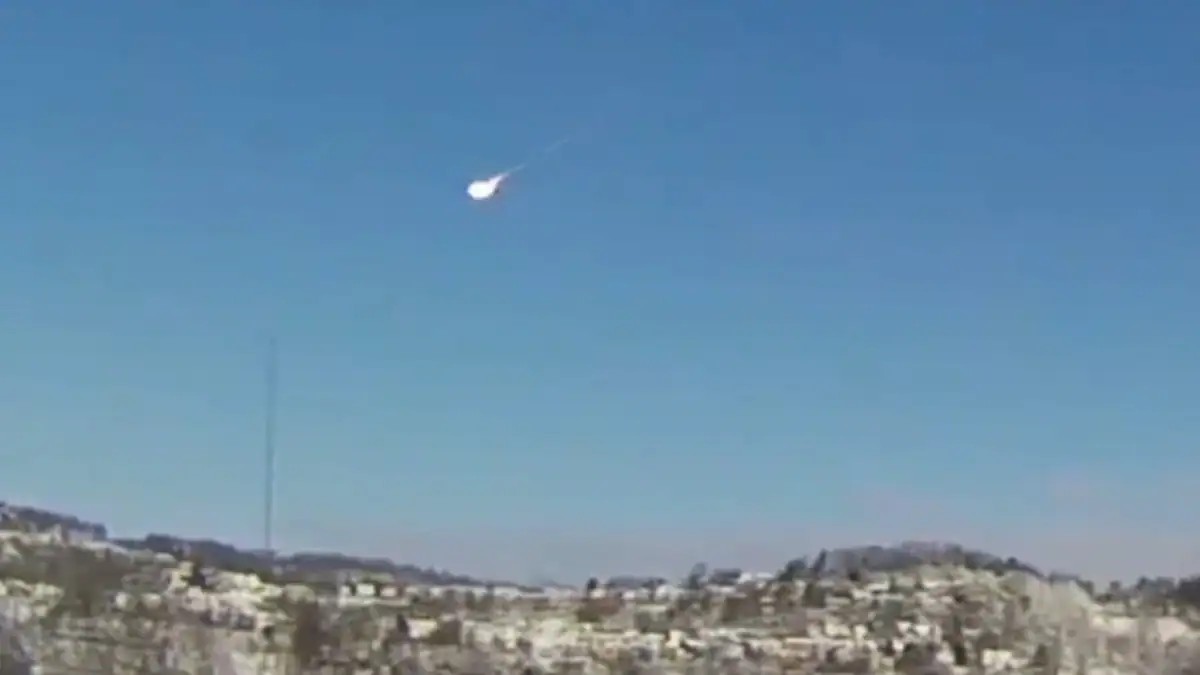
 Still from video captured by NWS Pittsburgh’s Jared Rackley via X.
On a Saturday afternoon this past March, a piece of the solar system plummeted toward a home in north Houston.
The one-ton space rock broke apart nearly 30 miles above the city, unleashing a violent sonic boom equivalent to 26 tons of TNT. A dark, jagged fragment smashed through a residential roof and even ricocheted around a bedroom like a cosmic pinball.
This would have been stunning in itself, except there were more such meteor strikes. During the first three months of 2026, our planet waded through an unusually dense shooting gallery. The American Meteor Society (AMS) has tracked a staggering wave of large, bright meteors — known as fireballs — lighting up skies from California to Germany.
Earth sweeps up tons of space dust every day. Usually, this material is the size of a grain of sand and burns up harmlessly in the upper atmosphere. But right now, we are colliding with much bigger rocks. And scientists are scrambling to figure out why.
Mike Hankey, a researcher who manages fireball reporting tools for the AMS, analyzed data stretching back to 2011. He shared his findings in a recent AMS report, noting this meteorite season is distinctly visible.
“After years of stable baseline activity, something appears to have shifted,” Hankey wrote in the AMS report. “The signal is consistent across multiple metrics.”
A Sonic Boom Every Three Days
If you look strictly at the raw numbers, the sky doesn’t look like it is falling. In the first quarter of 2026, the AMS recorded 2,046 total fireball events. That is high, but only marginally above the 2,037 events recorded in 2022 for the same three-month window.
What’s changed is the physical size of the rocks from space.
×
Thank you! One more thing…
Please check your inbox and confirm your subscription.
Usually, a fireball event draws a handful of witnesses. But in March 2026 alone, five different fireballs exceeded 200 eyewitness reports. That is more mass-sighting events in one month than all previous Marches combined over the last fifteen years.
At approximately 18:55 CET (17:55 UTC) on Sunday 8 March 2026, a very bright fireball moving from the southwest to the northeast was observed by many people in Belgium, France, Germany, Luxembourg, and the Netherlands. The fireball glowed for approximately six seconds, leaving a visible trail in the sky before fracturing into pieces. Credit: ESA/ALLSKY7 / Bernd Klemt – AMS76 Herkenrath/DE.
On March 8, a spectacular daytime bolide slowly disintegrated over Western Europe. An astonishing 3,229 people reported seeing it. On March 17, a 7-ton, 6-foot asteroid screeched above Ohio and Pennsylvania. It burned so brightly that NOAA’s GOES lightning mapper satellite captured the flash from space.
 Sonioc boom over Ohio. Credit: AccuWeather.
This isn’t just a case of more people looking up. It is a fundamental change in the kind of debris Earth is hitting.
“Almost half of all March 2026 events with 10+ reports were seen by 50 or more people,” Hankey wrote in the AMS report. “Events that would normally draw 25 [to] 49 witnesses instead drew 50, 100, or even 200+ witnesses. The distribution didn’t broaden — it shifted upward.”
These rocks are penetrating deep into our atmosphere, thick enough to punch through the sound barrier and send pressure waves rattling our windows.
“In 2026, both the rate and the absolute count are high. Thirty large fireball events producing audible booms in a single quarter mean roughly one every three days,” Hankey explained to AccuWeather.
Where Are They Coming From?
 Fireball counts over North America in March 2026. Credit: AccuWeather.
So, what exactly is throwing these rocks at us?
To find out, astronomers calculate a meteor’s radiant — the apparent point in the sky from which the fireball originated. By mapping the trajectories of these massive fireballs, researchers found two suspicious clusters.
The most prominent is the Anthelion sporadic source. This is a region of space sitting directly opposite the sun. Objects coming from the Anthelion direction are essentially catching up to Earth from behind as they plunge deeper into the inner solar system.
Historically, this region has always produced a few fireballs. But in early 2026, activity from this specific slice of sky doubled. Nearly ten major events emanated from a single 1,000-square-degree patch of the Anthelion zone, including a massive March 9 fireball seen by 282 people along the U.S. eastern seaboard.
Astronomers also noticed a strange spike in meteors coming from high-declination radiants, meaning rocks traveling on steeply inclined, almost vertical orbits relative to the flat plane of our solar system.
Is this just a new meteor shower? Probably not.
Predictable meteor showers, like the Perseids, happen when Earth plows through the narrow, dusty wake of a specific comet. The current surge is far too broad for that. Instead of a single comet’s tail, we seem to be experiencing a bizarre swelling of the solar system’s general background noise.
 Credit: ZME Science.
It’s Not Aliens
Whenever fiery objects start exploding over populated areas and causing sonic booms, some members of the public inevitably come out of the woodwork asking, “Could this be the work of a non-human intelligence?”
The short answer is no. No, these aren’t aliens bombing us.
“Every fireball in the AMS database with sufficient trajectory data is consistent with objects on heliocentric orbits – material orbiting the sun that intersects Earth’s path,” Hankey told AccuWeather.
We actually have surviving physical pieces of the culprits. Researchers recovered fragments from the German fireball and the Ohio daytime meteor. Both are rare types of meteorites known as achondrites. Specifically, the German rock is a diogenite, and the Ohio rock is a eucrite.
“The recovered specimens from Ohio and Germany are achondritic eucrites with mineral compositions formed over billions of years on differentiated asteroids,” Hankey added in his AccuWeather interview. “These are rocks from the inner solar system. There is no evidence of anomalous trajectory behavior, controlled flight or non-natural composition.”
In other words, these rocks were forged over 4.5 billion years ago in the crust of massive, differentiated asteroids like Vesta, which is one of the largest asteroids in the asteroid belt. Strangely, even though the German and Ohio rocks belong to the same broader family of meteorites, their orbital trajectories were separated by a massive 98.2 degrees.
They hit us just nine days apart, but they came from entirely different parts of the sky.
An interesting angle that explains the far larger sightings could strangely have to do with AI chatbots. A witness might simply ask ChatGPT, “Where do I report a fireball?” and be instantly routed to the AMS. This would explain, at least partly, the much higher than usual reportings.
However, while AI might explain the higher witness counts, it cannot explain the other changes in the physical characteristics of these recent meteors. A chatbot cannot generate an atmospheric sonic boom, trigger a satellite’s lightning mapper, or launch a rock through a roof in Texas.
Looking Up With Better Eyes
Ultimately, the early 2026 fireball wave highlights a glaring blind spot in our planetary defense and astronomical monitoring.
Right now, scientists are relying heavily on crowdsourced eyewitness accounts to calculate trajectories. When the 7-ton asteroid exploded over Ohio, the only AMS-affiliated allsky camera in the state was offline.
To truly understand our near-Earth environment, we need better eyes in the sky, and the best are not human. Astronomers are calling for expanded, automated allsky camera networks that can independently calculate a rock’s mass, velocity, and orbit the moment it strikes the atmosphere. We also need to systematically cross-reference fireball events with existing tools, like Doppler weather radar and infrasound arrays, just as meteorologists did during the Houston roof strike.
Laboratory analysis of the newly recovered meteorites will also be crucial. By measuring their exposure to cosmic rays, scientists can determine exactly how long these rocks wandered through space before hitting Earth. If the Ohio and German meteorites share the same exposure age, it might mean a large parent asteroid recently shattered, sending a shotgun blast of debris our way.
Earth is moving through a changed neighborhood. The rocks are bigger, they are louder, and they are hitting the atmosphere with alarming frequency.
“Whether this represents normal statistical variance, an uncharacterized debris population, or something else entirely will require continued monitoring and further analysis,” Hankey said.
For now, the only thing we can do is keep our cameras at hand and keep looking up.