
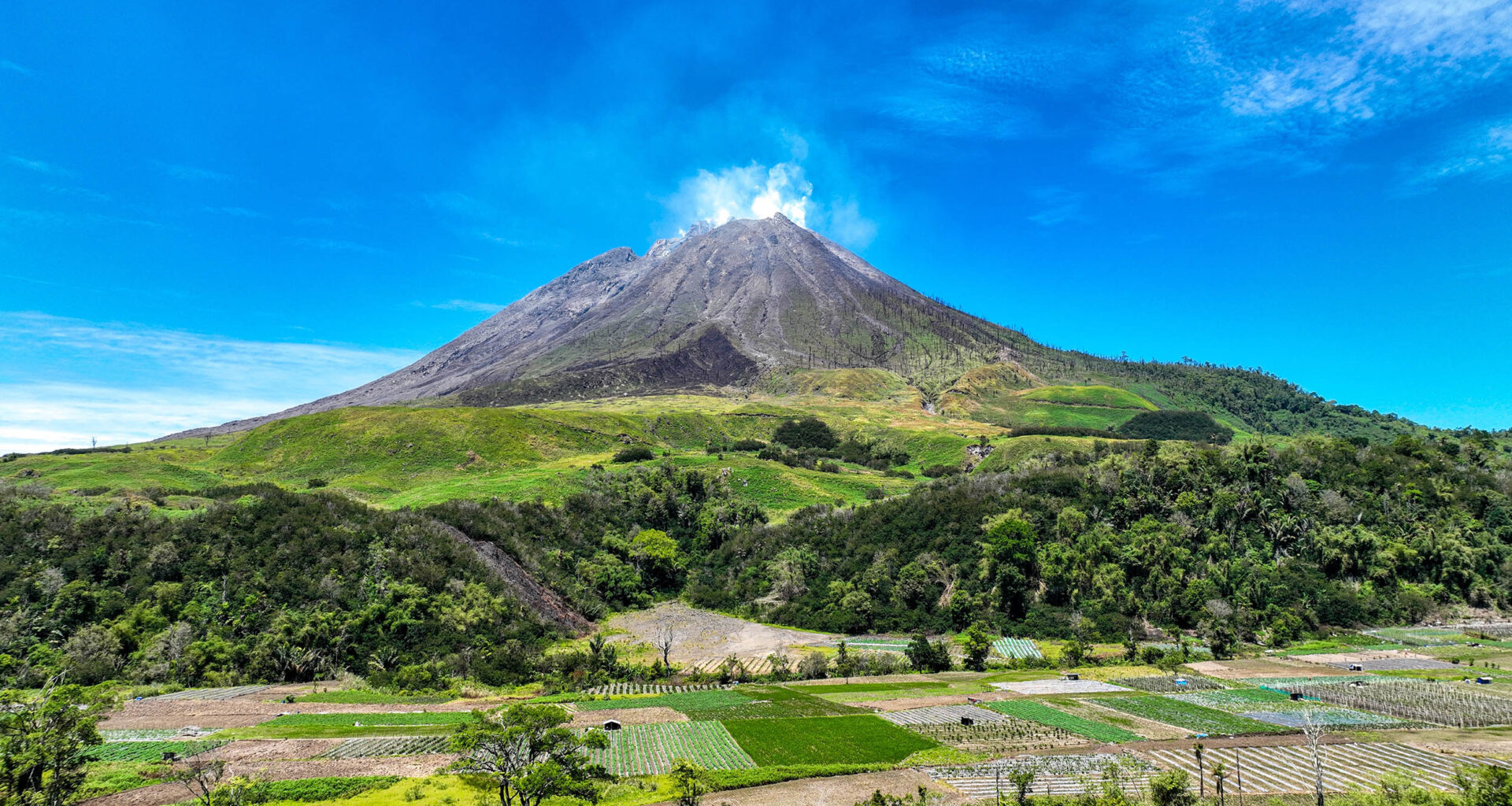
A new study has found that volcanic eruptions have repeatedly pushed Asian summer rainfall into the same three-part pattern produced by the climate system’s own long swings.
That link recasts centuries of flooding and drought across Asia as a story shaped not only by internal climate rhythms, but also by shocks from the sky.
Volcanoes and summer rainfall

Across 550 years of records, Asian summer rainfall kept returning to a recurring wet-dry pattern across the region.
In model runs built to trace that pattern through deeper time, Wenmin Man at the Institute of Atmospheric Physics (IAP), Chinese Academy of Sciences, found the same arrangement taking shape again.
South Asia and northern East Asia often moved together while Southeast Asia swung the other way, showing that the pattern persisted far beyond a few isolated decades.
Because those monsoon rains support billions of people, the repeated pattern demanded a closer look at what kept driving it back.
Natural rhythm dominates
Most of the pattern came from the climate’s own slow changes, rather than from outside shocks.
At its center sat the Interdecadal Pacific Oscillation, a Pacific Ocean swing that unfolds over decades and redirects heat and moisture.
When that ocean pattern flipped, South Asia and northern East Asia usually echoed each other again.
Volcanoes mattered because they could push the climate toward this arrangement, even when the ocean cycle itself was quiet.
Volcanoes join in
After major eruptions, rainfall reorganized into that familiar pattern instead of creating an entirely different map.
Volcanic aerosols, tiny particles thrown high above weather, reduced sunlight and cooled the surface enough to nudge ocean temperatures.
Those temperature changes looked so close to the natural decadal pattern that the forced and unforced maps almost overlapped.
The result did not erase the ocean cycle’s role, but it showed that eruptions could reinforce or imitate it.
History beats memory
Modern measurements are simply too short to separate rare volcanic jolts from a climate pattern that already wanders over decades.
One older reconstruction stitched tree rings and historical records into Asian rainfall maps reaching back to 1470.
A long model archive then gave IAP and its collaborators climate histories stretching from the year 850 onward.
Only that wider view made the volcanic signal visible, because the same rainfall pattern kept returning long before modern warming.
Numbers sharpen it
In long-term reconstructions, one widespread drying signal stood out most clearly, while the three-part rainfall pattern followed closely behind it.
Model results showed that the internally driven version of this pattern carried much more weight than the portion linked to outside forces.
Even so, volcanic effects closely mirrored the same ocean-driven pattern rather than creating something entirely different.
That overlap revealed how eruptions can reinforce an existing climate rhythm instead of reshaping it outright.
Symmetry gives it away
Natural Pacific swings tended to warm and cool the ocean in a balanced pattern across the equator.
Volcanic forcing broke that balance, because one hemisphere cooled more strongly and nudged tropical rainfall southward.
That lopsided cooling changed winds and sea surface temperatures, the skin of the ocean that steers evaporation and storms.
Because the volcanic version carried this extra tilt, researchers could separate internal variability, climate motion generated within Earth itself, from external shocks.
Rain shifts regionally
Along the southeastern Tibetan Plateau, the high terrain near southwest China and the Himalaya, rainfall often moved against South Asia.
Pacific warming altered rising air over the tropics, which weakened the South Asian monsoon and redirected moisture eastward.
Farther east, new wind patterns fed wetter conditions in south China even as northern China tipped drier.
That chain helps explain why a single climate trigger can produce floods in one place and drought nearby.
Eruptions leave names
Major peaks in the forced signal matched Tambora in Indonesia in 1815, Kuwae in Vanuatu in 1452, and Samalas in Indonesia in 1257.
A powerful blast at Changbaishan, in what is now northeastern China, also stood out even without a global-scale footprint.
Those matches showed that faraway eruptions could alter Asian rain even when the volcano sat outside the monsoon zone.
Local seasons still varied, but the continental-scale response surfaced often enough to leave a statistical trail.
Risks for intervention
Interest in stratospheric aerosol injection, a plan to release reflective particles high above weather, made that history hard to dismiss.
“If we’re considering stratospheric aerosol injection as a potential tool, we need to understand exactly how such interventions might affect regional rainfall patterns. Volcanic forcing can ‘project’ onto the internal variability mode that naturally drives these precipitation patterns,” Man said.
IAP’s evidence suggests cooling the planet on average could still rearrange who gets rain, when fields dry, and where reservoirs refill.
What comes next
Across centuries of evidence, the story that emerged was not volcanoes versus natural climate rhythm, but volcanoes acting through it.
That made the past useful for future planning, while also warning that any aerosol-based cooling scheme could redraw rainfall maps unevenly across Asia.
The study is published in Geophysical Research Letters.
—–
Like what you read? Subscribe to our newsletter for engaging articles, exclusive content, and the latest updates.
Check us out on EarthSnap, a free app brought to you by Eric Ralls and Earth.com.
—–