
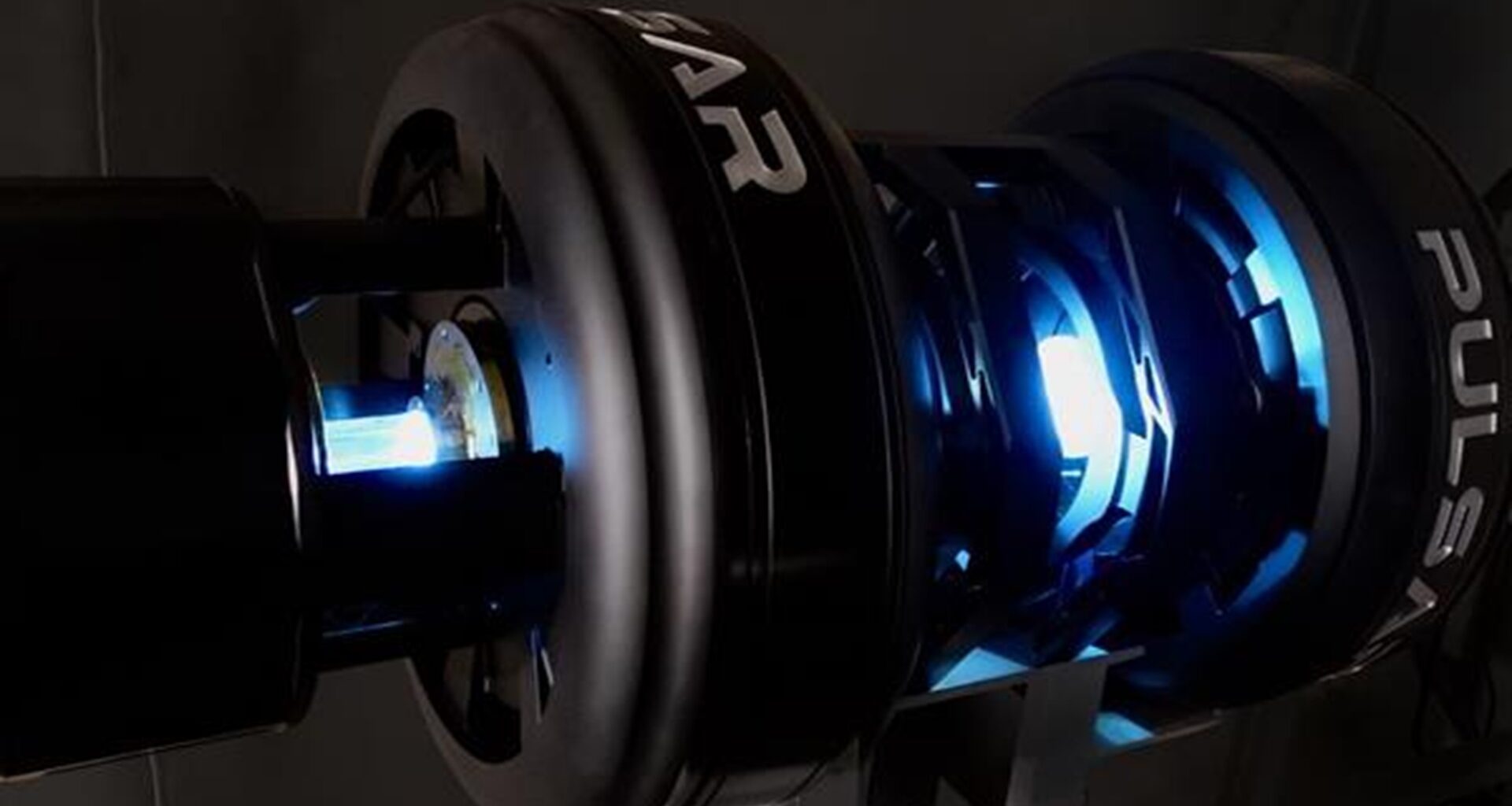
UK-based Pulsar Fusion has achieved its first plasma in the exhaust system of its Sunbird propulsion concept, marking an early step toward developing nuclear fusion-based engines for space travel.
The company said the test demonstrates the physical architecture of a fusion exhaust system, where charged particles are guided and accelerated using electric and magnetic fields.
The milestone was presented live at the MARS Conference in California, hosted by Jeff Bezos, while the actual test was carried out in the UK and streamed to the audience.
The demonstration focused on plasma confinement within the exhaust channel, a key requirement for any future fusion propulsion system.
Fusion engine takes shape
In this initial phase, Pulsar used krypton gas as a propellant because of its ionization efficiency and stable behavior during testing. The setup allowed researchers to observe how plasma behaves within the exhaust structure under controlled conditions.
The company said this is only the beginning. The next stage will involve measuring thrust and exhaust velocity using specialized instruments, including thrust balance systems and probes.
To support long-term development, Pulsar is also working with the UK Atomic Energy Authority to study how neutron radiation affects reactor materials. This is considered one of the main challenges in maintaining fusion systems over time.
“The Sunbird program showcased this milestone live in California at the MARS Conference, hosted by Jeff Bezos,” said CEO Richard Dinan. “There is no greater platform to share this first test than here.”
Fusion propulsion aims to solve a long-standing problem in space travel. Current systems rely on either chemical rockets, which provide high thrust but limited speed, or electric propulsion, which is efficient but slow.
Race for faster travel
Fusion engines could combine both advantages, offering high thrust and high exhaust velocity. This could significantly reduce travel time across the solar system and improve the economics of space missions.
For example, faster propulsion could enable quicker transport of materials and infrastructure for projects such as building stations in orbit or on other planets.
Pulsar plans to upgrade its system with high-temperature superconducting magnets to generate stronger magnetic fields. This would allow experiments at higher plasma densities and pressures.
Future tests will also explore advanced heating methods and more detailed performance measurements. The company ultimately aims to move toward aneutronic fusion fuel cycles, which could reduce radiation-related challenges.
While the technology remains in early development, the first plasma milestone provides a proof point for the concept. It shows that key elements of a fusion exhaust system can be tested in a controlled environment.
The broader goal is to build propulsion systems that can support faster and more efficient movement in space, as the global space economy continues to expand.