
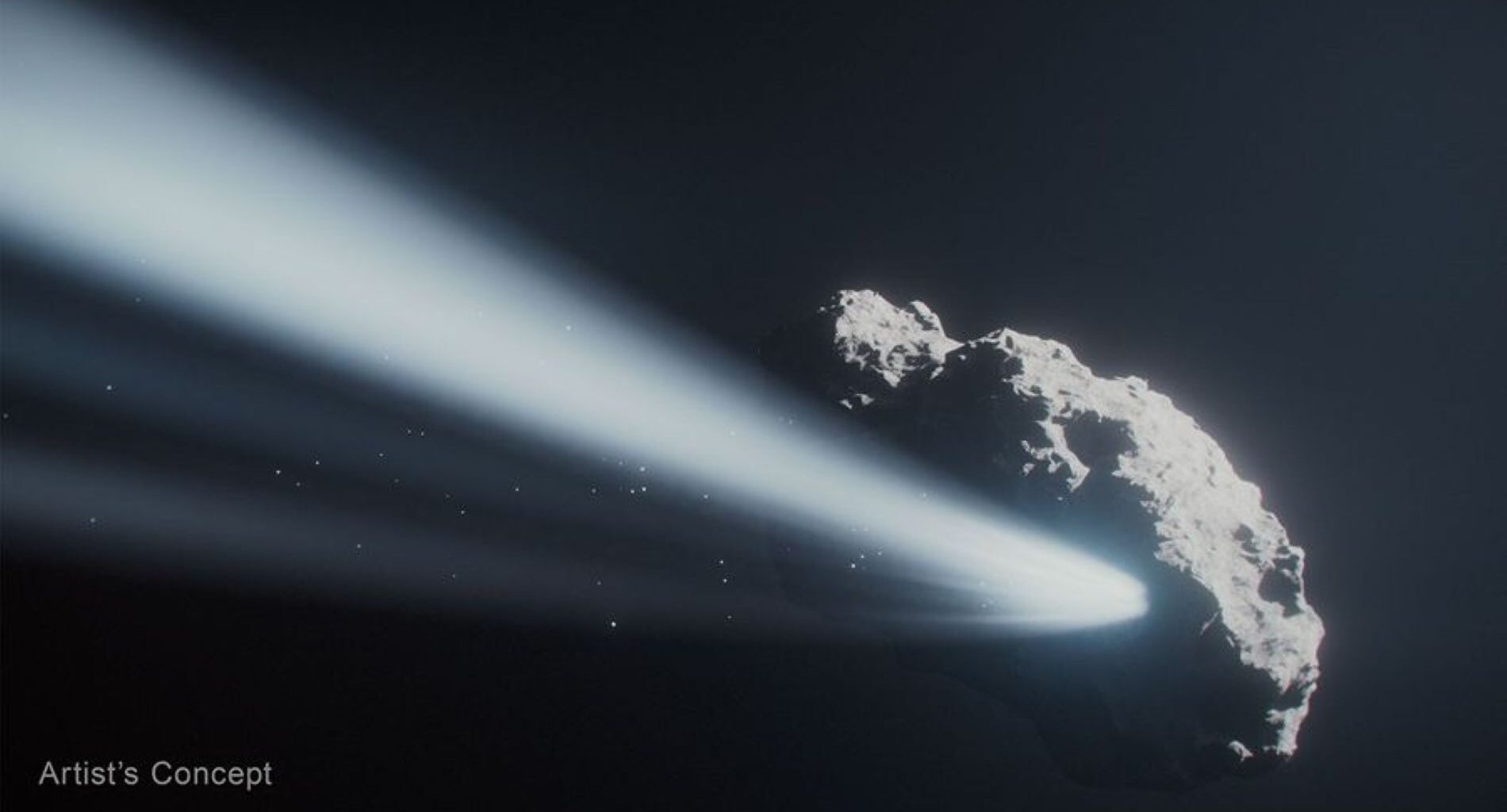
The spins of comet nuclei can change because of gas jets pushing on them. In April 2017, the Jupiter-family comet 41P/Tuttle–Giacobini–Kresak showed especially dramatic changes in its rotation as it neared the Sun.
Astronomers analyzed Hubble Space Telescope data from December 2017 to examine the comet’s brightness after it passed closest to the Sun. From these observations and measurements of its motion, they found that the comet’s nucleus is very small, about 0.6 miles (about 1 kilometer) across. This is especially small for a comet, making it easy to torque, or twist.
The comet likely came from the Kuiper Belt. It orbits the Sun with a path that ranges from about 1 au at its closest point to 5 au at its farthest. Although it frequently approaches Jupiter’s gravitational area, computer models indicate that its orbit is quite stable. TGK was placed in its current path after a close encounter with Jupiter about 1,500 years ago, and it’s expected to stay in a similar orbit for roughly the next 10,000 years.
The comet now swings through the inner solar system every 5.4 years. After its close pass by the Sun in 2017, scientists discovered that the comet’s rotation slowed down dramatically. According to Neil Gehrels Swift Observatory in May 2017, the comet’s rotation slowed down by 3 times than it had in March 2017 when it was observed by the Discovery Channel Telescope at Lowell Observatory in Arizona.
Scientists Found Seven Times More Massive Comets in Our Solar System
Follow-up Hubble observations revealed that comet 41P/Tuttle–Giacobini–Kresak took an even stranger turn after its 2017 solar encounter. By December, Hubble images showed the comet spinning much faster again, about once every 14 hours, compared to the 46–60 hour rotation measured earlier by Swift.
The simplest explanation is that the comet’s spin slowed almost to a stop, and then powerful outgassing jets on its surface forced it to start rotating in nearly the opposite direction.
When a comet gets close to the Sun, the heat makes its frozen ices turn directly into gas. This process, called sublimation, blasts material into space, creating the comet’s glowing tail.
Paper author David Jewitt of the University of California at Los Angeles said, “Jets of gas streaming off the surface can act like small thrusters. If those jets are unevenly distributed, they can dramatically change how a comet, especially a small one, rotates.”
The comet was originally spinning in one direction, but gas jets pushing against that rotation gradually slowed it. Because the jets kept pushing, they ultimately caused the comet to start rotating in the opposite direction.
“It’s like pushing a merry-go-round,” said Jewitt. “If it’s turning in one direction, and then you push against that, you can slow it and reverse it.”
Comet 41P/Tuttle–Giacobini–Kresak is fading fast. Once unusually active for its size during its 2001 close pass by the Sun, by 2017, its gas output had dropped nearly tenfold. Scientists think the comet’s surface is changing quickly, its volatile ices may be running out, or hidden beneath insulating dust.
Most comets evolve slowly, over centuries. But 41P’s rapid spin changes give researchers a rare chance to watch its transformation unfold within a human lifetime. Models suggest that if the spin continues to shift, the comet could become unstable. A nucleus that rotates too fast risks breaking apart under its own weak gravity.
Astronomer David Jewitt put it bluntly: “I expect this nucleus will very quickly self-destruct.”
Yet despite this precarious future, 41P has held its current orbit for about 1,500 years, a fragile survivor in the solar system’s dance.
Astronomer David Jewitt discovered the comet observations while browsing the archive and realized they had never been analyzed. Because NASA makes its science data openly available, researchers can revisit observations made years or even decades later to answer new questions. In fact, many discoveries come not just from new observations, but from mining this vast archive built over decades of exploration.
Journal Reference:
David Jewitt. Reversal of Spin: Comet 41P/Tuttle–Giacobini–Kresak. The Astronomical Journal. DOI 10.3847/1538-3881/ae4355